Fortress
Yangguan
🇨🇳 China · 2nd century BC
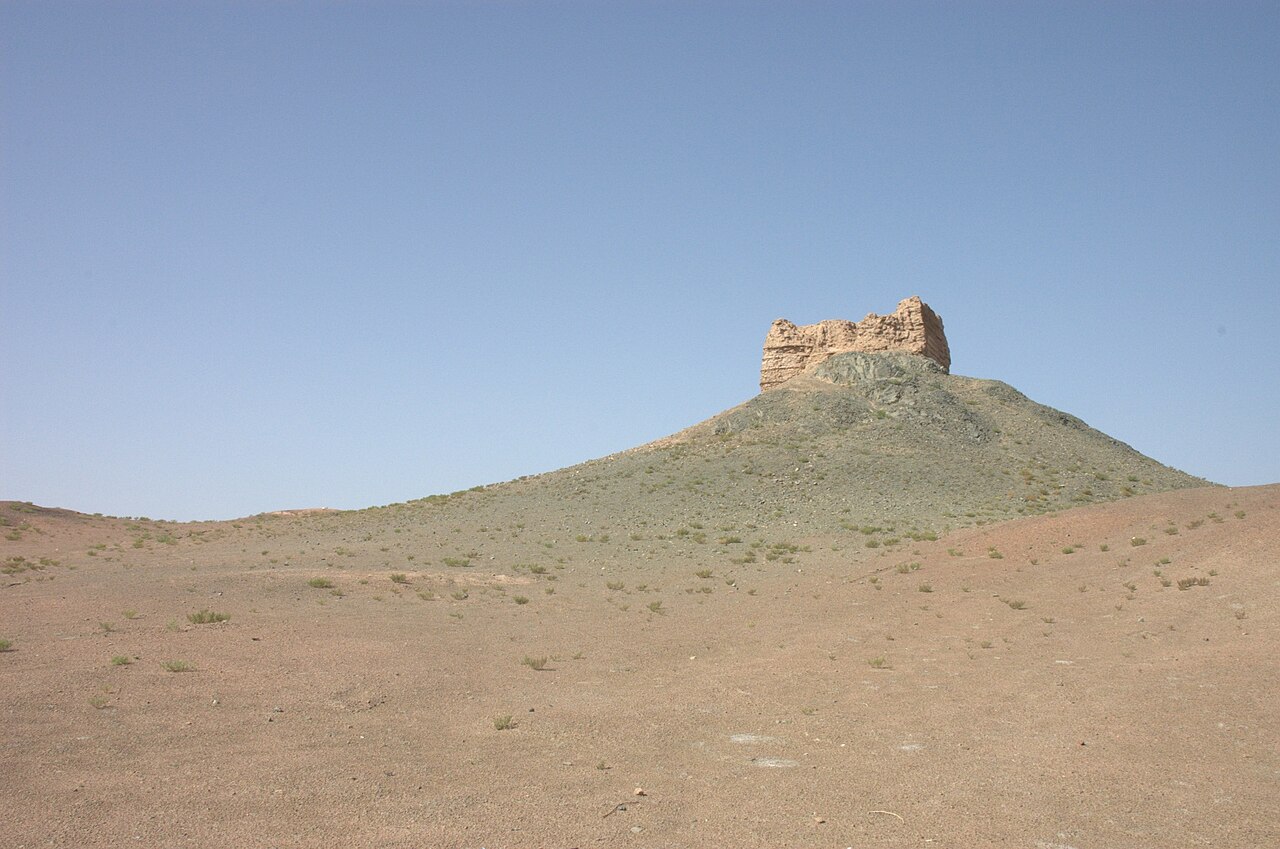
Yangguan, or Yangguan Pass (traditional Chinese: 陽關; simplified Chinese: 阳关; lit. 'Sun Gate'), is a mountain pass that was fortified by Emperor Wu of the Western Han dynasty around 120 BC and used as an outpost in the colonial dominions adjacent to ancient China. It is located approximately 70 kilometres (43 mi) southwest of Dunhuang, in the Gansu territory to the west of the Shaanxi province in the far Northwest China, which was in ancient times the westernmost administrative center of China. It was established as a frontier defense post, as well as a developed place in China's remote western frontier; Emperor Wu encouraged Chinese to settle there. Today Yangguan is located in Nanhu Village, along the Hexi Corridor.
Yangguan was one of China's two most important western passes, the other being Yumenguan. In Chinese, yang means "sun" or "sunny", but it can also be used to mean "south" (the sunny side of a hill being the southern side). Yangguan was therefore so-named because it lies to the south of the Yumenguan Pass. It was an important landmark on the Silk Road. The fortress at Yangguan however had fallen into ruin by around AD 900.
Text adapted from “Yang Pass” on Wikipedia, CC BY-SA 4.0.
Yangguan ranks #1,452 of 8,134 worldwide in the atlas's castle fame ranking, and #32 of the 119 mapped in China. Founded 120 BC, it is older than 99% of the atlas's dated landmarks — one of 12 atlas entries founded in the 2nd century BC. Its Wikipedia articles were opened 3,053 times in the last 60 days, more than 76% of the atlas. See how China compares in the castle statistics.
View on the interactive castle map →Frequently asked questions
Where is Yangguan?
Yangguan stands in China, at 39.92725°, 94.05904°.
When was Yangguan built?
The atlas dates its founding to 120 BC. Earlier structures may have stood on the site; this is the earliest documented founding year.
How famous is Yangguan?
In this atlas's fame ranking: #1,452 of 8,134 worldwide, and #32 in China. Fame here combines how many Wikipedia language editions cover a landmark with how many people read them.
What is the nearest castle to Yangguan?
Yumen Pass, about 50 km away.
More castles in China
- City Wall of Nanjing China · 14th century
- Guia Fortress China · 19th century
- Palace of Heavenly Purity China
- Simatai China · 6th century
More fortresses
- Torres dels Serrans Spain · 14th century
- Zvečan Fortress Kosovo · 11th century
- Fort Rotterdam Indonesia · 16th century
- Rinpung Dzong Bhutan · 17th century