 India · 17th century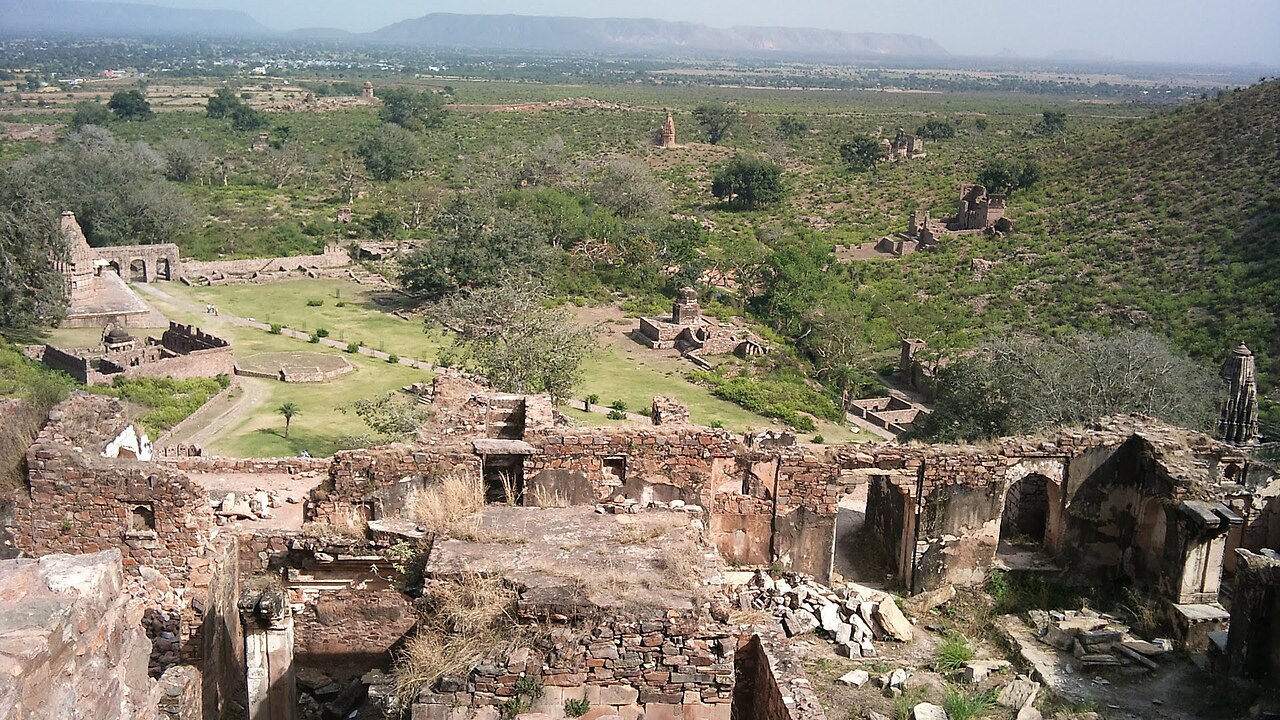
The Bhangarh Fort is a 16th-century fort built in the Rajasthan state of India. The town was established during the rule of Bhagwant Das as the residence of his second son, Madho Singh. The fort and its precincts are well preserved.
Bhangarh Fort is located on the border of the Sariska Reserve in the Aravali range of hills in the Alwar district of Rajasthan. The nearest village is Gola ka Baas.The fort is situated at the foot of the hills on sloping terrain. The ruins of the king's palace are located on the lower slope of the hills; trees surround the pond area and a natural stream falls into the pond within the premises of the palace.
The fort is located 235 kilometres (146 mi) from Delhi and the approach to the entrance gate of the fort in the last 2 kilometres (1.2 mi) stretch of the road is unpaved. The fort is 20 miles (32 km) from Thana Ghazi. The nearest airport is Jaipur International Airport, which is 88.2 km from the fort.
According to legend, a sadhu lived within the fort area, and according to his injunction, any house built in the precinct of the fort should not be taller than his own, and if the shadow of any such house fell on his house, it would result in destruction of the fort town. When columns were added to the fort that cast a shadow on the sadhu's house, the result was destruction of the fort and surrounding towns. According to another tale, a priest who was a practitioner of black magic fell in love with a beautiful Bhangarh princess with many suitors. One day, the priest followed the princess to the marketplace and offered her a love potion. However, she refused it, throwing it onto a large rock that consequently rolled onto the priest and crushed him to death. Before he died, the priest cursed the entire village, condemning it to destruction and desolation.
Entering through the main gate of the completely ruined fort city, one can find temples, palaces, and havelis. In addition, there are four more points of entry to the fort: the Lahori Gate, the Ajmeri Gate, the Phulbari Gate, and the Delhi Gate. At the entrance of the main gate are many Hindu temples, such as Hanuman Temple, Gopinath Temple, Someshwar Temple, Keshav Rai Temple, Mangla Devi Temple, Ganesh Temple, and Navin Temple. The Gopinath Temple is built above a 14 ft raised plinth, and yellow stones are used for the carvings of the temple.
Text adapted from “Bhangarh Fort” on Wikipedia, CC BY-SA 4.0.
Bhangarh Fort ranks #446 of 9,079 worldwide in the atlas's castle fame ranking, and #18 of the 224 mapped in India. Founded 1631, it is older than 28% of the atlas's dated landmarks — one of 721 atlas entries founded in the 17th century. Its Wikipedia articles were opened 15,269 times in the last 60 days, more than 96% of the atlas. The nearest day-trip guide is Jaipur, 50 km away. It is one of the 30 landmarks on the atlas's regional map of Rajasthan. See how India compares in the castle statistics.
View on the interactive castle map →