 England · 11th century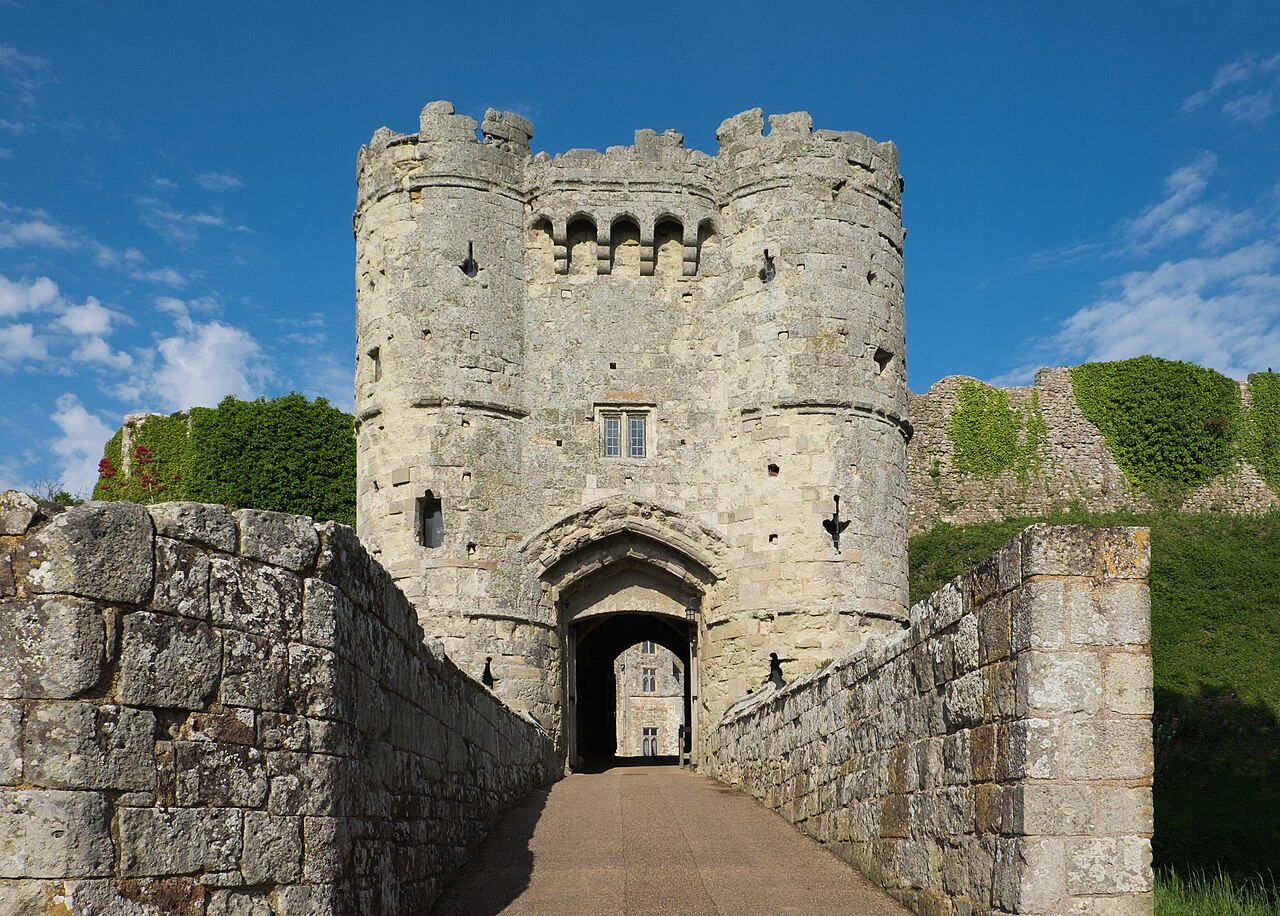
Carisbrooke Castle is a historic motte-and-bailey castle located above, and to the south of, Carisbrooke village centre, on the Isle of Wight, England. Charles I was imprisoned at the castle in the months prior to his trial.
The site of Carisbrooke Castle may have been occupied in pre-Roman times, but the area surrounding it was certainly a key area for settlement for the Romans. This is evidenced by at least three villas known in the area, suggesting considerable wealth. No Roman occupation of the hilltop itself, though, has been found. A ruined wall suggests that there was a building there in late Roman times. A 6th century cemetery is the earliest direct evidence of human activity on the hill, presumably belonging to a settlement in one of the valleys below the hill. The area is known to have been a relatively well-connected trading hub, evidenced from coins found in a 7th century Saxon settlement.
The Vikings based themselves on the island from 998 to 1009 to make it easier to raid the South coast of England. The local response to this was to build burhs (fortresses) to centralise power in different areas to better resist Viking raids, and provide refuge for the local population. It is likely that Carisbrooke was built as the burh for the Isle of Wight.
After the Norman conquest, the Isle of Wight was granted to William I's cousin William FitzOsbern who probably developed the Saxon burh soon afterwards. The castle is recorded in the Domesday Book of 1086. FitzOsbern's heir rebelled against William I and was deprived of his lands, so Carisbrooke was held directly by the Crown.
From around 1100 the Isle of Wight, and extensive estates in Devon, were granted to Richard de Redvers by Henry I who feared attacks from his brother Robert Curthose, Duke of Normandy. Richard de Redvers was almost certainly the one who built the motte-and-bailey castle on the site and, over the next two centuries, de Redvers' descendants improved the castle with stone walls, towers and a keep. Richard's son, Baldwin de Redvers, had supoorted Queen Matilda during the Anarchy and lost his lands to Stephen of Blois, only gaining them back in 1153. Carisbrooke stayed in the de Redvers family until 1293 when Countess Isabella, last of the de Redvers family, sold the castle to Edward I on her deathbed.
Text adapted from “Carisbrooke Castle” on Wikipedia, CC BY-SA 4.0.
Carisbrooke Castle ranks #671 of 9,079 worldwide in the atlas's castle fame ranking, and #49 of the 360 mapped in England. Founded 1100, it is older than 85% of the atlas's dated landmarks — one of 436 atlas entries founded in the 11th century. Its Wikipedia articles were opened 6,813 times in the last 60 days, more than 90% of the atlas. 14 more atlas landmarks stand within 25 km. The nearest day-trip guide is Portsmouth, 21 km away. See how England compares in the castle statistics.
View on the interactive castle map →