 Scotland · 15th century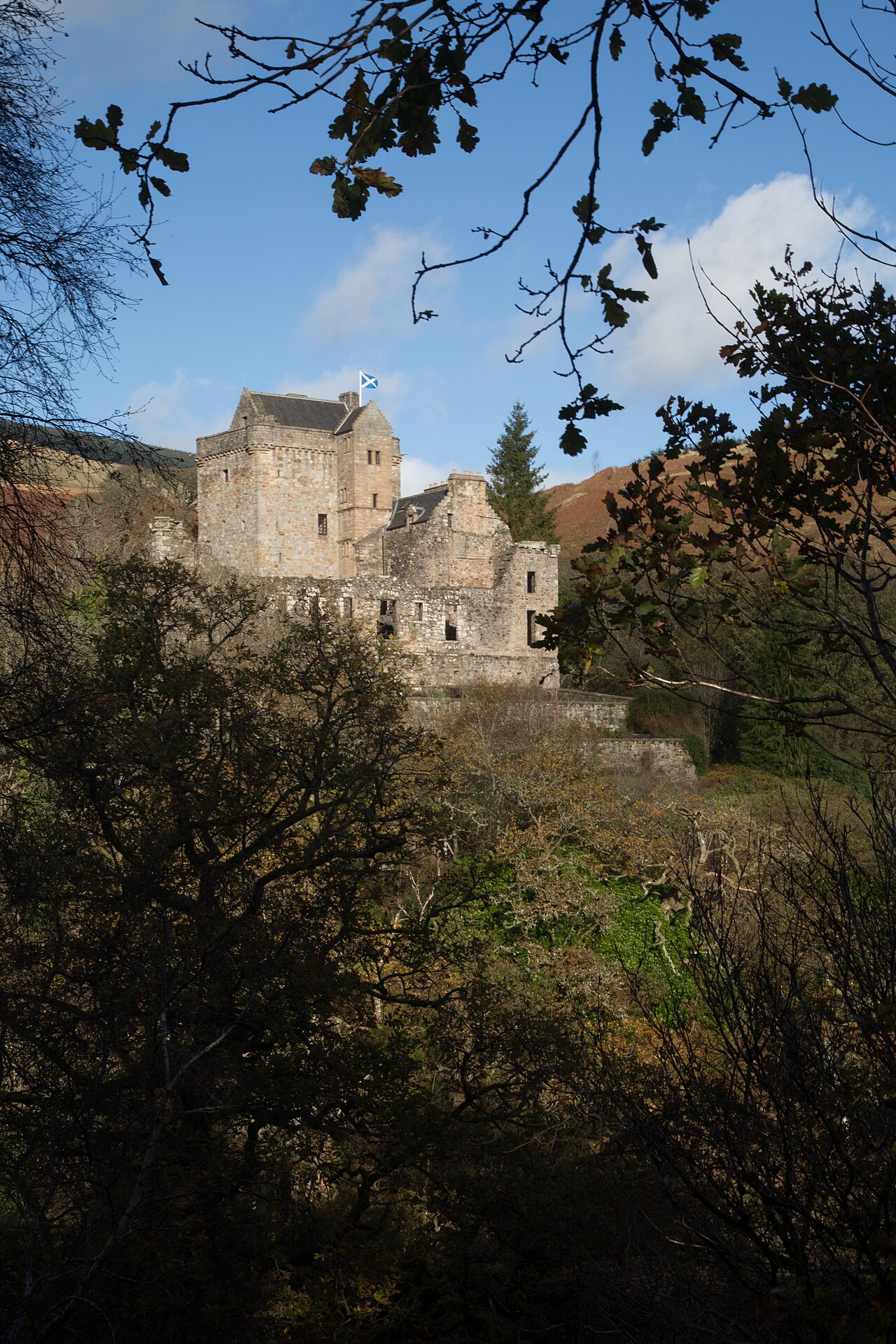
Castle Campbell is a medieval castle situated above the town of Dollar, Clackmannanshire, in central Scotland. It was the lowland seat of the earls and dukes of Argyll, chiefs of Clan Campbell, from the 15th to the 19th century, and was visited by Mary, Queen of Scots, in the 16th century. Mary was impressed by this and said "this reminds me of home".
Castle Campbell was originally known as Castle Gloom. The name was possibly derived from the Scottish Gaelic: glom meaning a "chasm", and referring to the narrow gorges to either side of the site. The naturally defended position may have been the site of a motte in the 12th century. The present tower was built around 1430 for John Stewart, Lord Lorne (d.1463), or one of his kinsmen. In about 1460, the property was acquired by Colin Campbell, 1st Earl of Argyll (d.1493) during his marriage to Isabel Stewart, Lord Lorne's daughter. The first historical record of the castle dates from the following year, when Pope Paul II issued a bull against Walter Stewart, son of Lord Lorne, for attacking and damaging the "Place of Glom".
At the time, Campbell, who was at the papal court, might have played a key role in organizing the Pope's involvement. The tower shows signs of early rebuilding following this episode.
The accession of Castle Gloom expanded the power of the Campbell family, from Argyll in the west into central Scotland, and also suited Colin Campbell's position as Master of the Household to King James III of Scotland, which required his frequent presence at court. In February 1490, Campbell petitioned the newly crowned King, James IV of Scotland, to formally change the name of Gloom to "Castle Campbell", and this was done by an act of parliament, the Castle Campbell Act 1489 (Feb. c. 23). The name change may imply that the term "castle" was seen as particularly prestigious, requiring royal approval for its use.
At this time, the castle would have consisted of the tower house, along with other buildings arranged around the courtyard and gardens outside. The east range was probably added first, and sometime after the accession of the 2nd Earl in 1493, the large south range was begun. These buildings show influence of the contemporary works at Stirling Castle, now known as the King's Old Building.
Text adapted from “Castle Campbell” on Wikipedia, CC BY-SA 4.0.
Castle Campbell ranks #1,972 of 9,079 worldwide in the atlas's castle fame ranking, and #69 of the 226 mapped in Scotland. Founded c. 1430, it is older than 49% of the atlas's dated landmarks — one of 554 atlas entries founded in the 15th century. Its Wikipedia articles were opened 3,213 times in the last 60 days, more than 79% of the atlas. 12 more atlas landmarks stand within 25 km. The nearest day-trip guide is Edinburgh, 39 km away. See how Scotland compares in the castle statistics.
View on the interactive castle map →