 England · 11th century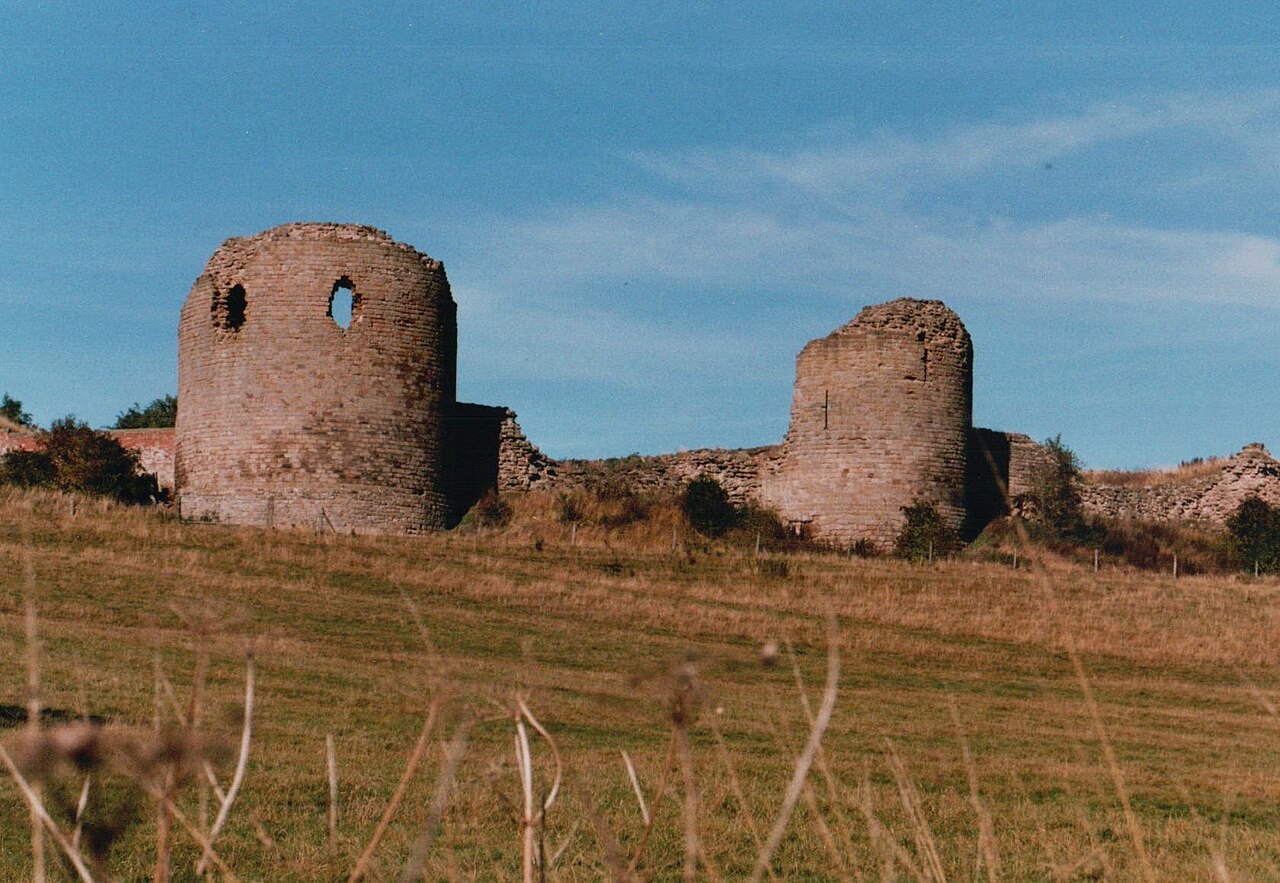
Chartley Castle lies in ruins to the north of the village of Stowe-by-Chartley in Staffordshire, between Stafford and Uttoxeter (grid reference SK010285). Mary, Queen of Scots, was imprisoned on the estate in 1585. The remains of the castle and associated earthworks are a Scheduled Monument, the site having been protected since 1925. The castle itself is a Grade II* listed building
The motte and bailey castle was built by one of the early Earls of Chester, about 1100, as a safe stop-over for their journeys to places such as Tutbury. It was rebuilt in 1220 by Ranulph de Blondeville, 4th Earl of Chester, who died in 1232. It then passed by marriage to William de Ferrers, 5th Earl of Derby. It remained in the Ferrers family for more than 200 years, and in 1453, passed to Walter Devereux, through his wife Anne de Ferrers, the Ferrers heiress. Through his wife, Walter also became jure uxoris Baron Ferrers of Chartley in 1461, and was killed at the Battle of Bosworth in 1485. The castle was then abandoned as a residence, and Chartley Manor, a moated and battlemented timber mansion, was built nearby.
Mary, Queen of Scots was a prisoner in this manor house. It was destroyed by fire in 1781. What is now known as Chartley Manor was in fact known as "Chartley Manor Farm" until the 1980s.
Substantial remains are still present today, including a rare cylindrical keep, a curtain wall flanked by two half-round towers, a twin-towered gatehouse and an angled tower. A survey conducted in the nineteenth century identified five towers ranging from 35 to 41 feet external diameter, and the keep, 50 feet in diameter. One author has noted similarities of the plan to the Château de Montlhéry near Paris, which Ranulph de Blondeville may have been familiar with. M.W. Thompson noted numerous architectural similarities between Chartley, Bolingbroke Castle, Lincolnshire and also Beeston Castle in Cheshire, all thought to have been built under de Blondeville.
When Chartley Manor belonged to Robert Devereux, 2nd Earl of Essex it became one of the last places of imprisonment of Mary, Queen of Scots. Her jailor Amias Paulet came from Tutbury Castle to view the manor in September 1585 and saw the house was just big enough to accommodate both his and the queen's households, "somewhat straitly.
Text adapted from “Chartley Castle” on Wikipedia, CC BY-SA 4.0.
Chartley Castle ranks #3,349 of 9,079 worldwide in the atlas's castle fame ranking, and #228 of the 360 mapped in England. Founded c. 1100, it is older than 85% of the atlas's dated landmarks — one of 436 atlas entries founded in the 11th century. Its Wikipedia articles were opened 1,925 times in the last 60 days, more than 68% of the atlas. 3 more atlas landmarks stand within 25 km. The nearest day-trip guide is Stoke-on-Trent, 21 km away. See how England compares in the castle statistics.
View on the interactive castle map →