 France · 10th century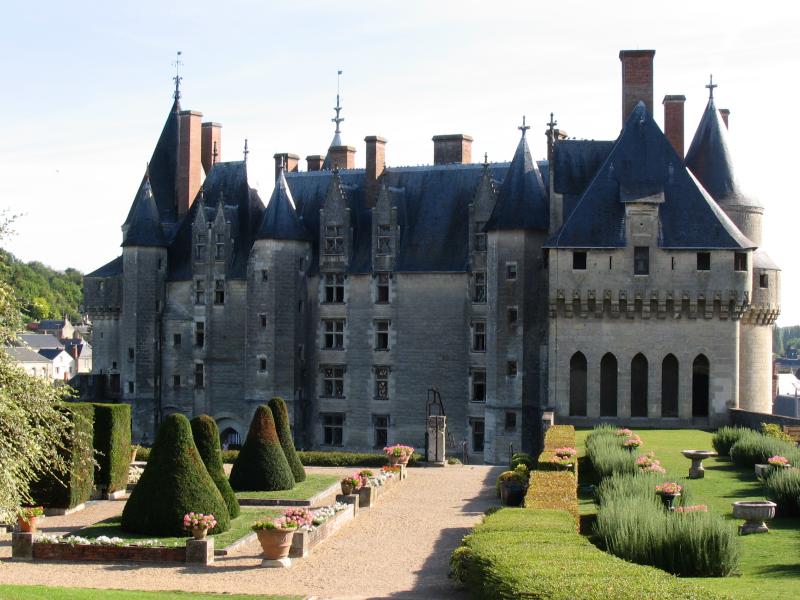
The Château de Langeais is a 15th-century Flamboyant Gothic castle in Indre-et-Loire, France, built on a promontory created by the small valley of the Roumer River at the opening to the Loire Valley. Founded in 992 by Fulk Nerra, Count of Anjou, the castle was soon attacked by Odo I, Count of Blois. After the unsuccessful attack, the now-ruined stone keep was built; it is one of the earliest datable stone examples of a keep. Between 994 and 996, the castle was besieged unsuccessfully twice more. During the conflict between the counts of Anjou and Blois, the castle changed hands several times, and in 1038 Fulk captured the castle again.
After it was destroyed during the Hundred Years' War, King Louis XI (1461–1483) rebuilt Château de Langeais into what today is one of the best-known examples of late medieval architecture. It is especially noted for its monumental and highly decorated chimneypieces. Restored in the late 19th century, Château de Langeais came under the control of the Institut de France, who owns the site today. It is listed as a monument historique by the French Ministry of Culture and is open to the public.
Text adapted from “Château de Langeais” on Wikipedia, CC BY-SA 4.0.
Château de Langeais ranks #690 of 9,079 worldwide in the atlas's castle fame ranking, and #61 of the 793 mapped in France. Founded 992, it is older than 92% of the atlas's dated landmarks — one of 193 atlas entries founded in the 10th century. Its Wikipedia articles were opened 5,588 times in the last 60 days, more than 88% of the atlas. 12 more atlas landmarks stand within 25 km. The nearest day-trip guide is Tours, 23 km away. It is one of the 73 landmarks on the atlas's regional map of the Loire Valley. It is stop 10 of 32 on the Loire Valley château route, Angers to Orléans. See how France compares in the castle statistics.
View on the interactive castle map →