Fortress
Chebaki fortress
🇷🇺 Russia
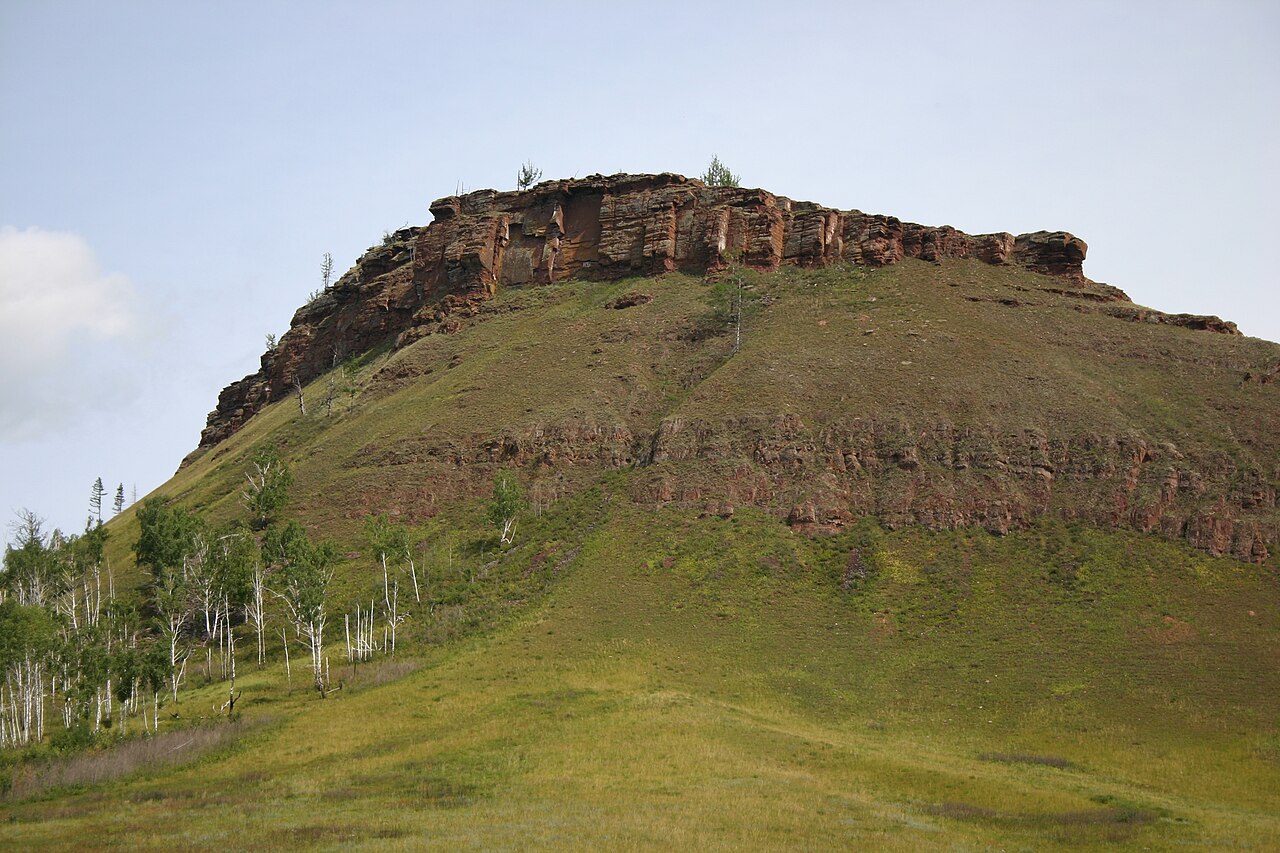
Chebaki fortress (Sve Chebaki) is an ancient mountain structure Sve fortress sanctuary from the Bronze Age (2nd millennium BC), located on the right bank of the river Black Iyus on the top of Chebaki mount Takh (Tag), 4.5 km northeast of the village Chebaki in the Shirinsky district of the Republic of Khakassia.
Russian: Крепость Чебаки, romanized: Krepost' Chebaki, lit. 'Chebaki fortress'; Khakas: Све Tағ, romanized: Sve Tağ, lit. 'Fortress Mountain'.
In the Khakass language, the term "sume" comes from Mongolian: Süm-e, lit. 'Temple, Church' Sumee or a place of prayer and often mixed with the word "sve, sybee, sibee" – a fortress (the sounds "b" and "m", as a rule, alternate; Khakas: Све, Ceбeе, romanized: Sve, Sebê, lit. 'Fortress, Fortification'). In southern Siberia and central Asia, similar fortification monuments are called shibee from Mongolian: Шивээ, romanized: Shebee, lit. 'Fortress, Fortification, military shelter, strengthening, Stockade, Hedge' Altay: Шибе, romanized: Şibe, lit. 'fortress, specially fortified, sometimes just a hard-to-reach place, mountain fortress, mountain shelter', Tuvan: Шивээ, romanized: Şivê, lit. 'Fortress'. Probably Altaic etymology from Proto-Mongolian sibeɣe, sibei, šibe'e 'stick, pole, rod; fence' and Khalkha šivē.
Reconstructed Proto-Indo-European swé / s(w)e / *se /*séwe /swé- – 'self' stem (and its substantive pronoun) was originally a reflexive element referring to all persons and numbers, as in Sanskrit स्व sva and in Proto-Slavic sę – 'oneself, myself, yourself, himself, herself, itself, ourselves, yourselves, themselves, each other', genitive of *sę in Proto-Slavic sebe sebe /се̏бе – '(of) oneself, each other'. Proto-Uralic *śe/ се / ся / шээ – 'it'. Compare to Proto-Germanic *swē – 'like, similar to, just like, in the same manner as, as if' and Latin se- "per se, by itself".
Reconstructed Proto-Indo-European *tag- – "to set in a row, to order".
After the discovery (more precisely, the beginning of the archeological excavations of the Minusinsk Sve), the researchers drew attention to the fact that there are similar fortress structures in other mountainous regions of the north of Central Asia – in the Baikal region, in the Altai Mountains, in Tuva.
Text adapted from “Chebaki Fortress” on Wikipedia, CC BY-SA 4.0.
Chebaki fortress ranks #6,410 of 8,134 worldwide in the atlas's castle fame ranking, and #124 of the 145 mapped in Russia. See how Russia compares in the castle statistics.
View on the interactive castle map →Frequently asked questions
Where is Chebaki fortress?
Chebaki fortress stands in Russia, at 54.62889°, 89.25028°.
How famous is Chebaki fortress?
In this atlas's fame ranking: #6,410 of 8,134 worldwide, and #124 in Russia. Fame here combines how many Wikipedia language editions cover a landmark with how many people read them.
What is the nearest castle to Chebaki fortress?
Kuznetsk Fortress, about 165 km away.
More castles in Russia
- Sujuk-Qale Russia
- Lauken Russia
- Burg Saalau Russia · 14th century
- Taplacken Castle Russia · 14th century
More fortresses
- Fortress of Our Lady of the Assumption Brazil · 19th century
- Fortaleza de Nossa Senhora dos Prazeres Brazil · 18th century
- Fortaleza de Nossa Senhora da Conceição (Rio de Janeiro) Brazil
- Fort of Gragoatá Brazil