Castle
Corby Castle
ENG England · 13th century
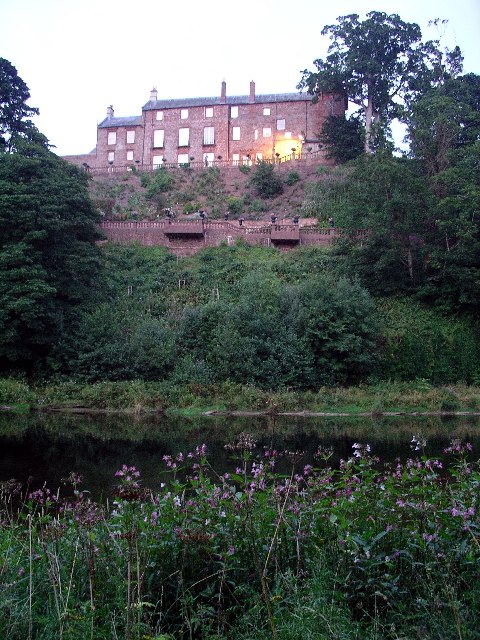
Corby Castle is a Grade I listed building and ancestral home of a cadet branch of the prominent Howard family situated on the southern edge of the village of Great Corby in northern Cumbria, England.
It was originally built in the 13th century, as a red sandstone tower house by the Salkeld Family, who also owned the nearby Salkeld Hall of similar age. It was sold in 1611 to Lord William Howard (1563–1640), the third son of Thomas Howard, 4th Duke of Norfolk, who added a two-storied L-shaped house onto the peel tower. Henry Howard (1757–1842) inherited the estate from Sir Francis Howard, Lord William Howard's second son. The present façade was built for Henry by Peter Nicholson between April 1812 and September 1817.
In 1981 the castle was used as a location for the filming of a five-part BBC dramatisation of Wilkie Collins' The Woman in White. Robert Martin and Ian Yeates started a glassworks in the grounds of Corby Castle in 1986.
Corby Castle was sold by Sir John Howard-Lawson Bt. and Lady Howard-Lawson in 1994 to Edward Haughey, Baron Ballyedmond, a businessman and Ulster Unionist Party life peer. The principal contents of the castle were sold in 1994 through Phillips of Scotland. Lord Ballyedmond carried out a total refurbishment of the castle, using it for both family and corporate entertainment. After his death in a helicopter crash in 2014 the castle was put up for sale by his estate in 2024, with an asking price of £15 million.
Corby Castle is a Grade I listed building, the highest grade. The estate has a number of other Grade I listed structures including: the eastern gate lodge and its walls and gate piers; the cascade which descends to the River Eden, a dovecote; a walled kitchen garden; a set of salmon coops; a small garden temple known as The Tempietto. and a set of caves, known as St Constantine's Cells, believed to have been excavated in medieval times by the monks of Wetheral Priory. A statue of St Constantine was added to the grounds to commemorate the cells by Philip Howard in 1843. It is a Grade II listed structure. A statue of Polyphemus is listed at Grade II*. The estate itself is listed at Grade I on the Register of Historic Parks and Gardens of Special Historic Interest in England.
Text adapted from “Corby Castle” on Wikipedia, CC BY-SA 4.0.
Corby Castle ranks #3,406 of 8,134 worldwide in the atlas's castle fame ranking, and #232 of the 333 mapped in England. Founded c. 1250, it is older than 69% of the atlas's dated landmarks — one of 861 atlas entries founded in the 13th century. Its Wikipedia articles were opened 1,374 times in the last 60 days, more than 57% of the atlas. 12 more atlas landmarks stand within 25 km. The nearest day-trip guide is Newcastle upon Tyne, 78 km away. See how England compares in the castle statistics.
View on the interactive castle map →Frequently asked questions
Where is Corby Castle?
Corby Castle stands in England, at 54.8798°, -2.82619°.
When was Corby Castle built?
The atlas dates its founding to c. 1250. Earlier structures may have stood on the site; this is the earliest documented founding year.
How famous is Corby Castle?
In this atlas's fame ranking: #3,406 of 8,134 worldwide, and #232 in England. Fame here combines how many Wikipedia language editions cover a landmark with how many people read them.
What is the nearest castle to Corby Castle?
Carlisle Castle, about 8 km away.
More castles in England
- Hereford Castle England · 11th century
- Trematon Castle England · 12th century
- Wigmore Castle England · 11th century
- Tamworth Castle England · 11th century
More castles
- Dudhope Castle Scotland · 13th century
- Taunton Castle England · 12th century
- Methoni Castle Greece · 13th century
- MacLellan's Castle Scotland · 16th century