Ruin
Wigmore Castle
ENG England · 11th century
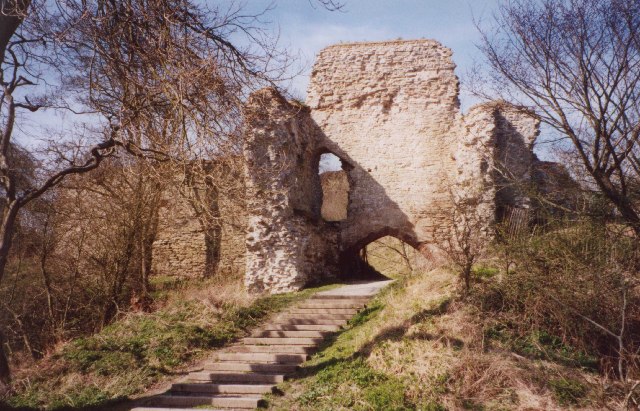
Wigmore Castle is a ruined castle about 1 km (0.62 mi) from the village of Wigmore in the northwest region of Herefordshire, England.
Wigmore Castle was founded after the Norman Conquest, probably c. 1070, by William FitzOsbern, 1st Earl of Hereford and a close associate of William the Conqueror. It was built on waste ground at a place called Merestun, the settlement by the mere or lake. The land was held at the time of the Conquest by Gunnfrothr or Gunnvarthr, who also held land at Lingen and Brampton Bryan. The associated village of Wigmore below the castle was probably also founded by FitzOsbern, perhaps around the earlier settlement.
The form of FitzOsbern's early castle at Wigmore is unknown, but given the scale of his fortifications at Chepstow, Monmouth and elsewhere, it is likely to have been substantial and probably covered much the same area as the present castle. In particular, he probably had a natural ravine reshaped to create a deep ditch behind the motte. No evidence of early stone defences has yet been discovered, leading to the conclusion that FitzOsbern's castle was built of timber, but it is just possible that the dense vegetation and thick deposits of debris conceal the foundations of an early stone keep.
FitzOsbern was killed in Flanders in 1071, and his son Roger de Breteuil took part in the Revolt of the Earls in 1075; after the Earls' subsequent defeat, William I seized the castle and gave it to another of his supporters, Ranulph de Mortimer (or Ralph de Mortimer). From this time on Wigmore became the head of the barony of the Mortimers, later from 1328 Earls of March.
In 1155 the castle was besieged by Henry II because Hugh de Mortimer refused to return Bridgnorth Castle to the crown. Two small earthworks to the east and west of the castle have survived to the present day, and may represent siege-works built for the campaign.
Parts of the walls were built or rebuilt in stone in the late 12th century or early 13th century, and further work was carried out in the 13th century, perhaps when Hugh de Mortimer (1197-1227) was given Royal money for the castle's garrisoning. The works included the curtain wall that surrounds the bailey; it still stands to this day at its full height on the east side and the south side between the south tower and the gatehouse.
Text adapted from “Wigmore Castle” on Wikipedia, CC BY-SA 4.0.
Wigmore Castle ranks #3,223 of 8,134 worldwide in the atlas's castle fame ranking, and #215 of the 333 mapped in England. Founded c. 1070, it is older than 89% of the atlas's dated landmarks — one of 325 atlas entries founded in the 11th century. Its Wikipedia articles were opened 1,643 times in the last 60 days, more than 62% of the atlas. 4 more atlas landmarks stand within 25 km. The nearest day-trip guide is Birmingham, 68 km away. See how England compares in the castle statistics.
View on the interactive castle map →Frequently asked questions
Where is Wigmore Castle?
Wigmore Castle stands in England, at 52.3179°, -2.86874°.
When was Wigmore Castle built?
The atlas dates its founding to c. 1070. Earlier structures may have stood on the site; this is the earliest documented founding year.
How famous is Wigmore Castle?
In this atlas's fame ranking: #3,223 of 8,134 worldwide, and #215 in England. Fame here combines how many Wikipedia language editions cover a landmark with how many people read them.
What is the nearest castle to Wigmore Castle?
Brampton Bryan Castle, about 5 km away.
More castles in England
- Tamworth Castle England · 11th century
- Taunton Castle England · 12th century
- Tiverton Castle England · 11th century
- HM Fort Roughs England · 20th century
More ruins
- Muslim Walls of Madrid Spain · 9th century
- Castriño of Conxo Spain
- Castro of Borneiro Spain
- Aquis Querquennis Spain