Fortress
Dajingmen
🇨🇳 China · 17th century
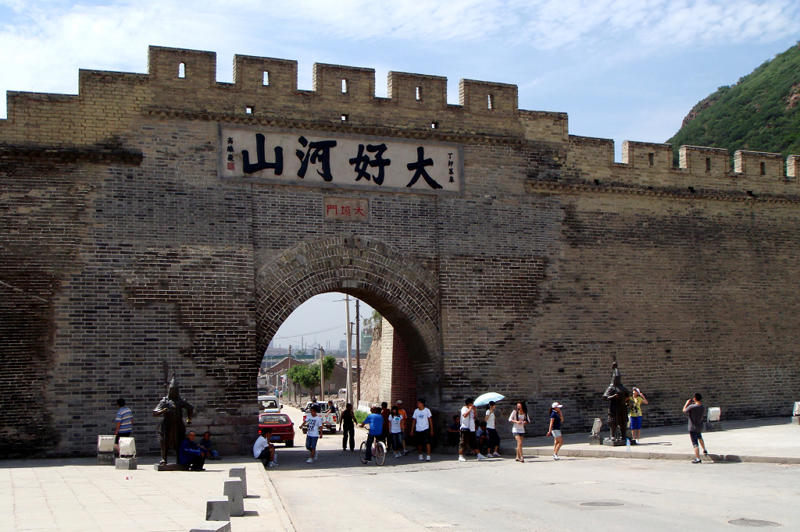
Dajingmen (simplified Chinese: 大境门; traditional Chinese: 大境門; pinyin: Dàjìngmén), also known as Dajing Gate, is an important junction of the Great Wall of China in the prefecture-level city of Zhangjiakou within the Chinese province of Hebei. Dajingmen was built in 1644 in the first year of the reign of the Shunzhi Emperor in the Qing Dynasty The gate is 12 metres high, 9 metres wide, and 13 metres deep. Above the gate is a terrace measuring 12 by 7.5 metres. The wall above the gate is topped by 1.7-metre-high (5.6 ft) towers, which are accompanied by a 0.8-metre-high (2.6 ft) parapet wall on the side. The inscription 大好河山 ("Magnificent Rivers and Mountains") found over the lintel was mounted in traditional Han-Style in 1927 on the initiative of Gao Weiyue (高维岳), the ruler of the former province of Chahar (now Inner Mongolia).
Just to the west of the gate, on the plain in which the city lies, there is an approximately 100 meter long part of the wall faced in brick; then further west, a very well-preserved Great Wall, built of hard rock, follows the mountainous terrain.
Text adapted from “Dajingmen” on Wikipedia, CC BY-SA 4.0.
Dajingmen ranks #4,117 of 8,134 worldwide in the atlas's castle fame ranking, and #56 of the 119 mapped in China. Founded 1644, it is older than 28% of the atlas's dated landmarks — one of 626 atlas entries founded in the 17th century. See how China compares in the castle statistics.
View on the interactive castle map →Frequently asked questions
Where is Dajingmen?
Dajingmen stands in China, at 40.84443°, 114.88601°.
When was Dajingmen built?
The atlas dates its founding to 1644. Earlier structures may have stood on the site; this is the earliest documented founding year.
How famous is Dajingmen?
In this atlas's fame ranking: #4,117 of 8,134 worldwide, and #56 in China. Fame here combines how many Wikipedia language editions cover a landmark with how many people read them.
What is the nearest castle to Dajingmen?
Badaling, about 109 km away.
More castles in China
- Suoyang City China · 2nd century BC
- Pinewood Battery China · 20th century
- Hailongtun China
- Kat Hing Wai China
More fortresses
- HM Fort Roughs England · 20th century
- Puerta de la Macarena (Seville) Spain · 12th century
- Tower of Mendoza Spain · 13th century
- Banna England · 2nd century