 Germany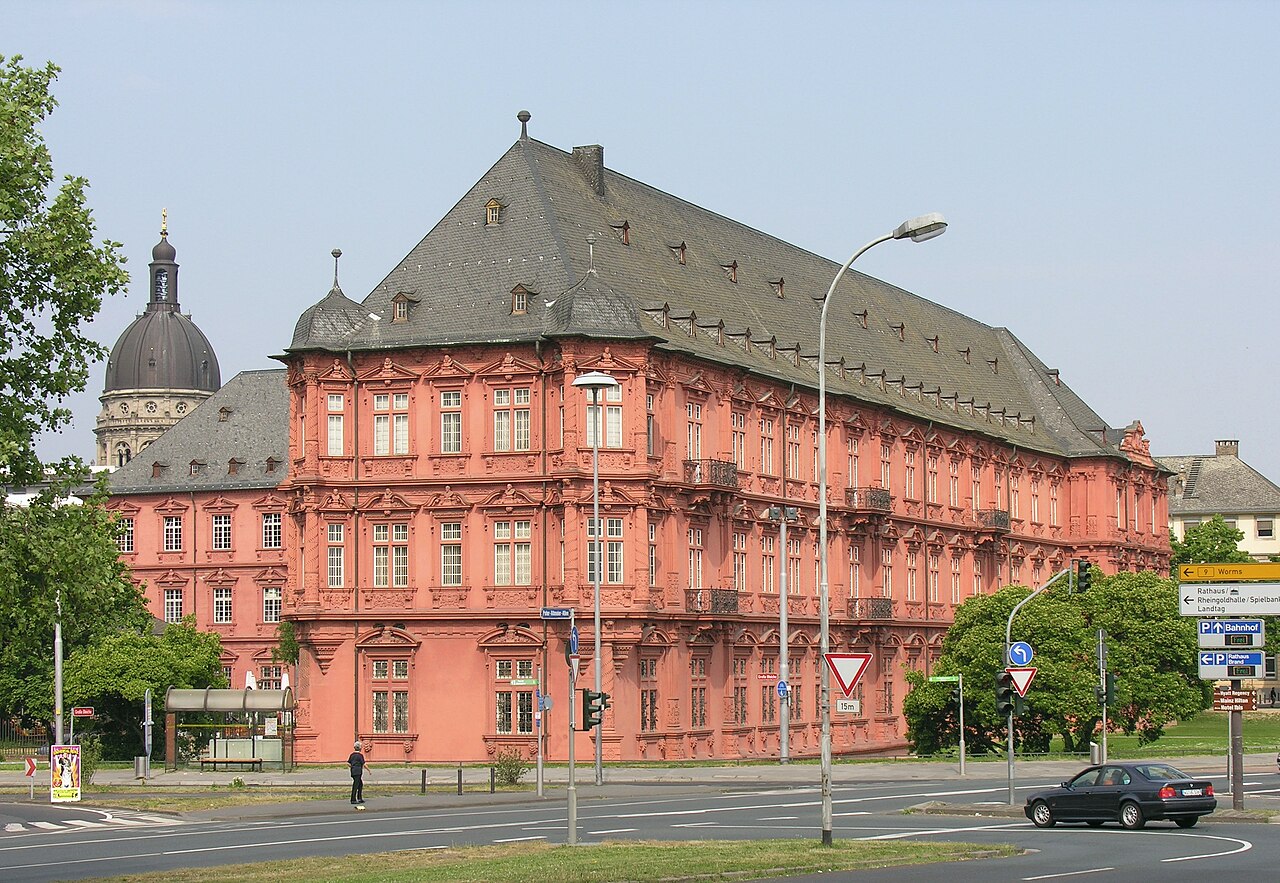
The Electoral Palace in Mainz (German: Kurfürstliches Schloss zu Mainz) is the former city Residenz of the Prince-elector and Archbishop of Mainz. It is one of the important Renaissance buildings in Germany.
Originally, the Archbishop of Mainz resided at the cathedral, where there is an old private chapel dating from 1137, but in 1475, when the Chapter re-elected Diether von Isenburg, conditions were imposed: he had to surrender the town of Mainz to the Chapter, and erect a castle in the city. The construction of Martinsburg began in 1478 and was completed two years later. For several decades, the archbishops lived either there or in the electoral palace at Aschaffenburg, Schloss Johannisburg. After receiving damage during the second war with the margraves in 1552 the castle was restored in a Renaissance style. Archbishop Daniel Brendel von Homburg built office buildings and St Gangolph's Church around the year 1580. (In order to make way for new avenues, these buildings as well as Martinsburg were demolished by Napoleon during the French occupation of the town between 1798 and 1814.)
The building of a new palace commenced in 1627 on the behest of Archbishop Georg Friedrich von Greiffenklau. The Rhine wing of the new palace could not be finished until 1678, construction being delayed by the Thirty Years War and the War of the Grand Alliance. The original plan is not known, but it was probably a four-wing construction, comparable to the 1604 repairs to Schloss Johannisberg. It can be assumed Martinsburg remained standing only because of the delays.
The north wing was begun in 1687, ready by 1752, and furnished in succeeding years. Work on the wing extending away from the river was begun during the reigns of Johann Friedrich Karl von Ostein (1743–1763) and Friedrich Karl Josef von Erthal (1774–1802).
Delays were due not only to the War of the Grand Alliance, but also to the extensive building activity of the nobility: for example, the Lustschloss Favorite begun in 1700 by Lothar Franz von Schönborn absorbed large amounts of resources. That summer residence was destroyed during the Siege of Mainz by coalition shelling in 1793.
On 23 October 1792, the Jacobin Club, a political group during the French Revolution, was established on what nowadays is German soil. This was the earliest democratic movement in Germany.
Text adapted from “Electoral Palace, Mainz” on Wikipedia, CC BY-SA 4.0.
Electoral Palace (Mainz) ranks #2,692 of 9,035 worldwide in the atlas's castle fame ranking, and #212 of the 709 mapped in Germany. Its Wikipedia articles were opened 1,460 times in the last 60 days, more than 61% of the atlas. 12 more atlas landmarks stand within 25 km. The nearest day-trip guide is Wiesbaden, 9 km away. See how Germany compares in the castle statistics.
View on the interactive castle map →