 Germany · 14th century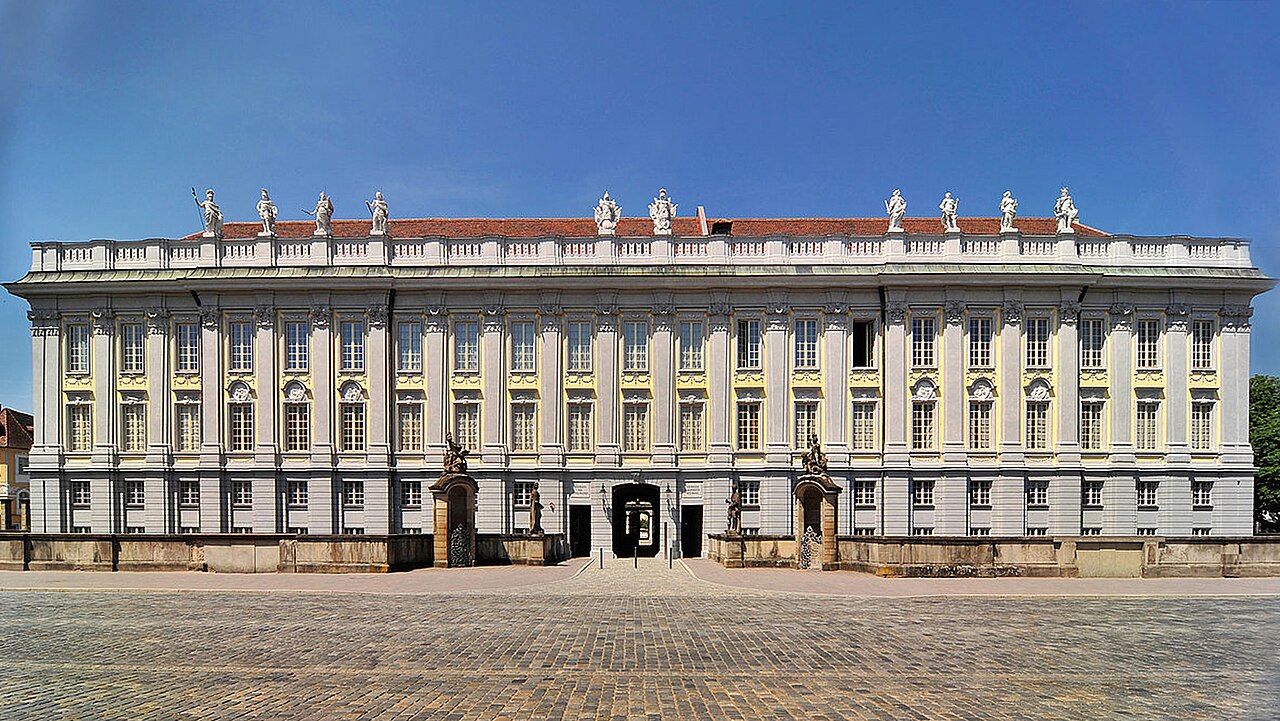
Ansbach Residence (Residenz Ansbach), also known as Margrave's Palace (Markgrafenschloss), is a palace in Ansbach, Germany. It was the government seat of the Margrave of Brandenburg-Ansbach. Today it is the administrative seat of the government of Middle Franconia. The Great Hall and the Orangerie in its garden serve as venues for the biennial music festival Bachwoche Ansbach.
The palace was developed from a medieval building. From 1398 to 1400 Frederick I, Elector of Brandenburg, expanded a Stiftshof outside the city walls to a water castle. Structural remains are preserved in the northwest wing of the present building.
George Frederick, Margrave of Brandenburg-Ansbach, ordered the Swabian architect Blasius Berwart (his chief architect from 1563 to 1580) to build a palace. It was erected in Renaissance style from 1565 to 1575. A large hall was built from 1565 to 1575, now called the "Gothische Halle" (Gothic Hall) because of its rib vault. It now houses the largest collection of fayence and porcelain of the former "Ansbacher Manufaktur".
A century later, the major construction was done by Gabriel de Gabrieli (1694–1716), by Karl Friedrich von Zocha (1719–1730), and by Leopold Retti (1731–1749). Between 1705 and 1738 the building was changed to its present form.
Gabriel de Gabrieli created before 1709 the southeast wing with the main facade in a style similar to Viennese Baroque. The interior dates from 1734 to 1745 under architect Leopoldo Retti. Carlo Carlone created a fresco on the ceiling of the Festsaal (Festive hall). Meissen porcelain is shown in the Spiegelkabinett (Hall of Mirrors).
The interior of the palace has a hall of mirrors with French rococo features; the great hall was provided with painted ceiling and the rooms were fitted with Ansbach porcelain tiles of 18th century vintage. It had a garden that was laid out in the 16th century and modified in the 18th century with an orangerie.
The castle has richly furnished state rooms on the first floor. In 1791, Karl August von Hardenberg, Prussia's representative in Ansbach, added board rooms and a library. From 1806, once the Royal Bavarian Government of Rezatkreis started functioning in Ansbach, the castle's first floor rooms were converted into offices, while the rooms on other floors remained unchanged. Between 1962 and 1974, the last major renovations to the castle were completed.
Text adapted from “Ansbach Residence” on Wikipedia, CC BY-SA 4.0.
Residenz Ansbach ranks #2,447 of 9,079 worldwide in the atlas's castle fame ranking, and #187 of the 711 mapped in Germany. Founded 1398, it is older than 52% of the atlas's dated landmarks — one of 755 atlas entries founded in the 14th century. Its Wikipedia articles were opened 2,275 times in the last 60 days, more than 72% of the atlas. 3 more atlas landmarks stand within 25 km. See how Germany compares in the castle statistics.
View on the interactive castle map →