 Germany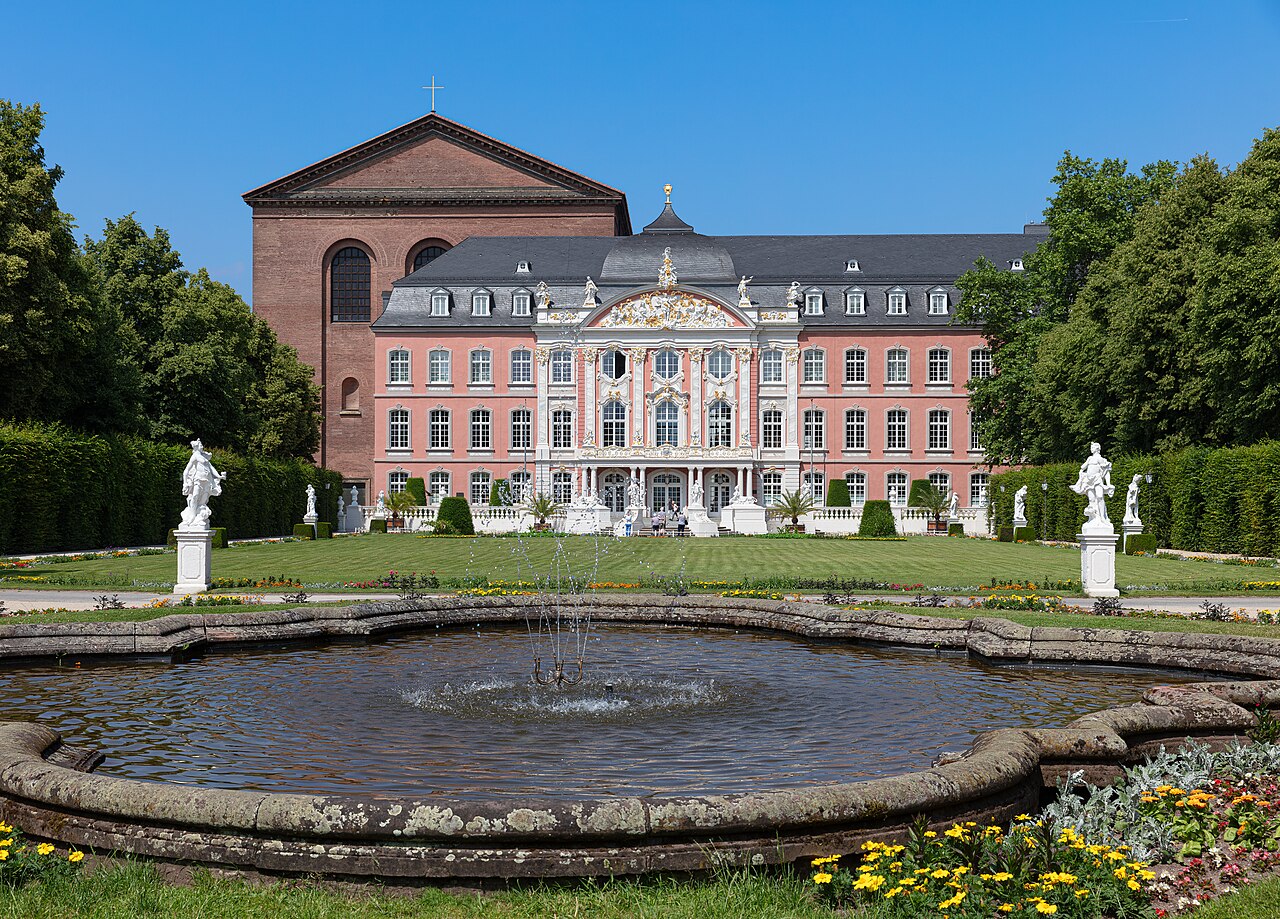
The Electoral Palace (German: Kurfürstliches Palais) in Trier, Germany, was the residence of the Archbishops and Electors of Trier from the 16th century until the late 18th century. It now houses various offices of the federal government and often hosts classical music concerts.
The site of the current Electoral Palace was already part of the Ancient Roman Imperial Palace that was used by Constantine the Great in the early 4th century. The (Basilica of Constantine or Aula Palatina) used as the Elector's throne room, is Roman. Some Roman mosaics also survive.
From the 11th century onward the archbishops of Trier used the Basilica, of which only the outer walls were standing, as a stronghold. The apse was fortified to serve as a bergfried and merlons were added to the other walls.
In the late 16th century, archbishop Johann von Schönenberg planned building a residence in the style of the German Renaissance for which parts of the Medieval fortress, as well as many houses, were demolished. It was only because the Roman walls proved to be resistant that some of them were incorporated in the new structure. Von Schönenberg's successors, Lothar von Metternich and Philipp Christoph von Sötern, completed the lower palace (Niederschloss) around 1650. The new residence was known as Saint Peter's Castle (St. Petersburg), after the town's patron saint. A chapel dedicated to Saint Lawrence stood on the south-west corner. In the same period work had started on the upper palace wings (Hochschloss) but this project was halted as a result of the Thirty Years' War. At this time, the bishops preferred their Koblenz residence at Ehrenbreitstein, which was considered safer.
From 1756 onwards, archbishop-elector Johann IX Philipp von Walderdorff had the south wing of the Trier Palace rebuilt in Rococo style by Johannes Seiz. Around the same time the Baroque gardens were fitted out with garden statues by Ferdinand Tietz.
In 1794 the French revolutionary armies conquered half of the Rhineland, including Trier. The Electoral Palace was confiscated and used as barracks. This continued after the Prussians took over in 1814.
Around 1850 it was decided that the Basilica of Constantine was going to be rebuilt as it had appeared in the fourth century. For that reason the west wing of the Electoral Palace (then barracks) were to be demolished.
Text adapted from “Electoral Palace, Trier” on Wikipedia, CC BY-SA 4.0.
Electoral Palace (Trier) ranks #1,664 of 9,079 worldwide in the atlas's castle fame ranking, and #127 of the 711 mapped in Germany. Its Wikipedia articles were opened 3,834 times in the last 60 days, more than 82% of the atlas. 4 more atlas landmarks stand within 25 km. The nearest day-trip guide is Trier, 1 km away. It is one of the 51 landmarks on the atlas's regional map of the Moselle. It is stop 1 of 36 on the Moselle castle route, Trier to Koblenz. See how Germany compares in the castle statistics.
View on the interactive castle map →