 Germany · 13th century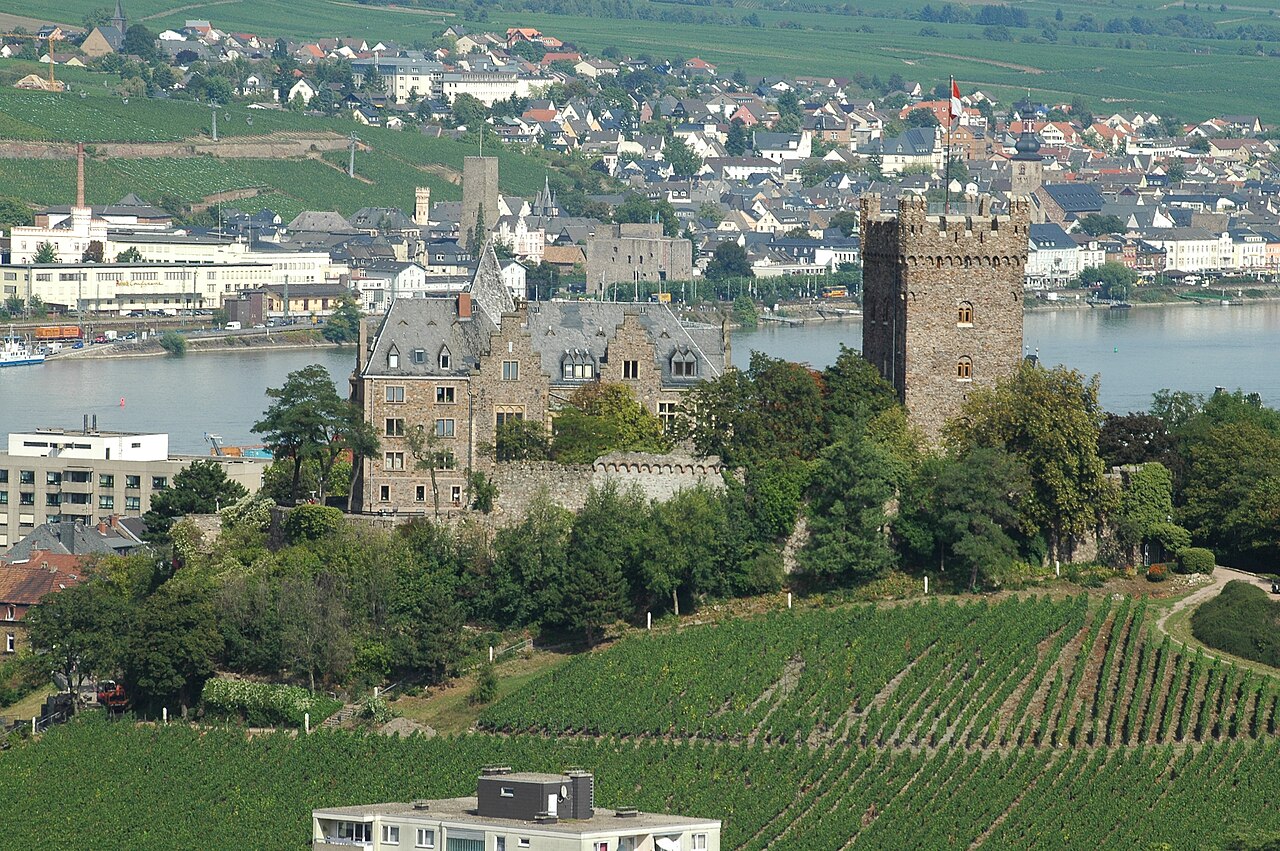
Klopp Castle (German: Burg Klopp) is a castle in the town of Bingen am Rhein in the Upper Middle Rhine Valley in Rhineland-Palatinate, Germany. In the nineteenth century, the bergfried (similar to a keep) from the original medieval fortified castle was restored and a new building added which houses the town's administration.
The castle stands on a hill above the town with a wide-ranging view, which may have been the site of a Roman fortification built by Nero Claudius Drusus at Bingium around 10 CE. Drusenburg or Drususburg was an early name for the castle. The hill is one of three locations where local legend says that Emperor Henry IV was imprisoned by his son in 1105 or 1106, this being the first surviving mention of a castle there.
The last medieval castle on the site was built in the 13th century: possibly around 1281, possibly between 1240, when Kloppberg (Klopp Hill) is mentioned as the residence of a churchman, and 1277, the first mention of Burg Clopp. Together with Ehrenfels Castle on the opposite side of the Rhine and later the Mouse Tower, it enabled the Archbishopric of Mainz to exact tolls on river trade. In 1438 the archbishop sold the town and the castle to the cathedral chapter and the townspeople effectively controlled it. The castle was already decaying in the 16th century and was destroyed in the Thirty Years' War, but was rebuilt in 1653.
The French destroyed it again in 1689 in the War of the Palatine Succession, and in the final phase of the War of the Spanish Succession in 1713, the Mainz forces themselves blew up what was left to prevent its use by the enemy. Early 19th-century paintings show ruined walls, one connecting the castle to the town, but the castle itself levelled.
The state of Hesse acquired the ruin in 1815 and sold it to Hermann Faber, a lawyer. It was later owned by a Berliner called Rosenthal, who renovated the well. Both charged tourists to climb the gate tower as a viewing platform; Faber built a stairway up the outside of the walls and a viewing room at the top which he furnished with books of poetry, a comfortable sofa and a fully equipped writing desk, and laid out the grounds as a garden with romantic paths through the grapevines, trees and flowers. He also installed an aeolian harp. The castle was one of the major sights of the Romantic Rhine. J.M.W. Turner sketched a view of it from the River Nahe in 1844.
Text adapted from “Klopp Castle” on Wikipedia, CC BY-SA 4.0.
Klopp Castle ranks #2,758 of 9,035 worldwide in the atlas's castle fame ranking, and #218 of the 709 mapped in Germany. Founded 1240, it is older than 71% of the atlas's dated landmarks, one of 1090 atlas entries founded in the 13th century. Its Wikipedia articles were opened 1,733 times in the last 60 days, more than 66% of the atlas. 23 more atlas landmarks stand within 25 km. The nearest day-trip guide is Wiesbaden, 28 km away. It is one of the 39 landmarks on the atlas's regional map of the Middle Rhine. It is stop 3 of 32 on the Rhine castle route, Bingen to Koblenz. See how Germany compares in the castle statistics.
View on the interactive castle map →