Ruin
Finlaggan Castle
SCT Scotland
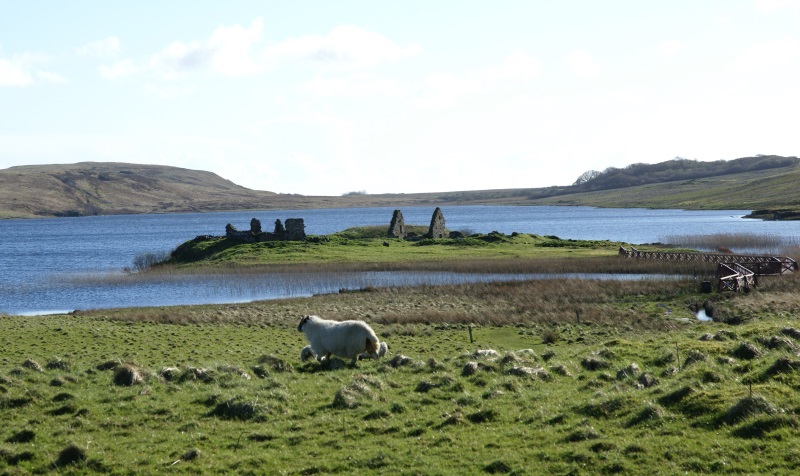
Finlaggan (NR 388 680, Scottish Gaelic: Port an Eilein) is a historic site on Eilean Mòr in Loch Finlaggan, on the island of Islay, around 4 km west of the ferry terminal at Port Askaig.
Finlaggan was the seat of the Lords of the Isles and of Clan Donald.
Two of the three islands in Loch Finlaggan, Eilean Mòr ("Great Isle") and Eilean na Comhairle ("Isle of the Council"), were the administrative centre of the Lordship of the Isles during the 13th to 15th centuries, until 1493 when the lordship of the Isles fell to James IV of Scotland, who administered the territory via a tenant-in-chief.
The Finlaggan Trust maintains the site and also refurbished a derelict cottage that has been converted into a comprehensive museum. The centre contains numerous artefacts discovered during archaeological excavations: from a sheep wool quilted aketon, worn under armour, to an ancient cross related to the lords.
The site has been the subject of recent archaeological investigations and hosted an episode of Channel 4's archaeological television programme Time Team in 1995. During summer 2008 the centre was extensively refurbished and extended. The stone walls of a medieval chapel dedicated to St Findlugan on Eilean Mòr have been stabilised and several 16th century graves put on display and covered by large glass panels. In May 2019, researchers at the University of St Andrews, working with the Finlaggan Trust and the National Museum of Scotland, announced the creation of a virtual-reality reconstruction of the settlement in the early 15th century, based on archaeological data. The reconstruction will be on show at the visitor centre.
Finlaggan Castle (Scottish Gaelic: Port an Eilein, English: Port of the Island), also known as Eilean Mòr Castle, is a ruined fortified house located on the isle of Eilean Mòr on Loch Finlaggan. It was once a residence and stronghold of Lord of the Isles and Clan Donald.
In the first half of the 7th century, a monastic community was established on Eilean Mòr, the largest of the three islands in the loch. This was either dedicated to or possibly founded by St Findlugan, an Irish monk and a contemporary of St Columba. St Findlugan is officially venerated as a saint in the Catholic Church and Eastern Orthodox Church.
The ruins we see today are from a castle built in the 13th century, with masonry walls.
Text adapted from “Finlaggan” on Wikipedia, CC BY-SA 4.0.
Finlaggan Castle ranks #3,137 of 8,134 worldwide in the atlas's castle fame ranking, and #109 of the 168 mapped in Scotland. Its Wikipedia articles were opened 1,785 times in the last 60 days, more than 64% of the atlas. 1 more atlas landmarks stand within 25 km. See how Scotland compares in the castle statistics.
View on the interactive castle map →Frequently asked questions
Where is Finlaggan Castle?
Finlaggan Castle stands in Scotland, at 55.8353°, -6.1727°.
How famous is Finlaggan Castle?
In this atlas's fame ranking: #3,137 of 8,134 worldwide, and #109 in Scotland. Fame here combines how many Wikipedia language editions cover a landmark with how many people read them.
What is the nearest castle to Finlaggan Castle?
Dunyvaig Castle, about 23 km away.
More castles in Scotland
- Colliston Castle Scotland · 16th century
- Dudhope Castle Scotland · 13th century
- Tap o' Noth Scotland
- MacLellan's Castle Scotland · 16th century
More ruins
- Longtown Castle England · 11th century
- Clitheroe Castle England · 12th century
- Wigmore Castle England · 11th century
- Tiverton Castle England · 11th century