 Austria · 15th century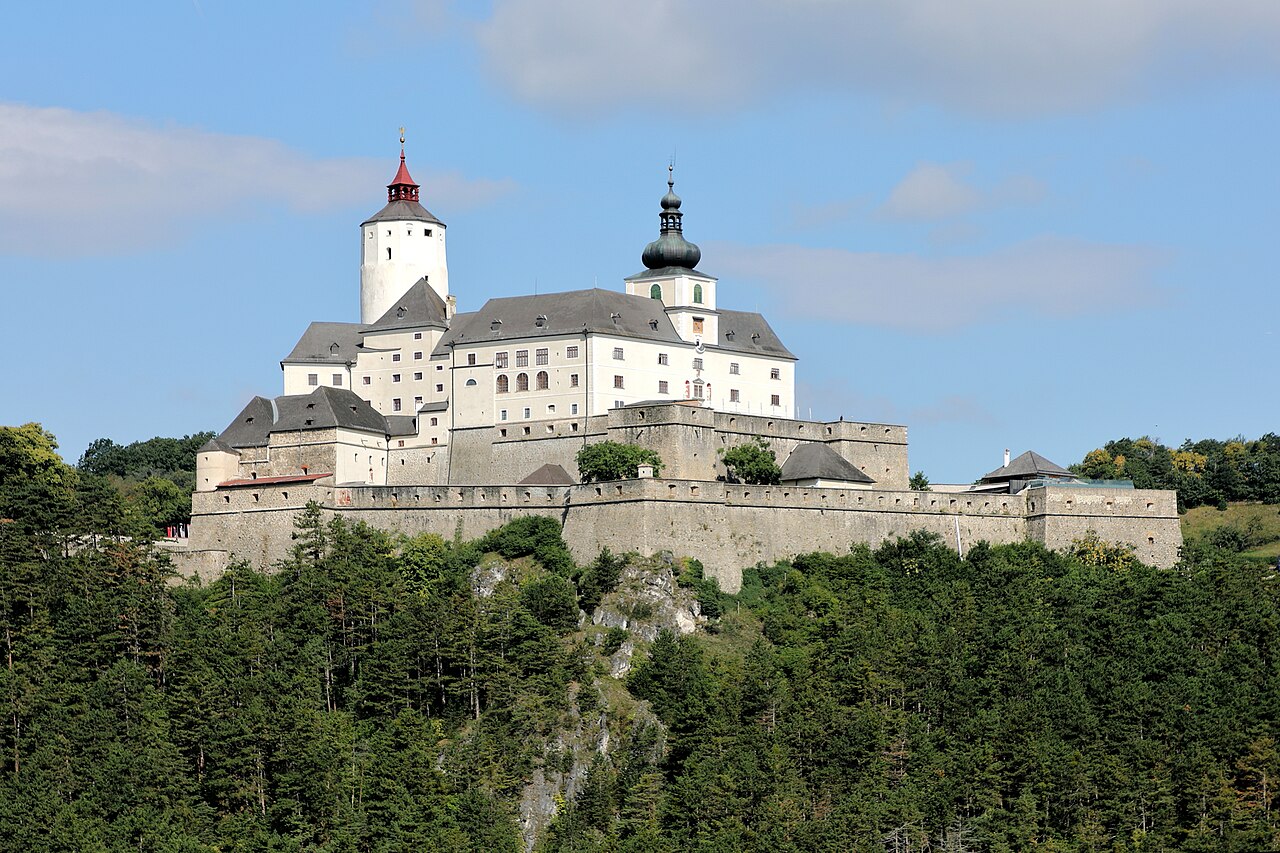
Forchtenstein Castle (German: Burg Forchtenstein; Hungarian: Fraknó vára; Croatian: Fortnavski grad) is a castle built in the Late Middle Ages near the municipality of Forchtenstein in northern Burgenland, Austria. Forchtenstein Castle is 511 metres (1,677 ft) above sea level.
The castle is south of Mattersburg above the Wulka valley.
The first part of the castle with its 50-metre (160 ft) high keep was built in the beginning of the 15th century by the Lords of Mattersburg, who later named themselves Lords of Forchtenstein.
The castle features a tower, known as the 'Black Tower' although the black rock that originally lined the tower has since been stripped. The tower contains a 12-metre (40 ft) deep pit used as a prison cell for those condemned to death. Rezallia, wife of Lettus of Forchtenstein used this with great frequency; on the return of her husband from military service, she was herself sentenced to death in the tower by her husband.
Around 1450 the Lords of Forchtenstein died off due to lack of a male heir and the castle was passed over to the House of Habsburg, which owned it for 170 years. They leased it to others, including the Counts of Weissbriach and Hardegg. During this time the building was not changed significantly.
In 1622 Nikolaus Esterházy, founder of the western Hungarian Esterházy line, received the castle from Emperor Ferdinand II, and Esterházy became a Count. Nikolaus started to fortify the crumbling castle and refurbished it with the services of Vienna builder Simon Retacco from 1630 to 1634 and with Domenico Carlone from 1643. The construction workers were all from Italy. This led to big orders for three masters of Kaisersteinbruch, the imperial quarry: Ambrosius Petruzzy, Pietro Maino Maderno, and Mathias Lorentisch. Kaiserstein stone was used for the main portals, fountains, cannonballs, etc. Once hewn the stone was delivered on large wagons drawn by six oxen.
In the second half of the 17th century his son Paul further extended and ornamented the castle with architect Domenico Carlone. After Paul's death the castle's function changed. It became a repository for weapons, archives, chronometers, machines, exotic animal preparations and other "marvels". The only access to the treasure vault was a secret passage leading to a door requiring two different keys used together.
Text adapted from “Forchtenstein Castle” on Wikipedia, CC BY-SA 4.0.
Forchtenstein Castle ranks #842 of 9,079 worldwide in the atlas's castle fame ranking, and #18 of the 240 mapped in Austria. Founded c. 1425, it is older than 49% of the atlas's dated landmarks — one of 554 atlas entries founded in the 15th century. Its Wikipedia articles were opened 4,455 times in the last 60 days, more than 85% of the atlas. 9 more atlas landmarks stand within 25 km. The nearest day-trip guide is Vienna, 56 km away. See how Austria compares in the castle statistics.
View on the interactive castle map →