 Belgium · 12th century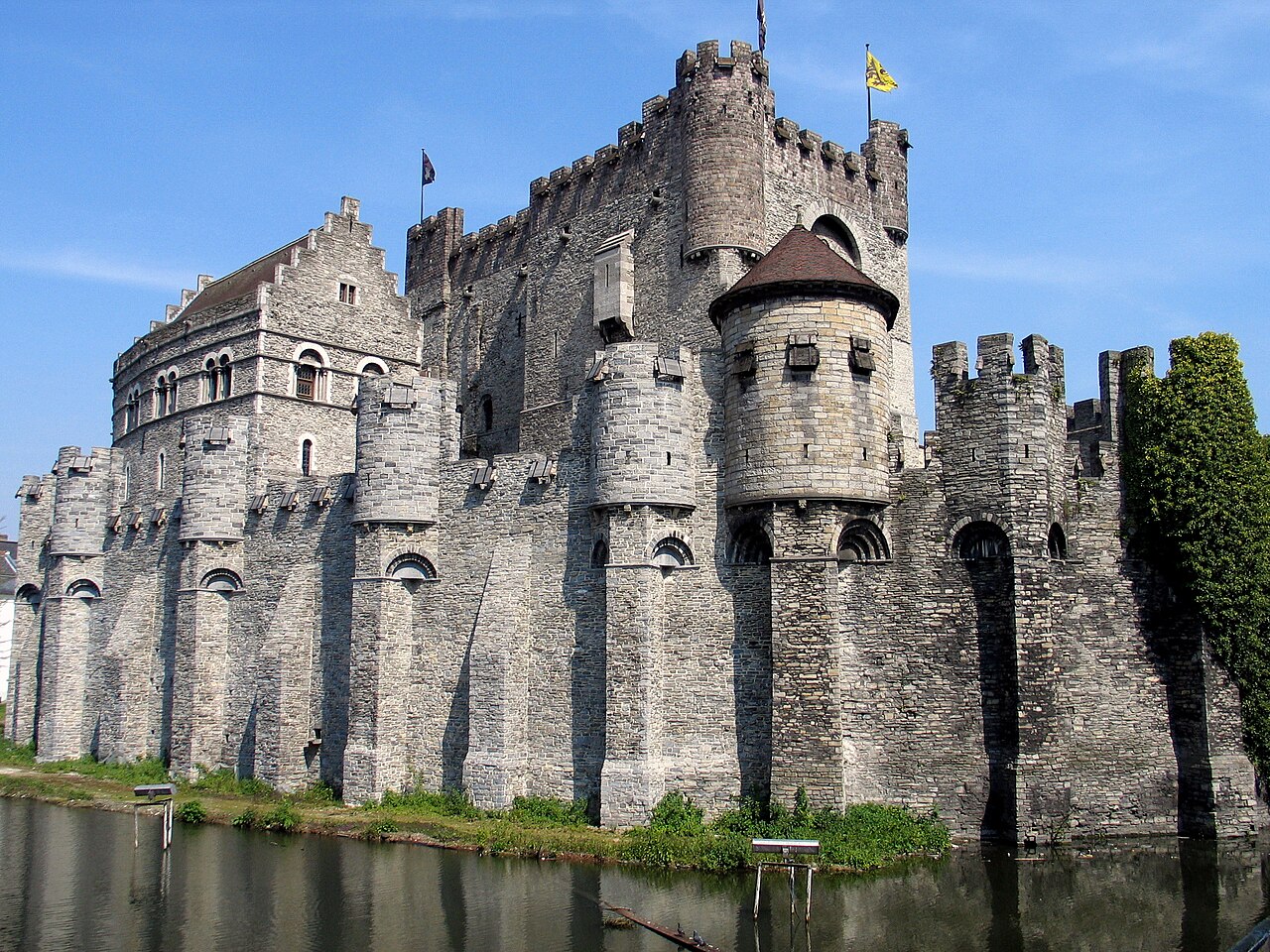
The Gravensteen (Dutch; lit. 'the Counts' stone [castle]') is a medieval castle in the city of Ghent, East Flanders in Belgium. The current castle dates from 1180 and was the residence of the Counts of Flanders until 1353. It was subsequently re-purposed as a court, prison, mint, and even as a cotton mill. It was restored over 1893–1903 and is now a museum and a major landmark in the city.
The origins of the Gravensteen date to the reign of Arnulf I (890–965) in the County of Flanders. The site, which sat between two branches of the river Lys, was first fortified around 1000, initially in wood and later in stone. This was soon transformed into a motte-and-bailey castle which was burnt down in around 1176.
The current castle dates to 1180 and was built by Philip of Alsace (1143–1191) on the site of the older fortification. It may have been inspired by crusader castles witnessed by Philip during the Second Crusade. As well as a protective citadel, the Gravensteen was intended to intimidate the burghers of Ghent who often challenged the counts' authority. It incorporates a large central donjon, a residence and various smaller buildings. These are surrounded by a fortified, oval-shaped enceinte lined with 24 small échauguettes. It also has a sizeable moat, fed with water from the Lys.
From 1180 until 1353, the Gravensteen was the residence of the Counts of Flanders. The decision to leave was taken by Louis of Male (1330–1384) who transferred the court to the nearby Hof ten Walle.
The foot of a wolf was once nailed to the gate and provides the last known archaeozoological evidence for the wolf in Flanders.
After ceasing to be the residence of the counts of Flanders, the castle entered a decline. It was used as a court and prison until the 18th century. From 1353 to 1491, it was the site of Ghent's mint. Private buildings were constructed on or around the medieval remains. Ghent emerged as a major centre for textile manufacturing during the Industrial Revolution in the 19th century, and the Gravensteen was converted into a cotton mill. It was at one point scheduled for demolition.
Parts of the castle were bought up gradually by the City of Ghent, which began a major restoration in a romanticising Gothic style between 1893 and 1907 under the architect Joseph De Waele.
Text adapted from “Gravensteen” on Wikipedia, CC BY-SA 4.0.
Gravensteen ranks #341 of 9,079 worldwide in the atlas's castle fame ranking, and #5 of the 128 mapped in Belgium. Founded 1180, it is older than 78% of the atlas's dated landmarks — one of 756 atlas entries founded in the 12th century. Its Wikipedia articles were opened 22,282 times in the last 60 days, more than 98% of the atlas. 7 more atlas landmarks stand within 25 km. The nearest day-trip guide is Ghent, 1 km away. See how Belgium compares in the castle statistics.
View on the interactive castle map →