 Austria · 20th century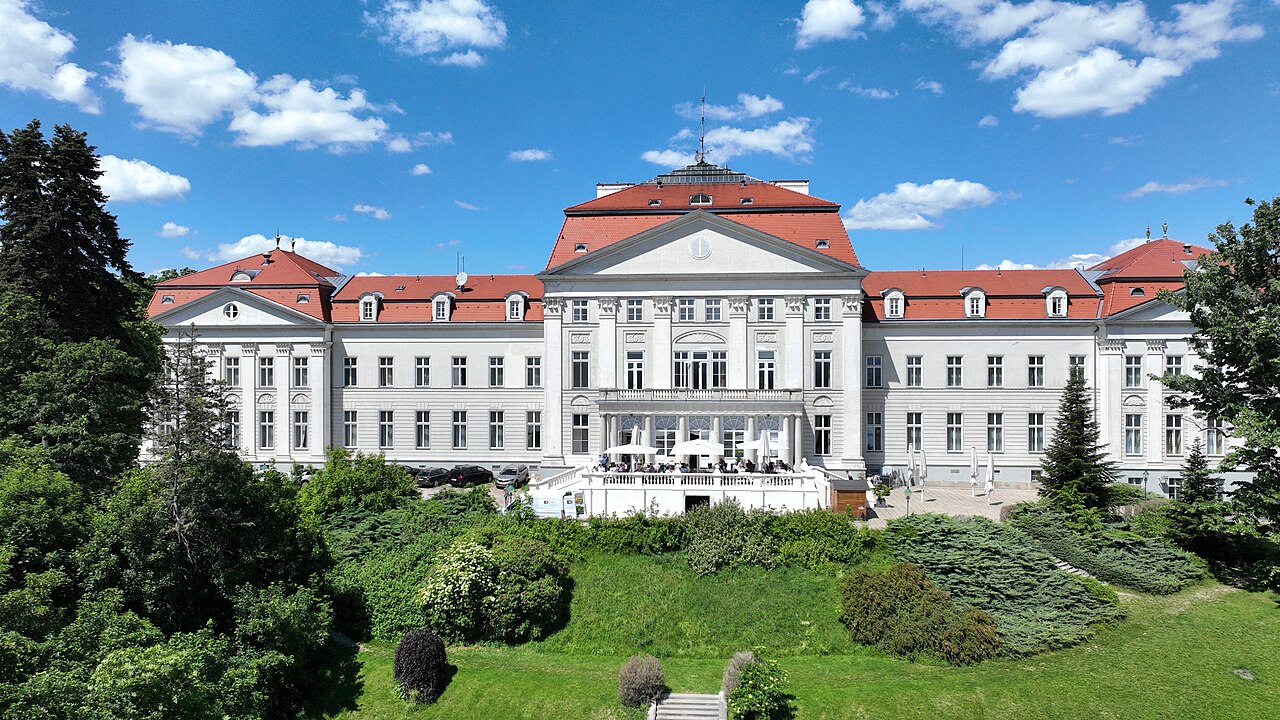
Wilhelminenberg Castle (German: Schloß Wilhelminenberg) is a former palace dating from the early 20th century, which is now a four-star hotel, restaurant and conference facility. It is situated on the eastern slopes of the Gallitzinberg, in the Wienerwald western parts of the Austrian capital, Vienna.
In 1780, Prince Dmitri Mikhailovich Galitzin, the Russian ambassador in Vienna, acquired forested property from Field Marshal Count Franz Moritz von Lacy, situated uphill of what was then the village of Ottakring. He ordered a small Jagdschloss to be erected, which soon became famous for its social events. By 1824, when the building was already in disrepair, ownership of the estate had passed on to Prince Julius de Montléart (1787–1865) and his wife Princess Maria Christina of Saxony. In 1838, the castle was expanded by adding two side wings.
When Julius' son, Prince Moritz de Montléart, acquired the property after considerable legal battles, he gave it to his wife Wilhelmine (née von Arnold) and named the castle "Wilhelminenberg". Upon their deaths in 1887 and 1895, respectively, both were interred in a small mausoleum which was built in the "neo-gothic" style close to the castle. Because of her generosity towards the poor, Wilhelmine de Montléart became known as the "Angel of Ottakring." In 1895, their nephew Archduke Rainer Ferdinand of Austria, son of the half-sister of Moritz de Montleart, inherited the estate.
In 1903, Archduke Leopold Salvator had the dilapidated building demolished and in the years to 1908, a palace in the Second Empire style was built according to plans of the architects Eduard Frauenfeld and Ignaz Sowinski. The construction costs, including the park and the ancillary buildings, amounted to 1.4 million Kronen.
In 1918, when World War I drew to its close, the castle became a military hospital and was subsequently used as a rehabilitation center for veterans. In 1927, the City of Vienna purchased the entire estate from the Zurich banker Wilhelm Ammann and established an orphanage there. From 1934 to 1938, the castle served as the home base for the world-famous Vienna Boys' Choir.
Following Austria's Anschluss to Nazi Germany in March 1938, Wilhelminenberg was confiscated and transferred to the Österreichische Legion, a paramilitary unit of exiled Austrian National Socialists. During World War II, it was once again made an army hospital.
Text adapted from “Schloss Wilhelminenberg” on Wikipedia, CC BY-SA 4.0.
Schloss Wilhelminenberg ranks #1,480 of 9,079 worldwide in the atlas's castle fame ranking, and #31 of the 240 mapped in Austria. Founded c. 1925 — one of 169 atlas entries founded in the 20th century. Its Wikipedia articles were opened 2,248 times in the last 60 days, more than 72% of the atlas. 40 more atlas landmarks stand within 25 km. The nearest day-trip guide is Vienna, 7 km away. It is stop 5 of 28 on the Wachau Danube route, Melk to Vienna. See how Austria compares in the castle statistics.
View on the interactive castle map →