 United States · 19th century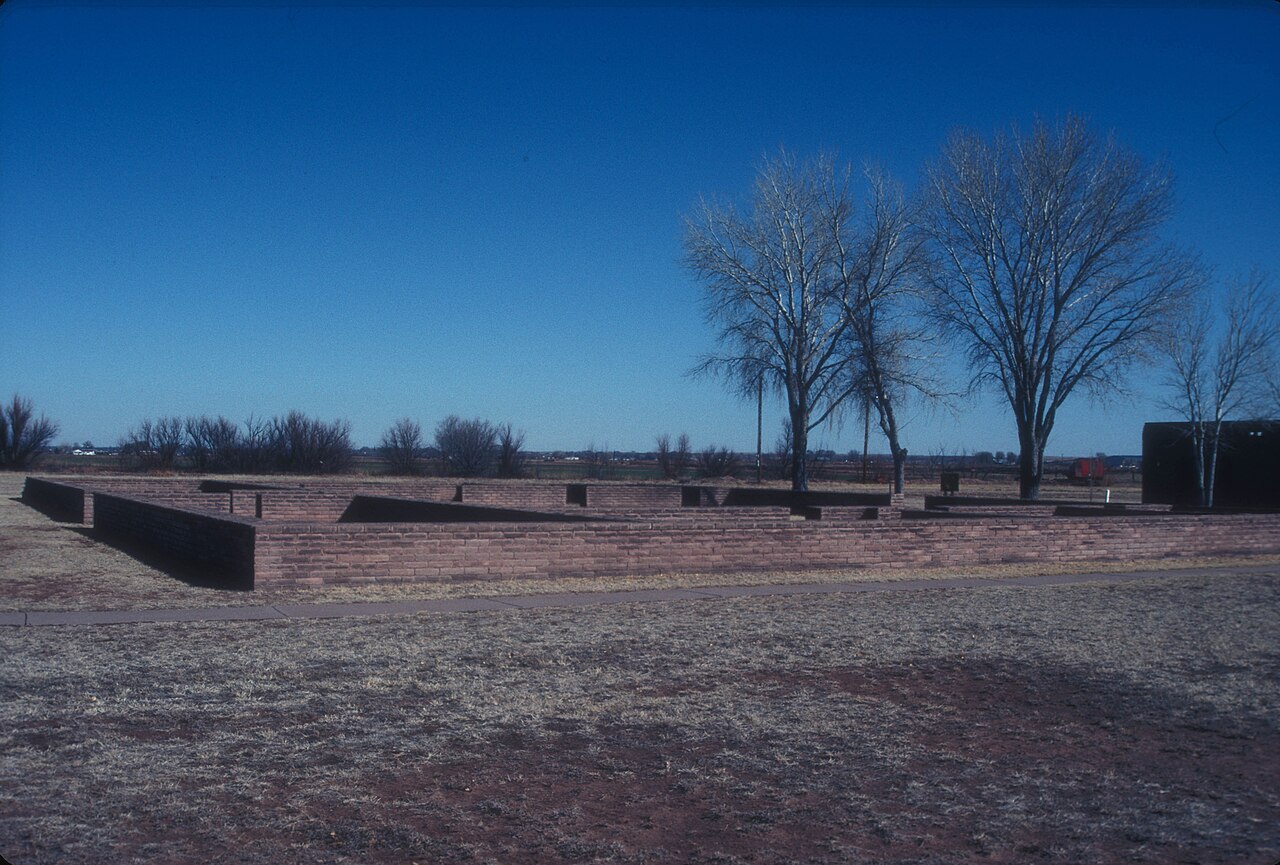
Fort Sumner was a military fort in New Mexico Territory charged with the internment of Navajo and Mescalero Apache populations from 1863 to 1868 at nearby Bosque Redondo.
On October 31, 1862, Congress authorized the construction of Fort Sumner. General James Henry Carleton initially justified the fort as offering protection to settlers in the Pecos River valley from the Mescalero Apache, Kiowa, and Comanche. He also created the Bosque Redondo reservation, a 1,600-square-mile (4,100 km2; 1,000,000-acre) area where over 9,000 Navajo and Mescalero Apache were forced to live because of accusations that they were raiding white settlements near their respective homelands. The fort was named for General Edwin Vose Sumner.
The reservation was to be self-sufficient, while teaching Navajo and Mescalero Apache how to be modern farmers. General Edward Canby, whom Carleton replaced, had first suggested that the Navajo people be moved to a series of reservations and be taught new skills. Some in Washington, D.C. thought that the Navajo should not be moved and that a reservation should be created on their own land. The 1865 and 1866 corn crop was sufficient, but in 1867 it was a total failure. Army officers and Indian agents realized that Bosque Redondo was a failure, as it had poor water and too little firewood for the numbers of people who were living there. The Mescalero soon ran away; the Navajo stayed longer, but were permitted to return to their native lands in May 1868.
When the Bosque Redondo was established, General Carleton ordered Colonel Kit Carson to do whatever necessary to bring first the Mescalero and then the Navajo there. All of the Mescalero Apache had been relocated by the end of 1862, but the Navajo were not resettled in large numbers until early 1864. The Navajo refer to the journey from Navajo land to the Bosque Redondo as the Long Walk. More than 300 Navajo died making the journey. It was a bitter memory to many Navajo. One man described it as follows: "By slow stages we traveled eastward by present Gallup and Shushbito, Bear spring, which is now called Fort Wingate. You ask how they treated us? If there was room the soldiers put the women and children on the wagons. Some even let them ride behind them on their horses.
Text adapted from “Fort Sumner” on Wikipedia, CC BY-SA 4.0.
Fort Sumner ranks #1,776 of 9,035 worldwide in the atlas's castle fame ranking, and #30 of the 110 mapped in United States. Founded 1862, it is older than 7% of the atlas's dated landmarks, one of 705 atlas entries founded in the 19th century. Its Wikipedia articles were opened 6,810 times in the last 60 days, more than 90% of the atlas. See how United States compares in the castle statistics.
View on the interactive castle map →