 England · 12th century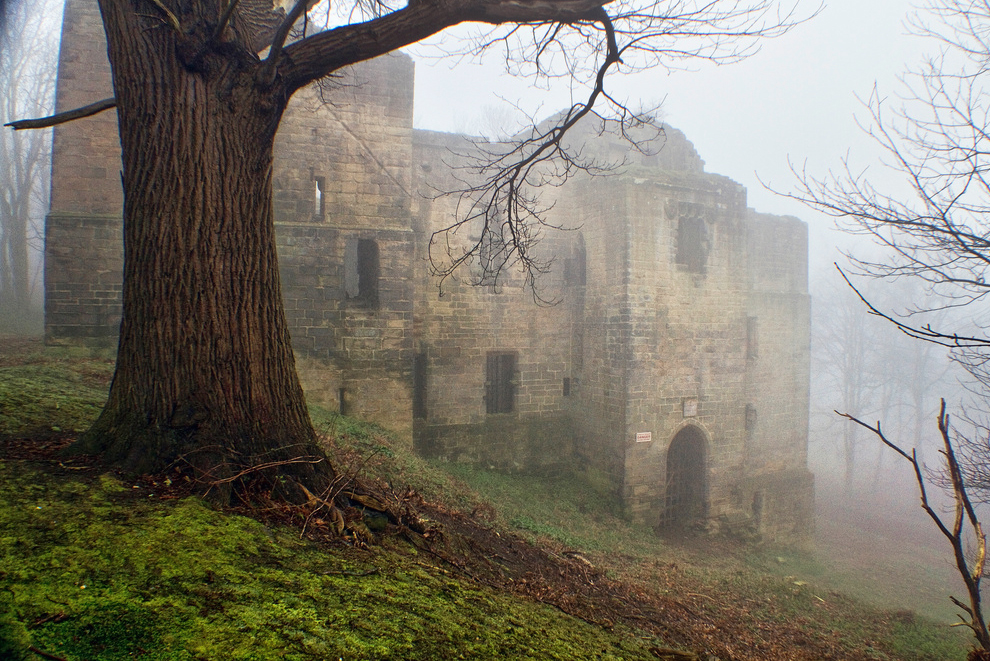
Harewood Castle is a 14th-century stone hall house and courtyard fortress, located on the Harewood Estate, Harewood, in West Yorkshire, England (Grid Reference SE 322457). Harewood Castle is a grade I listed building.
The castle is laid out as a keep in a rectangular shape with corner towers.
The main hall is two storeys high, with a three-storey accommodation wing. It is flanked by four angle towers, one being a plain entrance tower; the chapel is situated over the portcullis chamber. The lower kitchen wing is of four storeys, with a barrel-vaulted basement containing the well. The rectangular tower house on a steep slope is visible for miles around.
The castle was founded by the De Lisle family in the 12th century, and then passed to Sir William de Aldeburgh, following his marriage to Elizabeth de Lisle, heiress of Harewood, who was granted a licence to crenellate in 1366.
When the second Baron Aldeburgh died in 1391 without issue, the castle transferred to the Ryther and the Redmayne (Redman) families, into which his two daughters had married.
In 1574, James Ryther and partner William Plompton bought out the Redman family, although Ryther's financial situation must have worsened because he died in London's Fleet Prison in 1595. His son and two daughters sold the castle to Sir William Wentworth of Gawthorpe Hall in 1600 to clear debts; this is probably when Harewood Castle ceased to be a main residence.
The castle was last occupied in the 1630s, and in 1656 it was put up for sale as an 'upstanding source of stone and timber'. The Wentworths sold Harewood and Gawthorpe to Sir John Cutler, 1st Baronet, by which time the castle had probably already been partly dismantled, though Cutler lived there at the end of his life. At Cutler's death in 1693, it passed to his only surviving daughter, Elizabeth, Countess of Radnor and on her death without heir to Cutler's nephew, unmarried Edmund Boulter MP of Boston and Wimpole Hall then to his nephew John Boulter of Gawthorpe and Westminster, who died unmarried in 1738. His executors sold to Henry Lascelles (1690–1753) whose son, Edwin Lascelles, 1st Baron Harewood built Harewood House.
Centuries after it had been abandoned, Harewood Castle remained a landmark, the subject of several paintings in the 1797 by J. M. W. Turner.
Text adapted from “Harewood Castle” on Wikipedia, CC BY-SA 4.0.
Harewood Castle ranks #4,084 of 9,079 worldwide in the atlas's castle fame ranking, and #273 of the 360 mapped in England. Founded c. 1150, it is older than 80% of the atlas's dated landmarks — one of 756 atlas entries founded in the 12th century. Its Wikipedia articles were opened 1,109 times in the last 60 days, more than 53% of the atlas. 4 more atlas landmarks stand within 25 km. The nearest day-trip guide is Sheffield, 58 km away. See how England compares in the castle statistics.
View on the interactive castle map →