 England · 11th century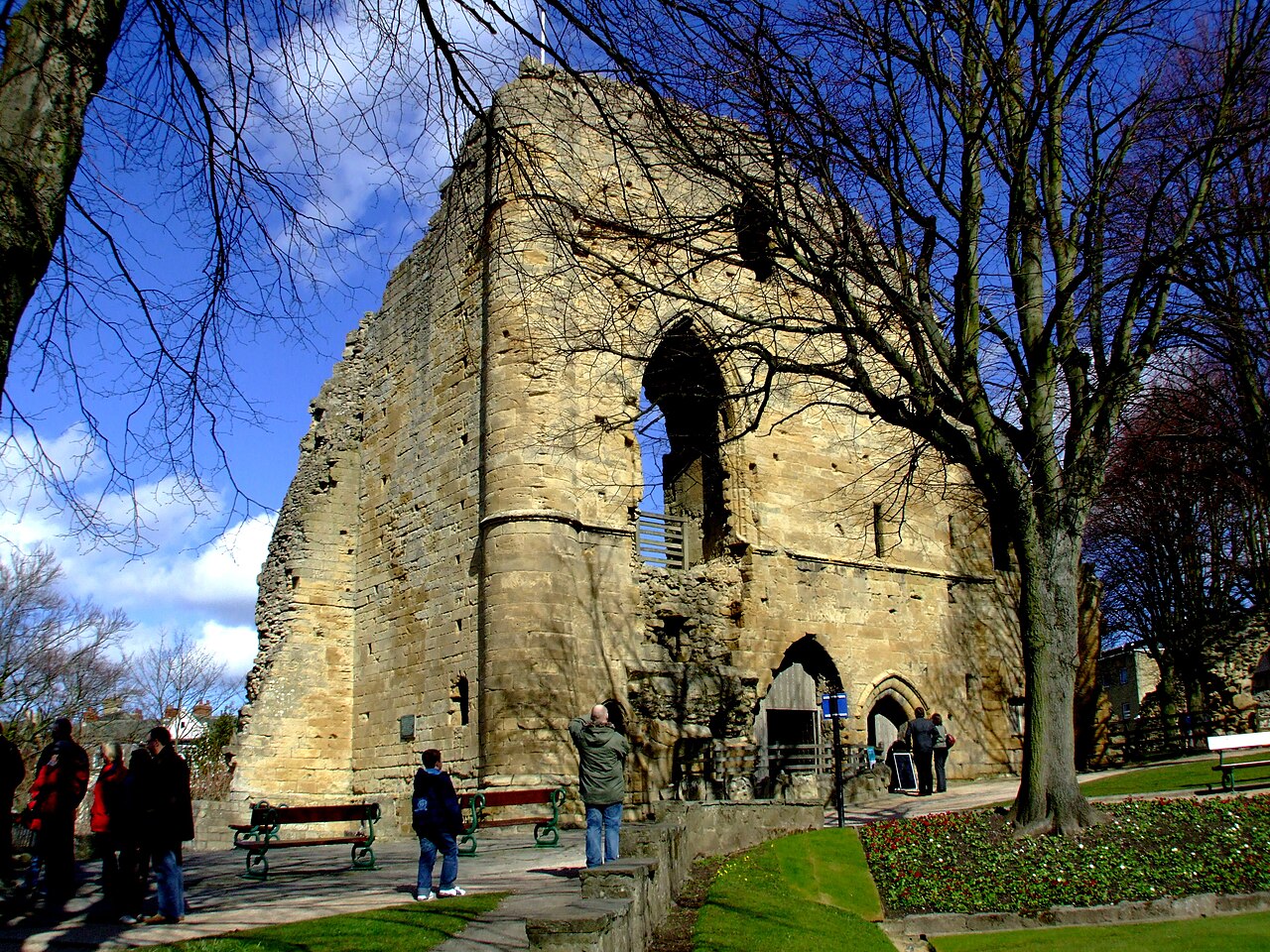
Knaresborough Castle is a ruined fortress overlooking the River Nidd in the town of Knaresborough, North Yorkshire, England.
The castle was first built by a Norman baron in c. 1100 on a cliff above the River Nidd. There is documentary evidence dating from 1130 referring to works carried out at the castle by Henry I. In the 1170s Hugh de Moreville and his followers took refuge there after assassinating Thomas Becket.
William de Stuteville was appointed as Governor of Knaresborough castle in Easter 1173. After de Stuteville's death in 1203, King John gave Hubert Walter, Archbishop of Canterbury, custody of all of William de Stuteville's lands and castles and the wardship of his son and heir Robert de Stuteville. However, Robert died in 1205 and William's brother Nicholas de Stuteville became William's heir. A charter dated at Lambeth 5 August 1205 confirmed that Nicholas had paid a fine of 10,000 marks for his inheritance, with the exception of the castles of Knaresborough and Boroughbridge, which were retained by the King.
The King regarded Knaresborough as an important northern fortress and spent £1,290 on improvements to the castle. In August 1304, Elizabeth of Rhuddlan, a daughter of Edward I, travelled from Linlithgow Palace to Knaresborough Castle. She gave birth to her son, Humphrey, in September, assisted by a holy relic of the girdle of the Virgin, brought especially from Westminster Abbey.
The castle was rebuilt at a cost of £2,174 between 1307 and 1312 by Edward I and completed by Edward II, including the great keep. Edward II gave the castle to Piers Gaveston and stayed there himself when the unpopular nobleman was besieged at Scarborough Castle.
Philippa of Hainault took possession of the castle in 1331, at which point it became a royal residence. The queen often spent summers there with her family. Her son, John of Gaunt acquired the castle in 1372, adding it to the vast holdings of the Duchy of Lancaster. Katherine Swynford, Gaunt's third wife, obtained the castle upon his death.
A detailed survey of the state of the castle buildings was made in 1561. The building was used by estate auditors and law courts were held in the hall.
The castle was taken by Parliamentarian troops in 1644 during the Civil War and largely destroyed in 1648, not as the result of warfare but because of an order from Parliament to dismantle all Royalist castles.
Text adapted from “Knaresborough Castle” on Wikipedia, CC BY-SA 4.0.
Knaresborough Castle ranks #1,979 of 9,079 worldwide in the atlas's castle fame ranking, and #133 of the 360 mapped in England. Founded 1100, it is older than 85% of the atlas's dated landmarks — one of 436 atlas entries founded in the 11th century. Its Wikipedia articles were opened 2,522 times in the last 60 days, more than 75% of the atlas. 4 more atlas landmarks stand within 25 km. The nearest day-trip guide is Sheffield, 70 km away. See how England compares in the castle statistics.
View on the interactive castle map →