 England · 11th century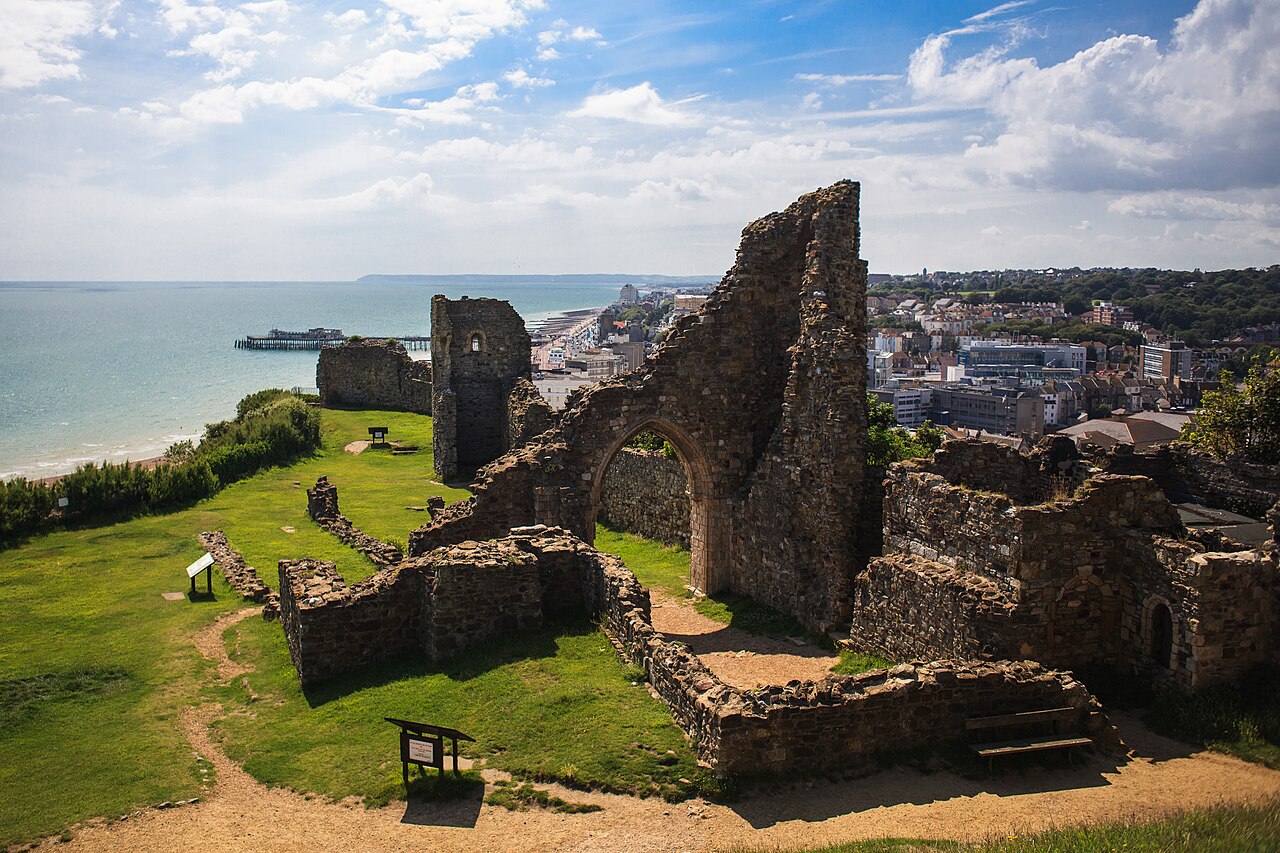
Hastings Castle is a keep and bailey castle ruin situated on the cliffs adjoining the town of Hastings, East Sussex. It overlooks the English Channel, into which large parts of the castle have fallen over the years.
Immediately after landing in England in 1066, William of Normandy ordered three fortifications to be built, Pevensey Castle in September 1066 (re-using the Roman Saxon Shore fort of Anderitum), Hastings (prior to the Battle of Hastings) and Dover. Hastings Castle was originally built as a wooden motte-and-bailey castle near the sea. Later that year, the famous Battle of Hastings took place some miles to the north of Hastings Castle, in which William was victorious. In 1070, William issued orders for the castle to be rebuilt in stone, along with the St Mary's Chapel.
The Counts of Eu held the castle for most of the Norman period, beginning with Robert. In 1216, King John gave orders to destroy (slight) the castles at Hastings and Pevensey, while he retreated from a French army that had landed in Kent under the leadership of Prince Louis of France. In 1220, Henry III re-fortified the castle.
In time however the house of Eu forfeited control of Hastings Castle, when the family heir William made the decision to keep his French assets over the English ones, and was denied the right to his inheritance. In 1249, Henry III bestowed rule of the castle and its lands, the Honour of Eu, to his wife's uncle, Peter of Savoy. Peter held the rights from 1249 until 1254, whence they passed to the Lord Edward, future Edward I of England. In 1262 and in need of funds, Edward quitclaimed the Honour and Hastings back to Peter who held the rights until his death in 1268.
In February 1287, violent storms hit the south coast of England with such force that the soft sandstone cliffs eventually succumbed to the elements. Large sections of the face fell into the sea along with parts of the castle.
In both 1339 and 1377, the town was attacked by the French leaving many burnt buildings which included homes. Throughout the next century erosion was unchecked and gradually more of the castle was lost to the sea.
The site was purchased by Thomas Pelham on 23 June 1591. After the purchase, the site was purchased by the Pelham family and used for farming until the ruins had become so overgrown they were lost from memory.
Text adapted from “Hastings Castle” on Wikipedia, CC BY-SA 4.0.
Hastings Castle ranks #1,957 of 9,079 worldwide in the atlas's castle fame ranking, and #130 of the 360 mapped in England. Founded 1066, it is older than 88% of the atlas's dated landmarks — one of 436 atlas entries founded in the 11th century. Its Wikipedia articles were opened 2,604 times in the last 60 days, more than 75% of the atlas. 6 more atlas landmarks stand within 25 km. The nearest day-trip guide is Eastbourne, 23 km away. See how England compares in the castle statistics.
View on the interactive castle map →