 England · 11th century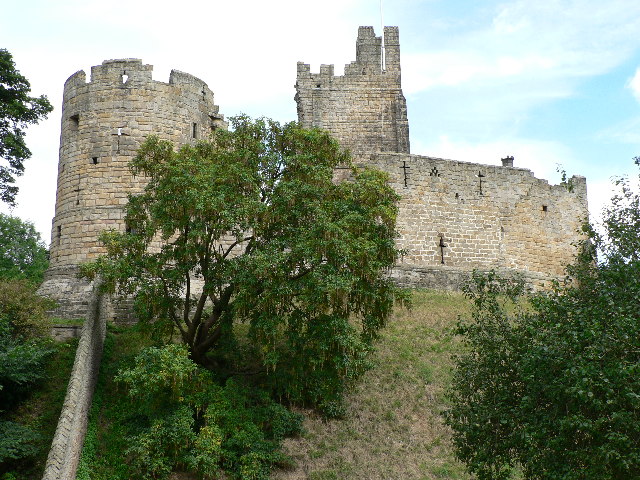
Prudhoe Castle is a ruined medieval English castle situated on the south bank of the River Tyne at Prudhoe, Northumberland, England. It is a Scheduled Ancient Monument and a Grade I listed building.
Archaeological excavations have shown that the first castle on the site was a Norman motte and bailey, built sometime in the mid 11th century. Following the Norman Conquest of England, the Umfraville family took over control of the castle. Robert d’Umfraville was formally granted the barony of Prudhoe by Henry I but it is likely that the Umfravilles had already been granted Prudhoe in the closing years of the 11th century. The Umfravilles (probably Robert) initially replaced the wooden palisade with a massive rampart of clay and stones and subsequently constructed a stone curtain wall and gatehouse.
In 1173 William the Lion of Scotland invaded the North East to claim the earldom of Northumberland. The head of the Umfraville family, Odinel II, refused to support him and as a result the Scottish army tried to take Prudhoe Castle. The attempt failed as the Scots were not prepared to undertake a lengthy siege. The following year William attacked the castle again but found that Odinel had strengthened the garrison, and after a siege of just three days the Scottish army left. Following the siege, Odinel further improved the defences of the castle by adding a stone keep and a great hall.
Odinel died in 1182 and was succeeded by his son Richard. Richard became one of the barons who stood against King John, and as a result forfeited his estates to the crown. They remained forfeited until 1217, the year after King John's death. Richard died in 1226 and was succeeded by his son, Gilbert, who was himself succeeded in 1245 by his son Gilbert. Through his mother, Gilbert II inherited the title of Earl of Angus, with vast estates in Scotland, but he continued to spend some of his time at Prudhoe. It is believed that he carried out further improvements to the castle. Gilbert took part in the fighting between Henry III of England and his barons, and in the Scottish expeditions of Edward I. He died in 1308 and was succeeded by his son, Robert D’Umfraville IV.
In 1314, Robert was taken prisoner by the Scots at Bannockburn, but was soon released, though he was deprived of the earldom of Angus and of his Scottish estates.
Text adapted from “Prudhoe Castle” on Wikipedia, CC BY-SA 4.0.
Prudhoe Castle ranks #2,195 of 9,079 worldwide in the atlas's castle fame ranking, and #152 of the 360 mapped in England. Founded c. 1050, it is older than 89% of the atlas's dated landmarks — one of 436 atlas entries founded in the 11th century. Its Wikipedia articles were opened 1,944 times in the last 60 days, more than 69% of the atlas. 15 more atlas landmarks stand within 25 km. The nearest day-trip guide is Newcastle upon Tyne, 16 km away. See how England compares in the castle statistics.
View on the interactive castle map →