 England · 14th century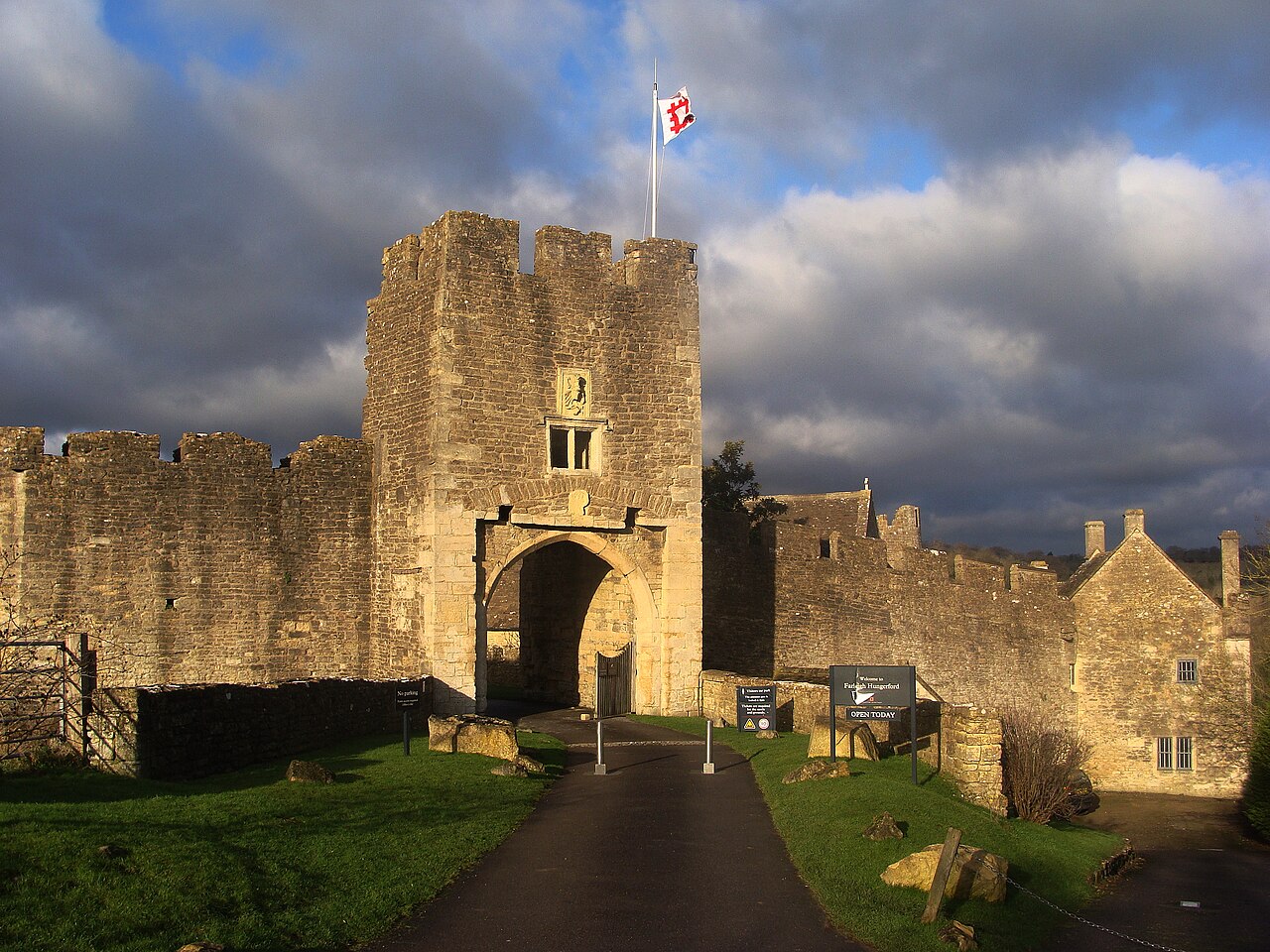
Farleigh Hungerford Castle, sometimes called Farleigh Castle or Farley Castle, is a medieval castle in Farleigh Hungerford, Somerset, England. The castle was built in two phases: the inner court was constructed between 1377 and 1383 by Sir Thomas Hungerford, who made his fortune as steward to John of Gaunt. The castle was built to a quadrangular design, already slightly old-fashioned, on the site of an existing manor house overlooking the River Frome. A deer park was attached to the castle, requiring the destruction of the nearby village. Sir Thomas's son, Sir Walter Hungerford, a knight and leading courtier to Henry V, became rich during the Hundred Years War with France and extended the castle with an additional, outer court, enclosing the parish church in the process. By Walter's death in 1449, the substantial castle was richly appointed, and its chapel decorated with murals.
The castle largely remained in the hands of the Hungerford family over the next two centuries, despite periods during the War of the Roses in which it was held by the Crown following the attainder and execution of members of the family. At the outbreak of the English Civil War in 1642, the castle, modernized to the latest Tudor and Stuart fashions, was held by Sir Edward Hungerford. Edward declared his support for Parliament, becoming a leader of the Roundheads in Wiltshire. Farleigh Hungerford was seized by Royalist forces in 1643, but recaptured by Parliament without a fight near the end of the conflict in 1645. As a result, it escaped slighting following the war, unlike many other castles in the south-west of England.
The last member of the Hungerford family to hold the castle, Sir Edward Hungerford, inherited it in 1657, but his gambling and extravagance forced him to sell the property in 1686.
Text adapted from “Farleigh Hungerford Castle” on Wikipedia, CC BY-SA 4.0.
Farleigh Hungerford Castle ranks #2,136 of 9,079 worldwide in the atlas's castle fame ranking, and #144 of the 360 mapped in England. Founded 1383, it is older than 53% of the atlas's dated landmarks — one of 755 atlas entries founded in the 14th century. Its Wikipedia articles were opened 2,083 times in the last 60 days, more than 70% of the atlas. 3 more atlas landmarks stand within 25 km. The nearest day-trip guide is Bristol, 26 km away. See how England compares in the castle statistics.
View on the interactive castle map →