 Japan · 17th century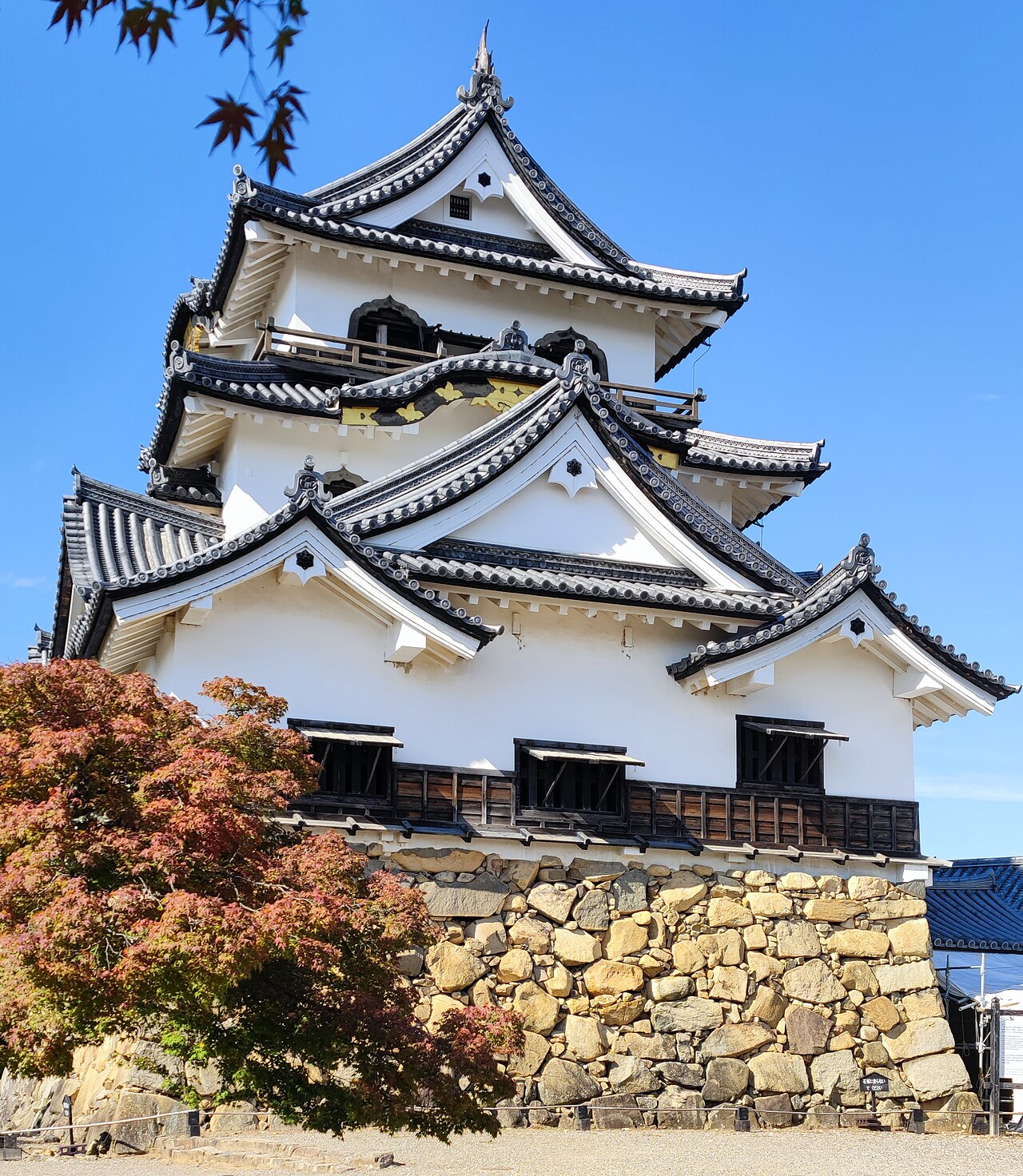
Hikone Castle (彦根城, Hikone-jō) is an Edo-period Japanese castle located in the city of Hikone, Shiga Prefecture, Japan. It is considered the most significant historical site in Shiga. The site has been protected as a National Historic Site since 1951. Hikone is one of only twelve castles in Japan with its original tenshu, and one of only five castles with buildings listed as National Treasures.
Hikone Castle is located one kilometer from Lake Biwa due to land reclamation, but originally the castle was directly on the lakeshore, and the north and east sides were surrounded by water. The Hikone area is in eastern Ōmi Province, and the site was a natural bottleneck on the route of the Tōsandō (later the Nakasendō) highway connecting Heian-kyō with the eastern provinces. Strategically, it was a vital point in protecting the capital from attack from the east. In the Sengoku period, this area was controlled by the Azai clan, who were based in northern Ōmi, and who built a castle called Sawayama Castle approximately two kilometers from this site.
The Azai were defeated by Oda Nobunaga, who assigned Sawayama Castle to his general Niwa Nagahide. Under Toyotomi Hideyoshi, this closest advisor, Ishida Mitsunari was entrusted with the castle. After Ishida Mitsunari was defeated at the Battle of Sekigahara in 1601, Tokugawa Ieyasu appointed his general Ii Naomasa as daimyō of a new domain centered at Sawayama Castle.
Ii Naomasa was one of the most capable and trusted of Ieyasu's generals, noted not only for his military prowess, but also for his diplomacy and strategies. At first, he used Sawayama Castle, but was not happy with its situation. The castle was considered obsolete and had weak defenses as it was divided between hilltop and hillside areas. Furthermore, it was formerly the stronghold of the enemy leader and had strong associations with the former regime. Therefore, Ii Naomasa decide to relocate his seat to a new location on the shores of Lake Biwa, constructing a new castle per the latest contemporary design. The site was previously occupied by a Buddhist temple called Hogon-ji which had been built in 1080 and which was a popular pilgrimage site for the worship of Kannon.
Hikone Castle consists of two concentric water moats surrounding a 100 meter hill called "Mount Konki".
Text adapted from “Hikone Castle” on Wikipedia, CC BY-SA 4.0.
Hikone Castle ranks #231 of 9,079 worldwide in the atlas's castle fame ranking, and #15 of the 296 mapped in Japan. Founded 1603, it is older than 31% of the atlas's dated landmarks — one of 721 atlas entries founded in the 17th century. Its Wikipedia articles were opened 24,796 times in the last 60 days, more than 98% of the atlas. 7 more atlas landmarks stand within 25 km. The nearest day-trip guide is Hikone, 1 km away. It is one of the 69 landmarks on the atlas's regional map of Kansai. See how Japan compares in the castle statistics.
View on the interactive castle map →