 England · 19th century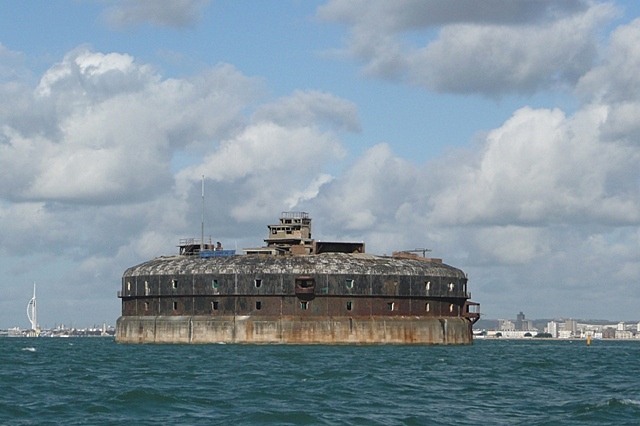
Horse Sand Fort or Horse Sands Fort is one of the larger Royal Commission sea forts in the Solent off Portsmouth, Hampshire, England. The fort is one of four built as part of the Palmerston Forts constructions. It is 200 feet (61 m) across, built between 1865 and 1880, with two floors and a basement and armour-plated all round.
Horse Sand Fort was designed by Captain E. H. Stewart, overseen by Assistant Inspector General of Fortifications, Colonel W. F. D. Jervois. Construction work began in 1865, and the fort was completed in 1880, long after the threat of a seaborne invasion from France had passed, at a cost of £424,694.
The original armament was to have been forty five 10-inch and 44 12.5-inch rifled muzzle-loading (RML) guns on the gun floors with 10 12-inch RMLs mounted on the roof in five turrets. In fact the turrets were never built and the limited space meant the 12.5-inch guns had to be operated with less than full charges of powder. In 1882, 12-inch rifled breech-loading guns were placed in alternate bays.
Horse Sand Fort was built on a ring of masonry consisting of large concrete blocks with an outer skin of granite blocks, the interior being filled with clay and shingle and covered with a thick layer of concrete. The lower foundation walls of the fort are 18 metres (59 ft) thick. The fort is split into three levels with the top measuring 62.4 metres (204 ft 9 in) in diameter. The floors would have originally provided storage of armoury and guns and the things needed to sustain the men that were stationed on site. The top of the fort consisted of a lighthouse and various chimneys and ventilators. The fort has its own artesian well which provided fresh water. The seaward side of the fort was covered in a heavy iron-armoured plating to protect it from seaborne attack. Access to the fort was by a wooden-decked landing stage supported on cast-iron piles.
In the late 19th century the Solent forts were painted in a black and white chequered paint scheme as an early form of dazzle camouflage. In its unrestored state remains of this pattern are still visible on parts of Horse Sand Fort.
Beginning in 1908, extensive submerged defences were built in the form of large concrete blocks running about 1.8 metres (5.9 ft) below sea level from the fort to the shore at Southsea.
Text adapted from “Horse Sand Fort” on Wikipedia, CC BY-SA 4.0.
Horse Sand Fort ranks #4,763 of 9,035 worldwide in the atlas's castle fame ranking, and #303 of the 360 mapped in England. Founded 1888, one of 705 atlas entries founded in the 19th century. Its Wikipedia articles were opened 2,865 times in the last 60 days, more than 77% of the atlas. 11 more atlas landmarks stand within 25 km. The nearest day-trip guide is Portsmouth, 6 km away. See how England compares in the castle statistics.
View on the interactive castle map →