 England · 19th century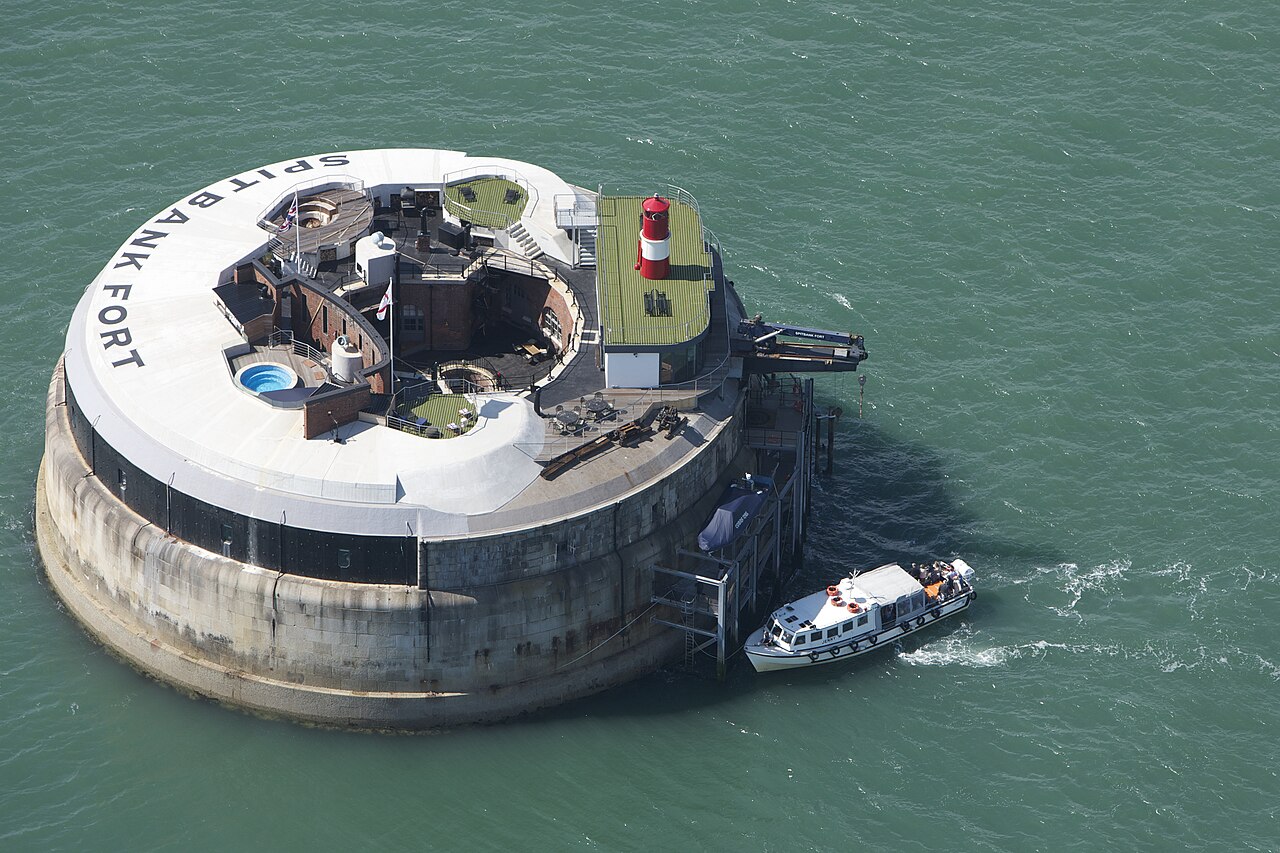
Spitbank Fort or Spitsand Fort or Spit Sand Fort or simply Spit Fort is a sea fort built as a result of the 1859 Royal Commission. The fort is one of four built as part of the Palmerston Forts constructions. Located in the Solent, near Portsmouth, England, and is now in private ownership following its sale after a period as a luxury hotel.
The four armour-plated forts were designed by Captain E. H. Stewart overseen by Assistant Inspector General of Fortifications, Colonel W. F. D. Jervois. Construction started in 1867, and was completed in 1878, at a cost of £167,300 STG.
Spitbank is smaller than the two main Solent forts, Horse Sand Fort and No Man's Land Fort. Its main purpose was as a further line of defence for ships that made it past the two main forts. It is 49.4 metres (162 ft) in diameter across at its base, with one floor and a basement and armour plating only on the seaward side. It was originally planned to have been armed with nine 10" 18-ton rifled muzzle loader (RML) guns on the seaward side, and six 7" seven-ton RML guns on the landward side. However, by the time of completion the plan had changed so that the seaward side received nine 12.5-inch muzzle-loading (RML) guns. From 1884 more modern 12-inch breechloading guns were installed and these were in service until after World War I.
In 1898 the role of the fort was changed to defend against light craft and the roof was fitted out with two 4.7" guns and searchlights. In the early 1900s all but three original large guns were removed. Minor upgrades to the smaller guns and searchlights continued through the years. A 2020 report stated that during the Second World War, "the forts were used to defend the Portsmouth dockyards. Life on site was grim; those serving were deliberately chosen for their inability to swim, to avoid any attempt to escape".
The fort remained unused after the abolition of coastal artillery in 1956. The fort was declared surplus to requirements in 1962, and put up for sale the following year unsuccessfully. The fort was declared a Scheduled Monument in 1967. The Ministry of Defence sold the fort to a private buyer in 1982, amid other defence spending cuts in the early 1980s.
Following the purchase of the fort, it underwent restoration and was opened to the public as a museum.
Beginning June 4, 2002 the fort was used as a location for Banged Up With Beadle.
Text adapted from “Spitbank Fort” on Wikipedia, CC BY-SA 4.0.
Spitbank Fort ranks #3,524 of 9,035 worldwide in the atlas's castle fame ranking, and #242 of the 360 mapped in England. Founded 1887, one of 705 atlas entries founded in the 19th century. Its Wikipedia articles were opened 7,412 times in the last 60 days, more than 91% of the atlas. 11 more atlas landmarks stand within 25 km. The nearest day-trip guide is Portsmouth, 4 km away. See how England compares in the castle statistics.
View on the interactive castle map →