 England · 19th century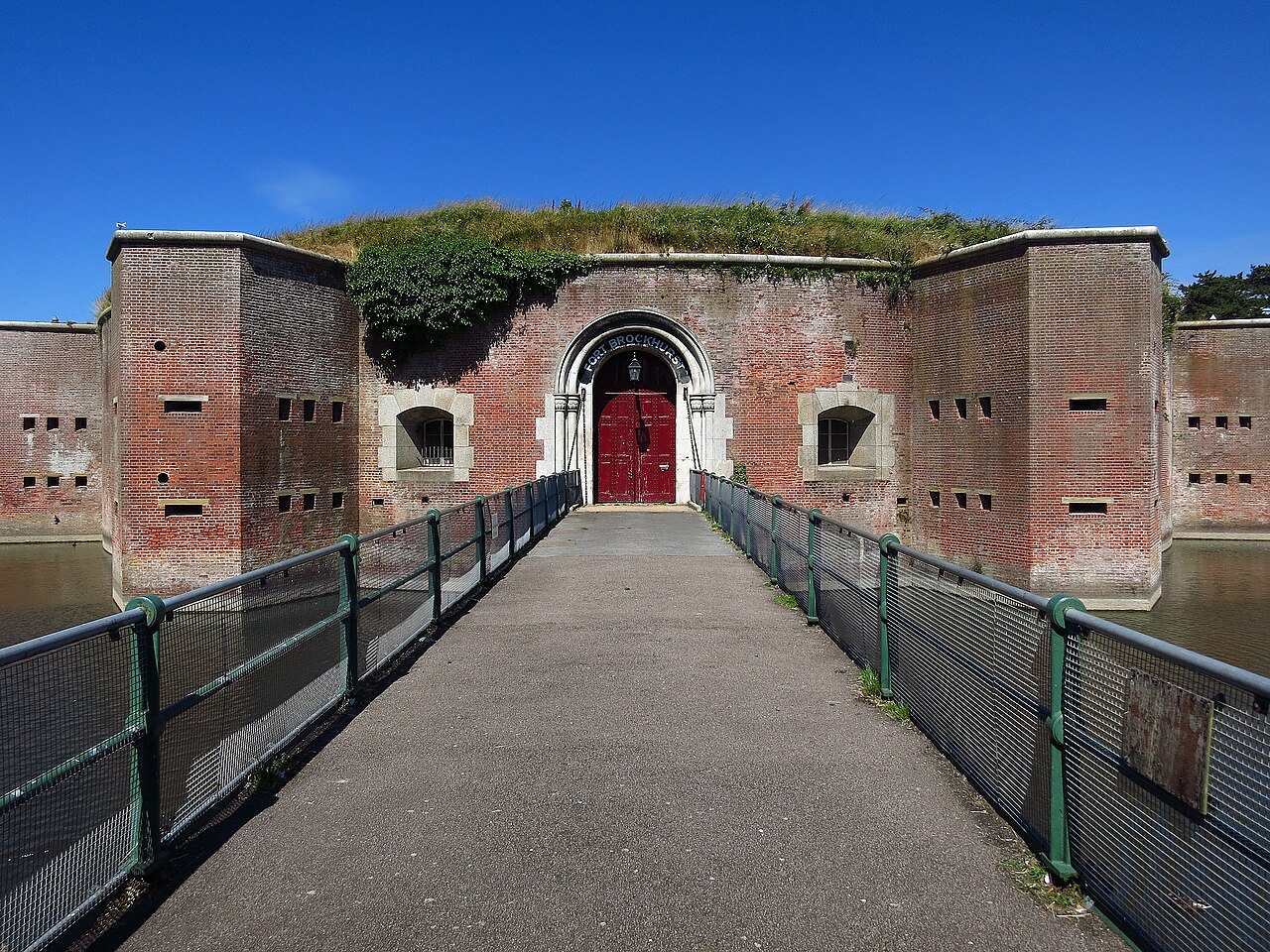
Fort Brockhurst is one of the Palmerston Forts, in Gosport, England, and a scheduled monument. It is now an English Heritage property.
Fort Brockhurst was designed by William Crossman in the 19th century to protect Portsmouth. Built between 1858 and 1862, it was one of a chain of five similar forts known as the Gosport Advanced Line. The other forts are Fort Elson to the north and Fort Grange, Fort Rowner and Fort Gomer to the south. With their formidable firepower, their main purpose was to guard the dockyards from potential attack from landing areas on the Hampshire coast. Construction took place amid fears of a French invasion at the time, which, in the event, never occurred.
Changes in artillery technology meant that the fort was obsolete before construction was even completed. Increases in range left the fort too close to the dockyard, meaning that a landing force that had arrived elsewhere on the coast would not need to pass the fort in order to bombard Portsmouth harbour. This was the reason for the construction of Fort Fareham at a greater distance from the harbour, which was completed six years later in 1868.
From 18 September 1882 onwards, it was used as a depot, to demobilise soldiers returning from India, whose time period of active service had come to an end. In 1898, on average from 9,000 to 10,000 soldiers were passing through on an annual basis. During the 1880s, it used to take fully a week to get a big detachment through the depot, but in subsequent years the soldier was only spending several days at the depot, prior to their transfer to the Army Reserve, and civilian life. When all necessary formalities had been completed, the ex-soldier was marched to Fort Brockhurst railway station, to take the train to their home.
In August 1914, 9th (Heavy) Battery Royal Garrison Artillery was formed at the fort as part of the raising of Kitchener's Army. It suffered minor bomb damage during the Second World War, but never saw action under its intended purpose. The fort did remain in commission however until 1957, serving variously as accommodation, storage and training facilities.
Although modern life has encroached on the fort, its fabric remains largely unaltered and the parade ground, gun ramps and moated keep can all be viewed.
Text adapted from “Fort Brockhurst” on Wikipedia, CC BY-SA 4.0.
Fort Brockhurst ranks #7,915 of 9,035 worldwide in the atlas's castle fame ranking, and #359 of the 360 mapped in England. Founded 1858, it is older than 7% of the atlas's dated landmarks, one of 705 atlas entries founded in the 19th century. 12 more atlas landmarks stand within 25 km. The nearest day-trip guide is Portsmouth, 5 km away. See how England compares in the castle statistics.
View on the interactive castle map →