Palace
Jabłonna Palace
 Poland · 18th century
- Founded
- 1779
- Architect
- Domenico Merlini
- Location
- Jabłonna
- Coordinates
- 52.37472°, 20.91417°
- Open data
- Wikidata Q1149917
Description
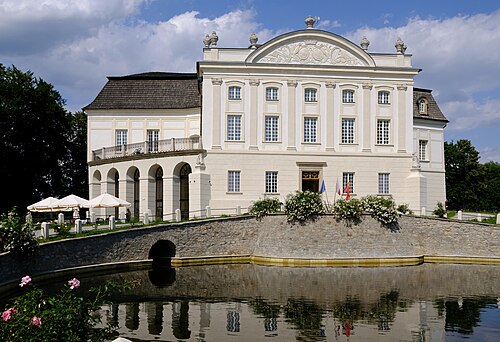
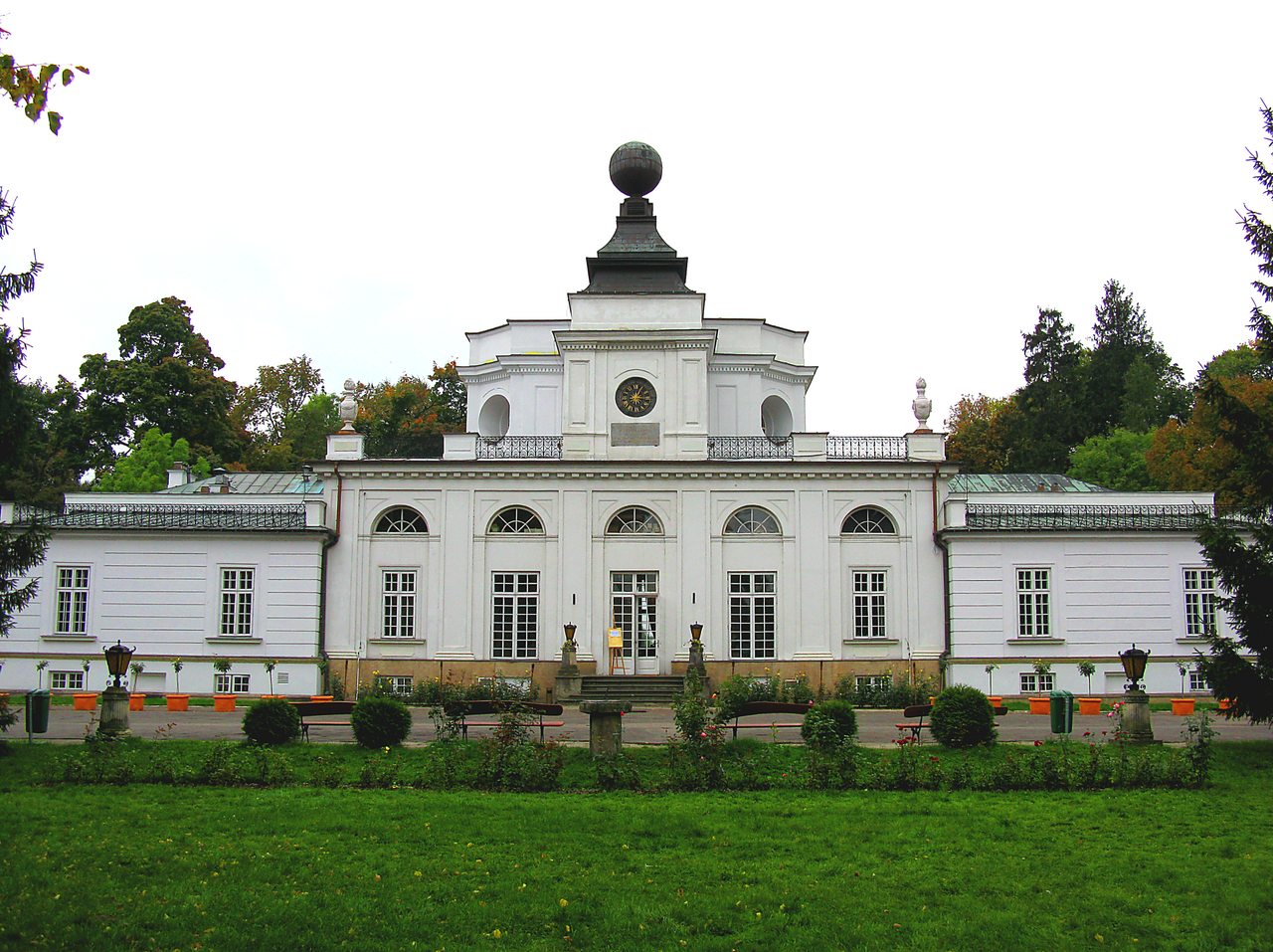
Jabłonna Palace (Polish: Pałac w Jabłonnie) is a palace, hotel and publicly accessible park-complex in Jabłonna near Warsaw in Poland whose uses include conferences and weddings.
During the Middle Ages, Jabłonna was the property of the Bishops of Płock, who built a summer residence here in the 15th century. In 1773 the brother of the King Stanisław August - Michał Poniatowski, then Bishop of Płock and later the primate of Poland, bought the property in Jabłonna with the intention of turning it into an elegant palace-and-park residential complex. In 1774 he commissioned the royal architect, Dominik Merlini, to design the new residence. The construction of a three-building complex was proposed: a one-storey palace, which was intended to be the residence of the owner, was to be situated in the middle and flanked on both sides by separate three-storey pavilions.
A scenic English-style park was developed in the 1770s and 1780s, based on the design of architect Szymon Bogumił Zug. The same architect also constructed a series of pavilions, of which three still remain today: the Grotto, the Orangerie and the Chinese Pavilion.
Originally, the central palace combined the austerity of the classical style with the baroque picturesqueness.
Over the next 40 years the buildings were extensively remodelled and added to, coinciding with a number of changes of ownership. In 1837 the palace was rebuilt according to the design of Henryk Marconi.
Jabłonna Palace was owned by the Potocki family until 1945. In 1944 the palace was burnt by the German army. Since 1953, Jabłonna has been owned by the Polish Academy of Sciences. Under its auspices the palace was transformed into the conference and recreational centre. The reconstruction of the palace was executed according to the design of Mieczysław Kuźma, and the reconstruction of the park according to the design of Gerard Ciołek. In the course of this renovation, the central part of the palace was restored to look as it did at the end of the 18th century, while its side parts, added in the first half of the 19th century, retained their original appearance.
The furnishing and decoration of the palace interior was completed after 1945. The representative halls and chambers of the palace were decorated with old furniture and paintings from the end of the 18th and the first half of the 19th centuries.
Text adapted from “Jabłonna Palace” on Wikipedia, CC BY-SA 4.0.
In the rankings
Jabłonna Palace ranks #4,981 of 9,040 worldwide in the atlas's castle fame ranking, and #186 of the 397 mapped in Poland. Founded 1779, it is older than 13% of the atlas's dated landmarks, one of 685 atlas entries founded in the 18th century. Its Wikipedia articles were opened 1,514 times in the last 60 days, more than 62% of the atlas. 45 more atlas landmarks stand within 25 km. The nearest day-trip guide is Warsaw, 17 km away. See how Poland compares in the castle statistics.
Castles nearby
- Big Fort of Zegrze Fortress12 km · Poland
- Fort Sokolnického13 km · Poland
- Small Fort of Zegrze Fortress13 km · Poland
- Warsaw Citadel14 km · Poland
More castles in Poland
- Kurozwęki PalacePoland · 14th century
- Antonin PalacePoland · 19th century
- Nowy Dwór Castle in WałbrzychPoland · 14th century
- Kamienna Góra CastlePoland · 14th century