 England · 13th century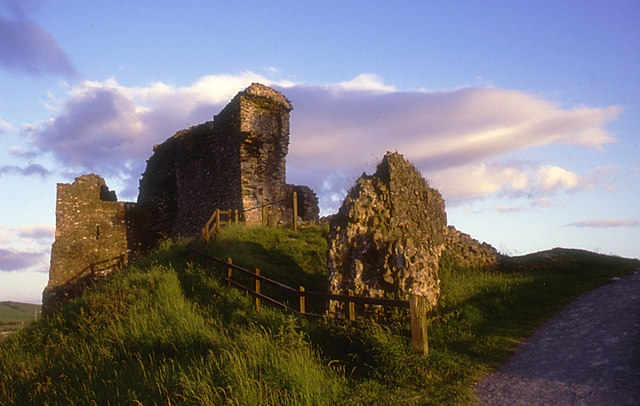
Kendal Castle is a medieval fortification to the east of the town of Kendal, Cumbria, in northern England. The castle, which is atop a glacial drumlin, was built in the 13th century as the Caput baroniae for the Barony of Kendal. By the 15th century, the Parr family owned the castle.
The earliest reference to a castle at Kendal occurs in 1216 and might refer either to the surviving stone castle at Kendal or the older castle in the town, Castle Howe.
The castle was built in the late 12th century as the home of the Lancaster family who were Barons of Kendal. The best-known family associated with the castle was the Parr family; including Queen Catherine Parr, the sixth wife of King Henry VIII of England. Her family had lived at Kendal since her ancestor Sir William Parr (c. 1350–1405) married the heiress of Kendal, Elizabeth Ros, during the reign of Edward III of England. By the time Catherine Parr was born, the family had long deserted the castle which was already falling into disrepair. Catherine's father Sir Thomas Parr preferred to live in the centre of court in London.
Her grandfather Sir William Parr (1434–1483) seems to be the last of the Parrs to have lived at Kendal Castle. Queen Catherine Parr was once thought to have been born at the castle; however, modern research has shown that it was in great disrepair by the 16th century and she was most likely born in Blackfriars, London.
The Parr family had their properties, including Kendal Castle, confiscated by the Crown in 1566.
Poet John Keats visited the ruins on a walking tour of the Lakes in the summer of 1818. He and his companion Charles Brown stayed the previous night at Endmoor. They then walked on to Windermere.
The castle is roughly circular, and is bounded by an 26-metre (85 ft) wide ditch. The curtain wall was roughly circular, with three mural towers unevenly spaced around the circuit, and a gatehouse on the north side of the castle; in the interior, to the east of the entrance was a hall with a tower further to the east. An assessment by the Royal Commission on Historical Monuments of England in the first half of the 20th century suggested that the hall was built in the 14th century.
A small excavation led by J. E. Spence and involving pupils from Heversham Grammar School was carried out on the site of the gatehouse in 1951.
Text adapted from “Kendal Castle” on Wikipedia, CC BY-SA 4.0.
Kendal Castle ranks #2,094 of 9,079 worldwide in the atlas's castle fame ranking, and #140 of the 360 mapped in England. Founded c. 1250, it is older than 67% of the atlas's dated landmarks — one of 1080 atlas entries founded in the 13th century. Its Wikipedia articles were opened 2,776 times in the last 60 days, more than 76% of the atlas. 4 more atlas landmarks stand within 25 km. See how England compares in the castle statistics.
View on the interactive castle map →