Castle
Lumley Castle
ENG England · 14th century
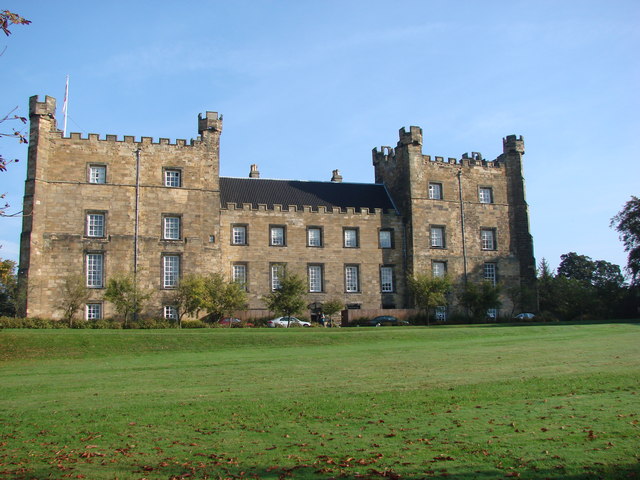
Lumley Castle is a 14th-century quadrangular castle at Chester-le-Street in the North of England, near the city Durham, and a property of the Earl of Scarbrough. It is a Grade I listed building. It is currently a hotel and sits on the banks of the Lumley Park Burn, tributary of the River Wear. The sundial located at Lumley Castle is Grade II listed.
It is named after its original creator, Sir Ralph Lumley, who converted his family manor house into a castle in 1389 after returning from wars in Scotland. However, after being implicated in a plot to overthrow Henry IV, he was imprisoned and ultimately executed, forfeiting his lands to the Earl of Somerset. In 1421 the ownership of the castle reverted to Sir Ralph Lumley's grandson, Thomas.
During the time of John Lumley, 1st Baron Lumley, he altered the windows of the castle to let more light in, installed a new fireplace in the great hall along with a lavabo of black and white marble, adorned by a pelican, which is the crest of the Lumley coat of the arms. On the accession of James VI and I as King of England in 1603, he journeyed from Edinburgh to London to take his new throne. On 13 April, en route from Newcastle upon Tyne to Durham, he stopped briefly at the castle as a guest of Lord Lumley. The King James Suite hotel room commemorates this connection with the king. However, the suite was previously the chapel; the king did not stay at Lumley overnight, instead travelling later that day and staying at Durham Castle.
Although there are no documents to prove it, the Georgian alterations to the castle are attributed to Sir John Vanbrugh, particularly the library, which is now the Black Knight Restaurant.
By the nineteenth century, the castle had become the residence of the Bishop of Durham, after Bishop Van Mildert gave his residence of Durham Castle to the newly founded University of Durham. The castle thus became a hall of residence for University College, Durham. Castlemen, as the students of University College are known, spent their first year at Lumley Castle and subsequent years in the Castle at Durham. Lumley Castle was sold in the 1960s by University College to fund the building of the 'Moatside' residential halls in central Durham, in order to keep all students on the same site. The role of Lumley Castle in University College's history is still commemorated by students in the biannual 'Lumley Run'.
Text adapted from “Lumley Castle” on Wikipedia, CC BY-SA 4.0.
Lumley Castle ranks #2,067 of 8,134 worldwide in the atlas's castle fame ranking, and #140 of the 333 mapped in England. Founded 1389, it is older than 55% of the atlas's dated landmarks — one of 604 atlas entries founded in the 14th century. Its Wikipedia articles were opened 3,063 times in the last 60 days, more than 76% of the atlas. 12 more atlas landmarks stand within 25 km. The nearest day-trip guide is Sunderland, 12 km away. See how England compares in the castle statistics.
View on the interactive castle map →Frequently asked questions
Where is Lumley Castle?
Lumley Castle stands in England, at 54.8547°, -1.55293°.
When was Lumley Castle built?
The atlas dates its founding to 1389. Earlier structures may have stood on the site; this is the earliest documented founding year.
How famous is Lumley Castle?
In this atlas's fame ranking: #2,067 of 8,134 worldwide, and #140 in England. Fame here combines how many Wikipedia language editions cover a landmark with how many people read them.
What is the nearest castle to Lumley Castle?
Lambton Castle, about 2 km away.
More castles in England
- Stokesay Castle England · 13th century
- Bothal Castle England
- Muncaster Castle England · 13th century
- Bungay Castle England · 11th century
More castles
- Oystermouth Castle Wales · 12th century
- Portumna Castle Ireland · 17th century
- Newgate England
- Cadbury Castle England