 Japan · 12th century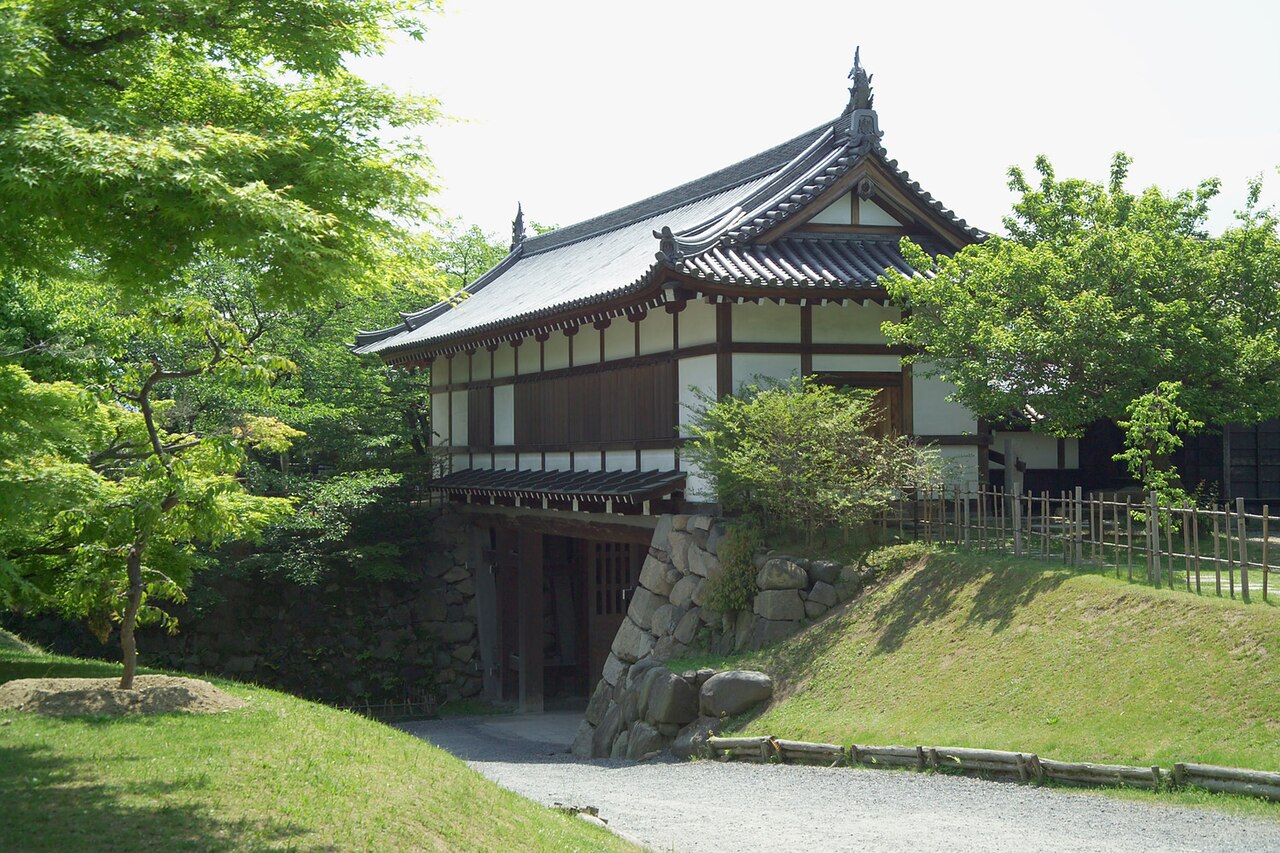
Kōriyama Castle (郡山城, Kōriyama-jō) is a flatlands-style Japanese castle located in the city of Yamatokōriyama, Nara Prefecture, Japan. Its ruins have been protected as a National Historic Site since 2023. It is No.194 on the list "Continued 100 Fine Castles of Japan".
Kōriyama Castle is located at the center of the Nara Basin on the southern end of the Saikyo Hills, on a peninsula protected by the Akishino and Tomio Rivers. The site appears to have been a physic garden in the Nara period, and the first record of a fortification dates from the late 10th century. During the Sengoku period, it was extensively remodeled by Tsutsui Junkei (1549-1584), a local petty warlord who had previously been a general commanding the sōhei (armed monks) of Kofuku-ji. The clan controlled central Yamato Province, but were defeated by Matsunaga Hisahide. Kōriyama Castle was taken by Matsunaga Hisahide, but was soon recovered by Tsutsui Junkei.
After Matsunaga Hisahide failed rebellion against Oda Nobunaga, Tsutsui Junkei was awarded all of Yamato Province. Oda Nobunaga ordered him to consolidate his castles, and he selected Koriyama as his stronghold. Following the assassination of Nobunaga in 1582, Tsutsui remained neutral in Toyotomi Hideyoshi's battle against Akechi Mitsuhide, and was awarded with confirmation in his existing territory. However, after Tsutsui Junkei's death, his successor was transferred to Iga Province in 1585 and Kōriyama was awarded to Hideyoshi's younger brother, Toyotomi Hidenaga. Hidenaga significantly expanded Kōriyama Castle to have the prestige suitable for the brother of Hideyoshi, and the shape of the current castle was completed at this time.
The basic layout was like a whirlpool, with secondary and outer enclosures surrounding the central bailey, which had a tenshu constructed in its northwest corner and the main gate at the southeast edge. Since Yamato lacked high-quality stone, each household in the area was required to provide 20 loads of stones. Stone Buddhist statues, gravestones, and stone pagodas from temples were robbed to provide building materials. Among the stones used were foundation stones the Rajōmon of Heijō-kyō, and stone Buddhas from the "Zōtō", a pyramidical Buddhist ruin from around the 8th century in Nara city.
Text adapted from “Kōriyama Castle” on Wikipedia, CC BY-SA 4.0.
Kōriyama Castle ranks #1,251 of 9,079 worldwide in the atlas's castle fame ranking, and #61 of the 296 mapped in Japan. Founded 1162, it is older than 79% of the atlas's dated landmarks — one of 756 atlas entries founded in the 12th century. Its Wikipedia articles were opened 9,142 times in the last 60 days, more than 93% of the atlas. 5 more atlas landmarks stand within 25 km. The nearest day-trip guide is Osaka, 26 km away. It is one of the 69 landmarks on the atlas's regional map of Kansai. See how Japan compares in the castle statistics.
View on the interactive castle map →