 South Korea · 17th century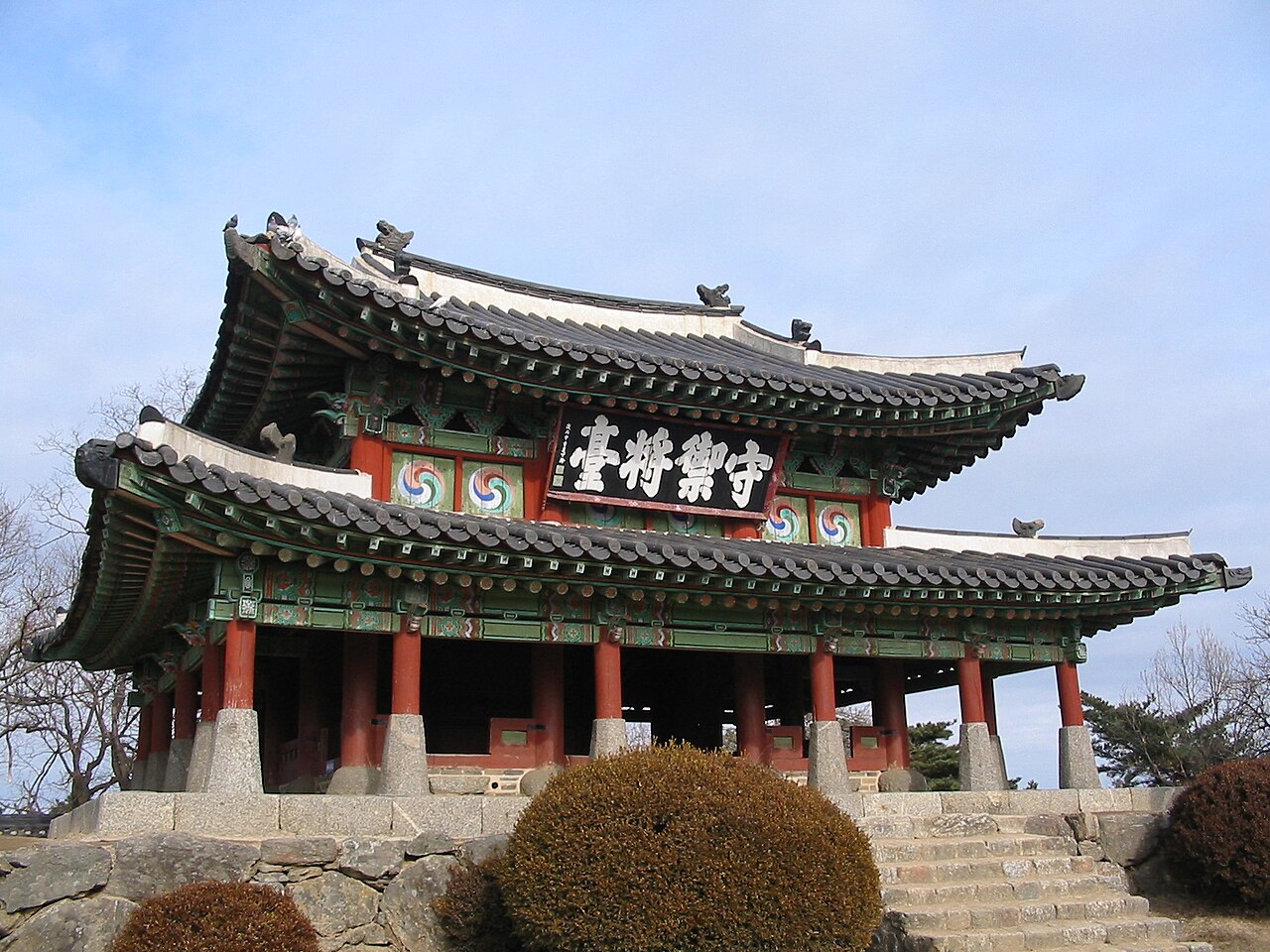
Namhansanseong (Korean: 남한산성; Hanja: 南漢山城) is a historic Korean fortress city in Gwangju, Gyeonggi Province, South Korea. A UNESCO World Heritage Site, the fortress lies atop the mountain Namhansan and stretches 12 km in length. It served as an emergency capital city during the 1392–1910 Joseon period. The design is based on fortress architecture of East Asia, embodying aspects of four historical cultural styles: Joseon of Korea, the Azuchi-Momoyama Period of Japan, and Ming and Qing China.
It was extensively developed during the 16th to 18th centuries, a period of continuous warfare. The technical development of weaponry and armaments during this period, which saw the use of gunpowder imported from Europe, also greatly influenced the architecture and layout of the fortress. Namhansanseong portrays how the various theories of defense mechanisms in Korea were put to form by combining the everyday living environment with defense objectives. The fortress indicates how Buddhism played an influential role in protecting the state, and it became a symbol of sovereignty in Korea.
It can be accessed from Seoul through Namhansanseong station of Seoul Subway Line 8.
Text adapted from “Namhansanseong” on Wikipedia, CC BY-SA 4.0.
Namhansanseong ranks #490 of 9,079 worldwide in the atlas's castle fame ranking, and #6 of the 57 mapped in South Korea. Founded c. 1650, it is older than 25% of the atlas's dated landmarks — one of 721 atlas entries founded in the 17th century. Its Wikipedia articles were opened 6,221 times in the last 60 days, more than 89% of the atlas. 11 more atlas landmarks stand within 25 km. The nearest day-trip guide is Seoul, 19 km away. See how South Korea compares in the castle statistics.
View on the interactive castle map →