 South Korea · 14th century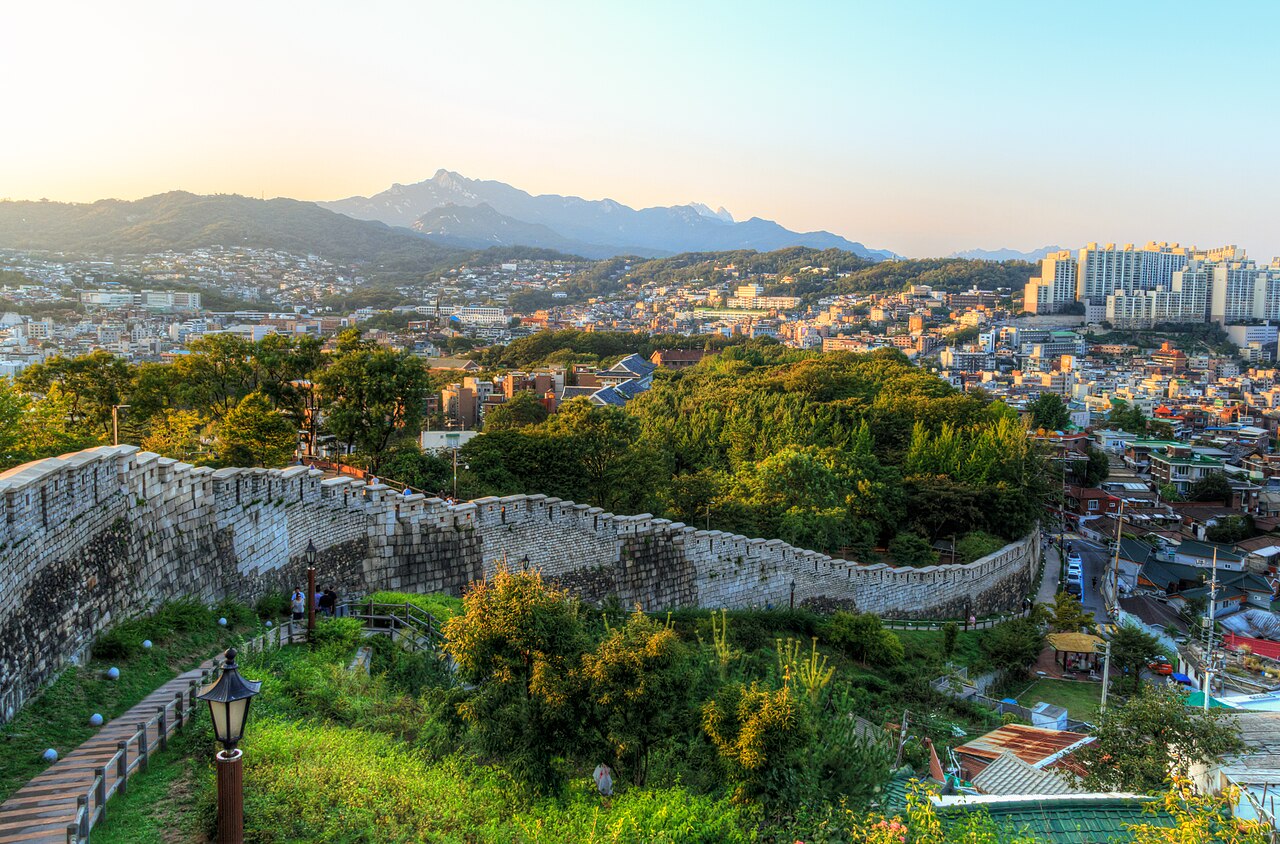
The Seoul City Wall (Korean: 서울 성곽) or Hanyang Doseong (한양도성) is a defensive wall first built by the King Taejo of Joseon dynasty to defend the downtown area of Joseon's capital city Hanseong (한성; 漢城). It was designated as a Historic Site of South Korea in 1963, and is currently a tourist attraction around Downtown Seoul.
Construction of the Seoul City Wall was launched in 1395, and significant part of the whole City Wall was completed in 1396, including the Eight Gates. While the City Wall was continuously fortified through almost the entire history of the Joseon dynasty period, its history of fortification can be divided into three major periods during the 14th, 15th and 18th centuries.
In the early era of Joseon, one of major function of the City Wall was as an administrative demarcation distinguishing the downtown area of the capital city named as Seong-jung (성중; 城中) or Doseong-an (도성 안; lit. 'inside the fortress'), from urban peripheral areas named as Seongjeosimni (성저십리; 城底十里; lit. '10 ri's around the fortress'). After Joseon suffered an invasion from Japan in the 1590s by Toyotomi Hideyoshi and another invasion almost 40 years later by the Qing Empire, the City Wall was redeveloped during late Joseon period to strengthen military functions.
During the colonial era of Joseon under the Japanese empire, significant parts of the City Wall and its gates were demolished by the Japanese colonial government to modernize the cityscape of Seoul. One notable demolition is the west gate of the City Wall, Seodaemun. However, even through this period of harsh modernization, much of the City Wall survives to the present day in the Jongno and Jung districts of Seoul, it is now preserved as Historic Sites of South Korea. The City Wall is a famous tourist attraction, and still functions as a cultural boundary distinguishing Seoul's original city center of Downtown Seoul from other parts of Seoul city.
The original walls, built in the late 14th century, were constructed of medium-sized round stones held together by mud. During King Sejong the Great's reign in the mid-15th century, a large-scale refurbishment work was carried out on the wall, including the replacement of earthen wall sections with rectangular stone sections.
Text adapted from “Seoul City Wall” on Wikipedia, CC BY-SA 4.0.
Seoul City Wall ranks #1,017 of 9,035 worldwide in the atlas's castle fame ranking, and #8 of the 57 mapped in South Korea. Founded 1396, it is older than 52% of the atlas's dated landmarks, one of 757 atlas entries founded in the 14th century. Its Wikipedia articles were opened 4,053 times in the last 60 days, more than 83% of the atlas. 13 more atlas landmarks stand within 25 km. The nearest day-trip guide is Seoul, 2 km away. See how South Korea compares in the castle statistics.
View on the interactive castle map →