Castle
Nassenfels Castle
🇩🇪 Germany · 13th century
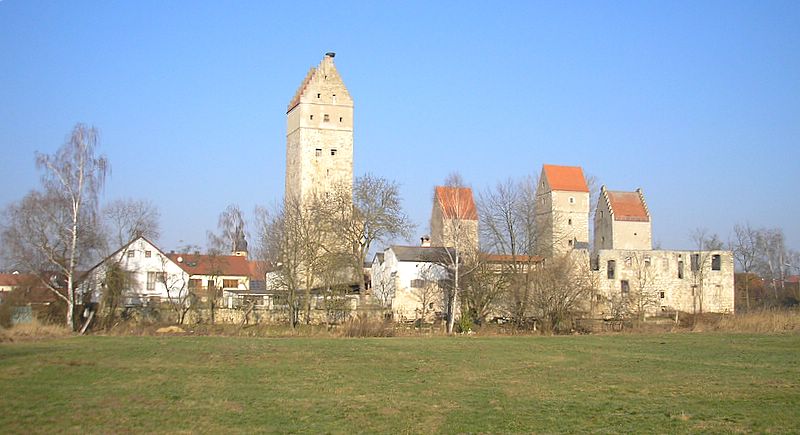
Nassenfels Castle (German: Burg Nassenfels) stands at the edge of the market village of Nassenfels in the county of Eichstätt in Upper Bavaria. The former water castle is still lived in and may only be viewed from the outside.
Nassenfels was already an important market village (known as Vicus Scutarensium) in the hinterland of the Rhaetian Limes in the 2nd century AD and was protected by a small castellum. The Roman camp was probably abandoned after the establishment of nearby Pfünz Roman Fort (Vetoniana). During the Hungarian invasions of the 10th century, the ramparts of the old fortification were probably expanded to form a refuge castle.
From the High Middle Ages the village belonged to the Bishopric of Eichstätt. The castle first appears in the records in 1245 in a deed, when Count Gebhard of Hirschberg was murdered by his court jester during the siege of the fortress. Episcopal vassals with the surname von Nassenfels are, however, recorded from 1198 onwards, but disappear again from literary sources in the mid-14th century.
The present castle goes back mainly to its expansion under Bishops Conrad II of Pfeffenhausen (1297–1305) and Frederick IV of Oettingen (c. 1400). In 1699, the prince-bishop's court architect, Jakob Engel, built the Kastenhaus in the southeastern corner as an office building for the episcopal steward (Kastner). Until 1804, the castle served as the seat of Eichstätt officials (Amtmänner and pfleger. In the wake of secularisation, a revenue office (Rentamt) was created in the rooms for 2 years. In 1806, the Bavarian state sold the complex to private buyers, who built their own houses against the enceinte and demolished several buildings.
In 1867, stone taken away to be used to build the stations of Adelschlag and Tauberfeld. In 1932, the Kastenhaus, with its stuccoed ceilings, was razed by a lightning strike. Plans to rebuild it came to nothing. In 1990, part of the chemin de ronde was reconstructed. Since the 1980s, the four Jura houses in the castle grounds have been restored.
Today the interior of the castle is only open to the public on special occasions, because the structures of the late 18th and early 19th centuries are still used as residences and for trade (some holiday apartments and restoration workshop).
The rectangular castle lies on the southern edge of the market village.
Text adapted from “Nassenfels Castle” on Wikipedia, CC BY-SA 4.0.
Nassenfels Castle ranks #6,190 of 8,134 worldwide in the atlas's castle fame ranking, and #473 of the 505 mapped in Germany. Founded 1245, it is older than 73% of the atlas's dated landmarks — one of 861 atlas entries founded in the 13th century. 3 more atlas landmarks stand within 25 km. The nearest day-trip guide is Munich, 78 km away. See how Germany compares in the castle statistics.
View on the interactive castle map →Frequently asked questions
Where is Nassenfels Castle?
Nassenfels Castle stands in Germany, at 48.79607°, 11.22917°.
When was Nassenfels Castle built?
The atlas dates its founding to 1245. Earlier structures may have stood on the site; this is the earliest documented founding year.
How famous is Nassenfels Castle?
In this atlas's fame ranking: #6,190 of 8,134 worldwide, and #473 in Germany. Fame here combines how many Wikipedia language editions cover a landmark with how many people read them.
What is the nearest castle to Nassenfels Castle?
Schloss Neuburg (Bayern), about 7 km away.
More castles in Germany
- Brüggen Castle Germany · 13th century
- Breitenstein Castle Germany · 13th century
- Burg Wildenburg (Eifel) Germany · 13th century
- Campen castle Germany · 13th century
More castles
- Burg Wernerseck Germany · 15th century
- Altrathen Castle Germany · 13th century
- Stettenfels Castle Germany · 10th century
- Burg Bodenstein Germany