 Northern Cyprus · 16th century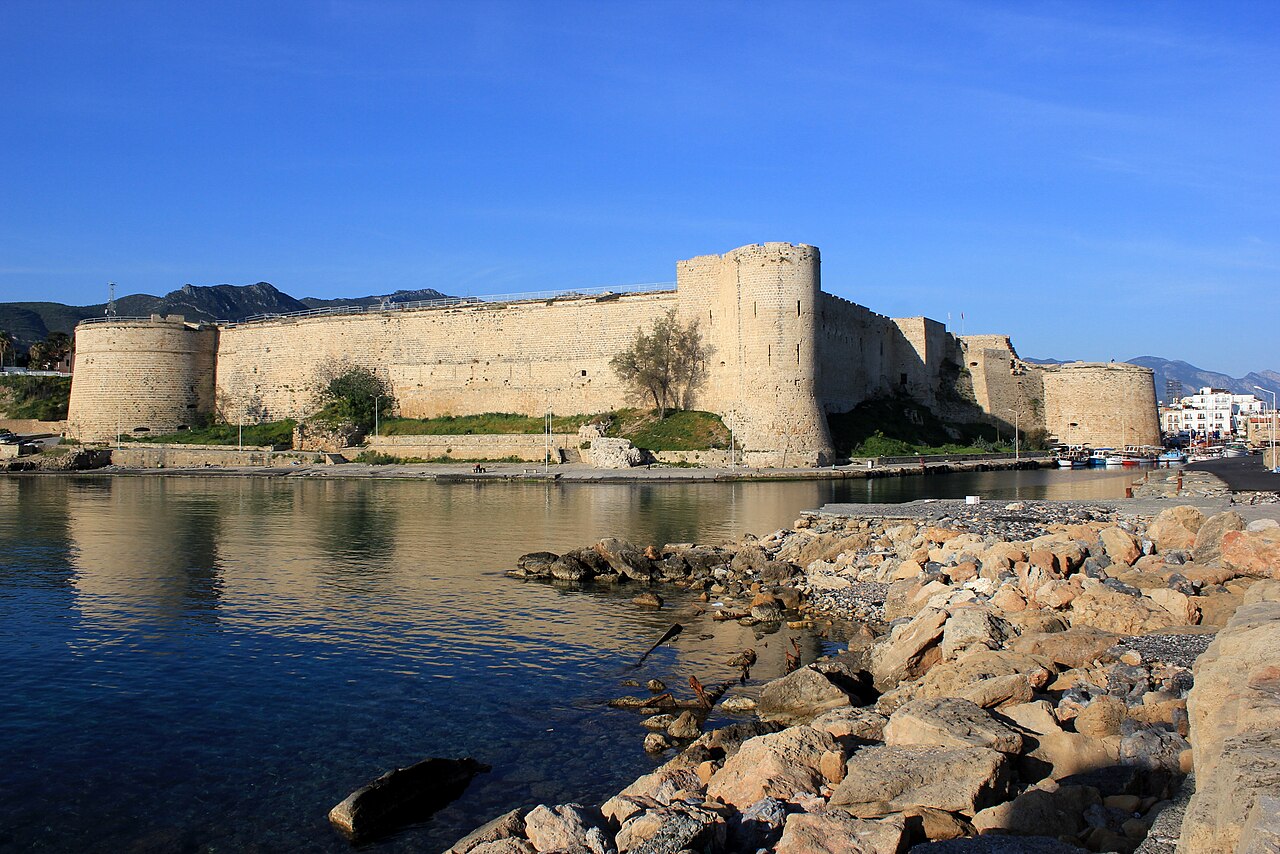
Kyrenia Castle (Greek: Κάστρο της Κερύνειας Turkish: Girne Kalesi) is a 16th-century castle in the north of Cyprus, built by the Venetians over a previous Crusader fortification. Within its walls is a twelfth-century chapel showing reused late Roman capitals, and the Shipwreck Museum.
Kyrenia has existed since the 10th century BC. Excavations have revealed Greek traces that date back to the 7th century BC, but the site was developed into a city under Roman rule.
Research carried out at the site suggests that the Byzantines built the original castle in the 7th century to guard the city against the new Arab maritime threat. The first historical reference to the castle occurs in 1191, when King Richard I of England captured it on his way to the Third Crusade by defeating Isaac Komnenos, an upstart local governor who had proclaimed himself emperor.
After a short period, Richard I sold the island first to the Knights Templar who could not control it because of peasant revolt, and then to his cousin Guy of Lusignan, the former king of Jerusalem. This began the 300 years Lusignan rule over the Kingdom of Cyprus (1192–1489). Initially the castle was quite small. John of Ibelin enlarged it between 1208 and 1211. The castle's main function was military and the improvements consisted of a new entrance, square and horseshoe-shaped towers, embrasures for archers, and dungeons.
The castle was subjected to several sieges. A Genoese attack in 1373 almost destroyed it, and the longest amongst the sieges, in the 15th century, lasted nearly four years and reduced the occupants to eating mice and rats. By 1489 the Venetians had taken control of Cyprus and in 1540 they enlarged the castle, giving it its present-day appearance. The chief changes, such as the addition of thick walls and embrasures for cannons, were adaptations to changes in warfare in the form of gunpowder artillery. The Venetians also installed gun ports at three levels so that they could direct cannon fire against attackers from the land. Inside the castle, they built huge long ramps so as to be able to drag artillery up on the walls. When the work on the castle was finished, its walls also encompassed the small church of St. George, which the Byzantines may have built in the 11th or 12th century.
In 1570, Kyrenia surrendered to the Ottomans.
Text adapted from “Kyrenia Castle” on Wikipedia, CC BY-SA 4.0.
Kyrenia Castle ranks #962 of 9,079 worldwide in the atlas's castle fame ranking, and #2 of the 6 mapped in Northern Cyprus. Founded c. 1550, it is older than 37% of the atlas's dated landmarks — one of 891 atlas entries founded in the 16th century. Its Wikipedia articles were opened 3,326 times in the last 60 days, more than 80% of the atlas. 4 more atlas landmarks stand within 25 km. The nearest day-trip guide is Limassol, 78 km away. See how Northern Cyprus compares in the castle statistics.
View on the interactive castle map →