 Japan · 16th century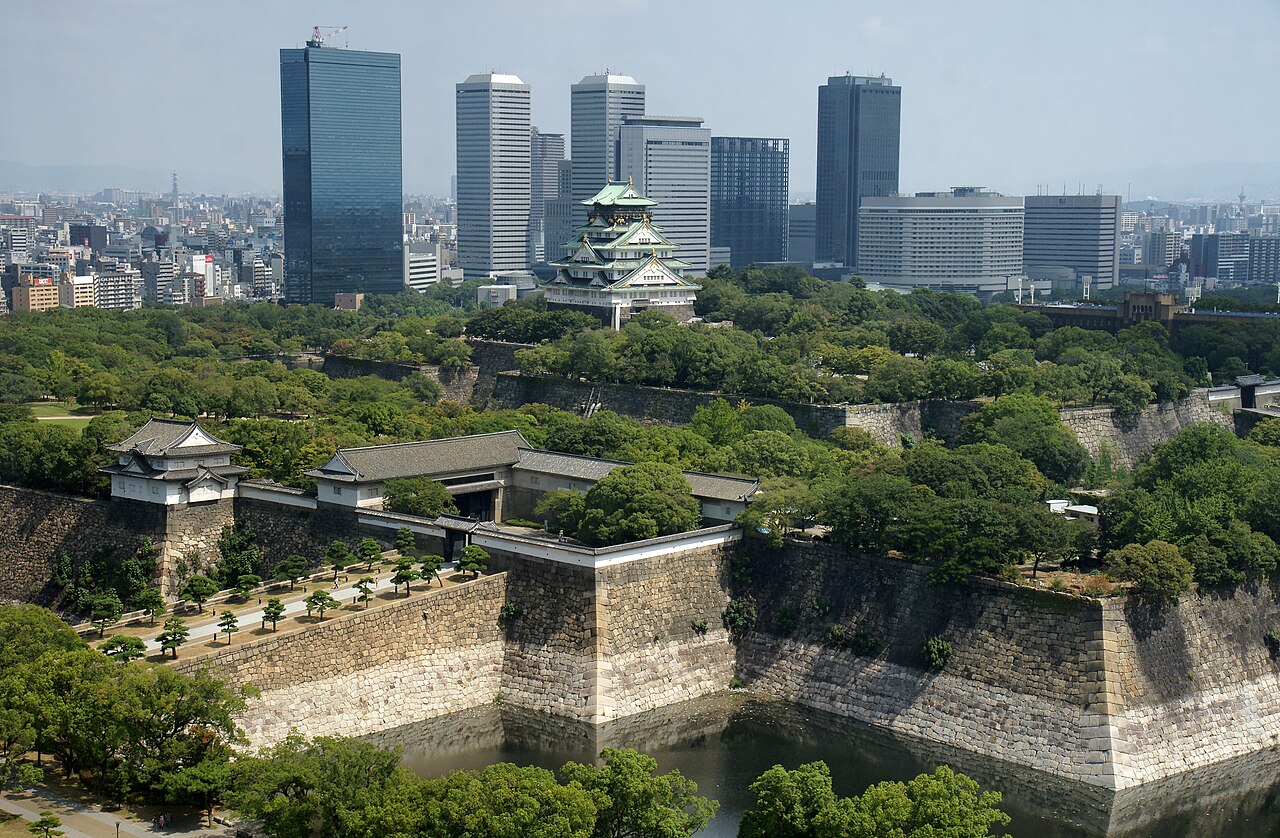
Osaka Castle (大坂城 or 大阪城, Ōsaka-jō) is a Japanese castle in Chūō-ku, Osaka, Japan. The castle is one of Japan's most famous landmarks and played a major role in the unification of Japan during the sixteenth century of the Azuchi–Momoyama period.
The inner keep of Osaka Castle is situated on a plot of land roughly one square kilometre. It is built on two raised platforms of landfill supported by sheer walls of cut rock, using a technique called burdock piling, each overlooking a moat. The keep is five stories tall on the outside and eight on the inside, built atop a tall stone foundation to protect its occupants from attackers.
A series of moats and defensive fortifications surrounds the main keep. The castle has two moats (an inner and an outer one). The inner castle moat lies within the castle grounds and consists of two types: wet (northern-easterly) and dry (south-westerly). The outer moat, meanwhile, surrounds the entire castle and denotes its outer limits, consisting of four water-filled sections, each representing a cardinal direction (North, East, South, West). The castle grounds, which cover approximately 61,000 square metres (15 acres), contain the following thirteen structures that were denoted as "important cultural assets" by the Japanese government:
Ote-mon Gate Sakura-mon Gate Ichiban-yagura Turret Inui-yagura Turret Rokuban-yagura Turret Sengan Turret Tamon Turret Kinmeisui Well Kinzo Storehouse Enshogura Gunpowder Magazine Three sections of 'dobei' mud-and-plaster wall, all located around the Otemon Gate; each has its own Important Cultural Property status There are also some megaliths at the castle, including the Octopus stone, but these have no cultural property status. The outer moat has two main sentry checkpoints: the Aoyamon Gate (in the north-east) and the Otemon Gate (in the opposing south-west).
Between the inner and outer moat are the following: Fushimi-yagura Turret Remains, Ensho-gura Gunpowder Storehouse, Osaka Geihinkan, Hoshoan Tea House, Osaka Castle Nishinomaru Garden, Sengan-yagura Turret, Tamon-yagura Turret, Remains of Taiko-yagura Turret, Osaka Shudokan Martial Arts Hall, Hokoku Shrine (Osaka), Ichiban-yagura Turret (The first turret), and Plum Grove.
There are two places to cross the inner moat: Gokuraku-bashi Bridge (located in the North) and Sakuramon Gate (the main sentry point in the South).
Text adapted from “Osaka Castle” on Wikipedia, CC BY-SA 4.0.
Osaka Castle ranks #39 of 9,079 worldwide in the atlas's castle fame ranking, and #2 of the 296 mapped in Japan. Founded 1583, it is older than 34% of the atlas's dated landmarks — one of 891 atlas entries founded in the 16th century. Its Wikipedia articles were opened 72,075 times in the last 60 days, more than 99% of the atlas. 7 more atlas landmarks stand within 25 km. The nearest day-trip guide is Osaka, 2 km away. It is one of the 69 landmarks on the atlas's regional map of Kansai. See how Japan compares in the castle statistics.
View on the interactive castle map →