Castle
Oystermouth Castle
WLS Wales · 12th century
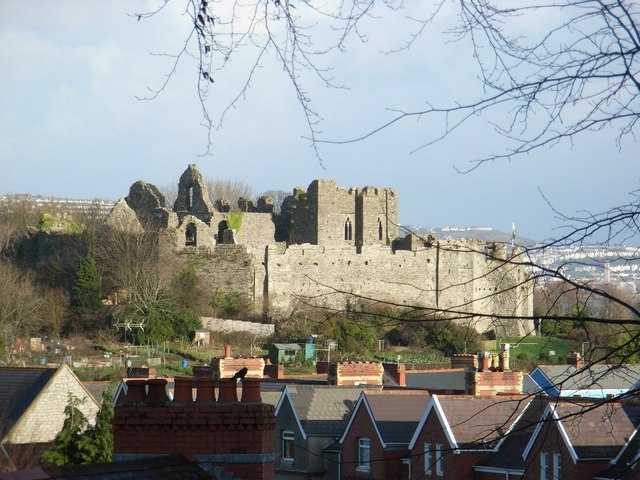
Oystermouth Castle (Welsh: Castell Ystum Llwynarth) is a Norman stone castle in Wales, overlooking Swansea Bay on the east side of the Gower Peninsula in the village of Mumbles.
A number of Antiquarians state that the Norman castle was built on the site of a former native fortification. Nineteenth century works by Samuel Lewis and Nicholas Carlisle both name this fortification as the "Caer Tawy" of Medieval Welsh literature. The name indicates that a Welsh fort (a Caer) was built here to guard the river Tawe long before Oystermouth or Swansea Castle were built by the Normans.
The first Norman castle was founded by William de Londres of Ogmore Castle soon after 1106 following the capture of Gower by the Normans. In 1116 the Welsh of Deheubarth retook the Gower Peninsula and forced William to flee his castle which was put to the torch. The castle was rebuilt soon afterwards, but was probably destroyed again in 1137 when Gower was once more retaken by the Princes of Deheubarth. The Londres or London family finally died out in 1215 when Gower was again taken by the Welsh under the leadership of Llywelyn the Great. In 1220 the Welsh were expelled from the peninsula and the government of Henry III of England returned the barony of Gower to John de Braose who rebuilt both Swansea and Oystermouth castles.
In the 13th century the Braose family were Lords of Gower and held the castle as part of their extensive land holdings and titles, including other castles on Gower and in the Welsh Marches. The de Braose dynasty could afford to rebuild Oystermouth castle in stone. A high curtain wall was built, internal buildings added, a chapel, basements, three storey residential buildings with fireplaces and garderobes on each floor. The castle had every residential feature necessary for living in some comfort and was also refortified cleverly. Towards the end of the century Oystermouth rather than Swansea Castle became their principal residence. Edward I paid a brief visit here in December 1284.
By 1331 the Lords of Gower were living elsewhere and the castle declined in importance in the 14th century.
Text adapted from “Oystermouth Castle” on Wikipedia, CC BY-SA 4.0.
Oystermouth Castle ranks #2,645 of 8,134 worldwide in the atlas's castle fame ranking, and #42 of the 100 mapped in Wales. Founded c. 1106, it is older than 86% of the atlas's dated landmarks — one of 564 atlas entries founded in the 12th century. Its Wikipedia articles were opened 1,535 times in the last 60 days, more than 60% of the atlas. 9 more atlas landmarks stand within 25 km. The nearest day-trip guide is Swansea, 6 km away. See how Wales compares in the castle statistics.
View on the interactive castle map →Frequently asked questions
Where is Oystermouth Castle?
Oystermouth Castle stands in Wales, at 51.577°, -4.00271°.
When was Oystermouth Castle built?
The atlas dates its founding to c. 1106. Earlier structures may have stood on the site; this is the earliest documented founding year.
How famous is Oystermouth Castle?
In this atlas's fame ranking: #2,645 of 8,134 worldwide, and #42 in Wales. Fame here combines how many Wikipedia language editions cover a landmark with how many people read them.
What is the nearest castle to Oystermouth Castle?
Swansea Castle, about 6 km away.
More castles in Wales
- St Fagans Castle Wales · 16th century
- Hawarden Old Castle Wales · 13th century
- Abergavenny Castle Wales · 11th century
- Gwydir Castle Wales · 15th century
More castles
- Bungay Castle England · 11th century
- Portumna Castle Ireland · 17th century
- Newgate England
- Cadbury Castle England