 Wales · 12th century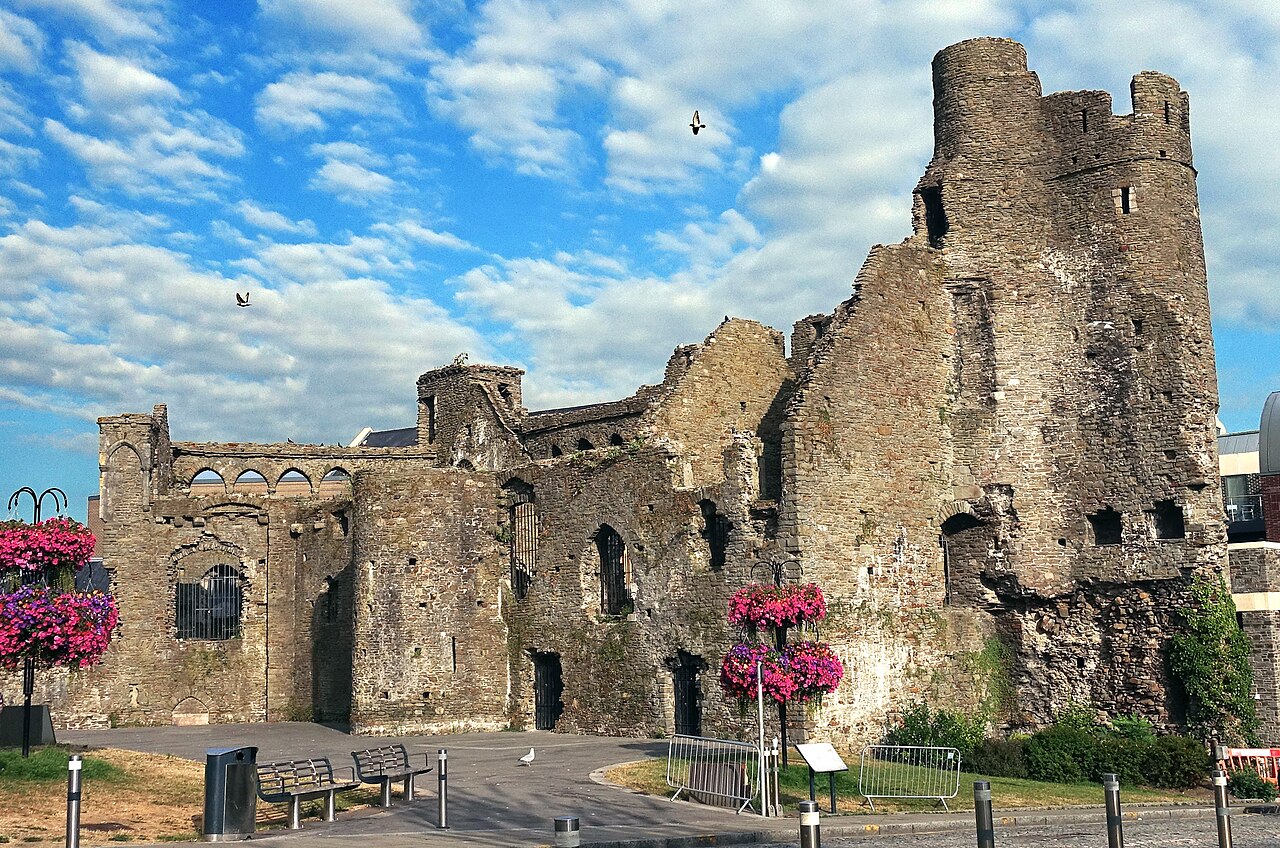
Swansea Castle (Welsh: Castell Abertawe) is located in the city centre of Swansea, Wales, UK. It was founded by Henry de Beaumont in 1107 as the caput of the lordship of Gower. The castle is now ruined and only two blocks remain, though the site has been improved in the 2010s for use as a public space.
Swansea Castle is located on the east side of the city centre, facing Castle Square (the River Tawe used to flow a short distance east on what is now the Strand). Originally covering 4.6 acres (1.9 ha), the surviving remains of the square castle include residential blocks, together with a section of parapet wall forming an L-shape to the southeast. There are five tunnel-vaulted basement rooms.
Henry de Beaumont was granted the Lordship of Gower in 1106 and he began to solidify the control of the Normans in the area. A timber castle existed in Swansea in 1116, when it was recorded as being attacked by Welsh forces who destroyed the outer defences.
The original castle seems to have been a sub-rectangular/oval enclosure overlooking the River Tawe on the east, surrounded on the north, west and south sides by a larger sub-rectangular outer bailey. The inner bailey probably contained a motte but the other view is that it was a ring work. The motte (or ring work) was 52 metres (171 ft) in diameter (only second in size to Cardiff Castle) and survived to the early 20th century.
The castle was besieged and captured in 1192 by Rhys ap Gruffydd, Prince of Deheubarth. Despite 10 weeks of starvation the castle was saved.
After various other unsuccessful attacks the castle fell in 1217 but was restored to the English in 1220 as part of the settlement between Llywelyn ap Iorwerth and Henry III of England.
The castle was rebuilt in stone, probably between 1221 and 1284 (described now as the "New Castle"), firstly the inner castle with at least one tower, finally the large outer bailey.
The only visible remains today, two sides of the rectangular South East corner of the "new castle"'s outer bailey, were built in the late 13th or early 14th century. The south face (which ends in a tall garderobe tower) is capped with an elegant series of arcades at the wall-head, which are similar to structures at the Bishop of Saint David's palaces at Lamphey and St David's.
By the 14th century the castle was losing its military importance.
Text adapted from “Swansea Castle” on Wikipedia, CC BY-SA 4.0.
Swansea Castle ranks #2,805 of 9,079 worldwide in the atlas's castle fame ranking, and #46 of the 107 mapped in Wales. Founded 1107, it is older than 85% of the atlas's dated landmarks — one of 756 atlas entries founded in the 12th century. Its Wikipedia articles were opened 1,158 times in the last 60 days, more than 54% of the atlas. 8 more atlas landmarks stand within 25 km. The nearest day-trip guide is Swansea, 1 km away. See how Wales compares in the castle statistics.
View on the interactive castle map →