 Italy · 16th century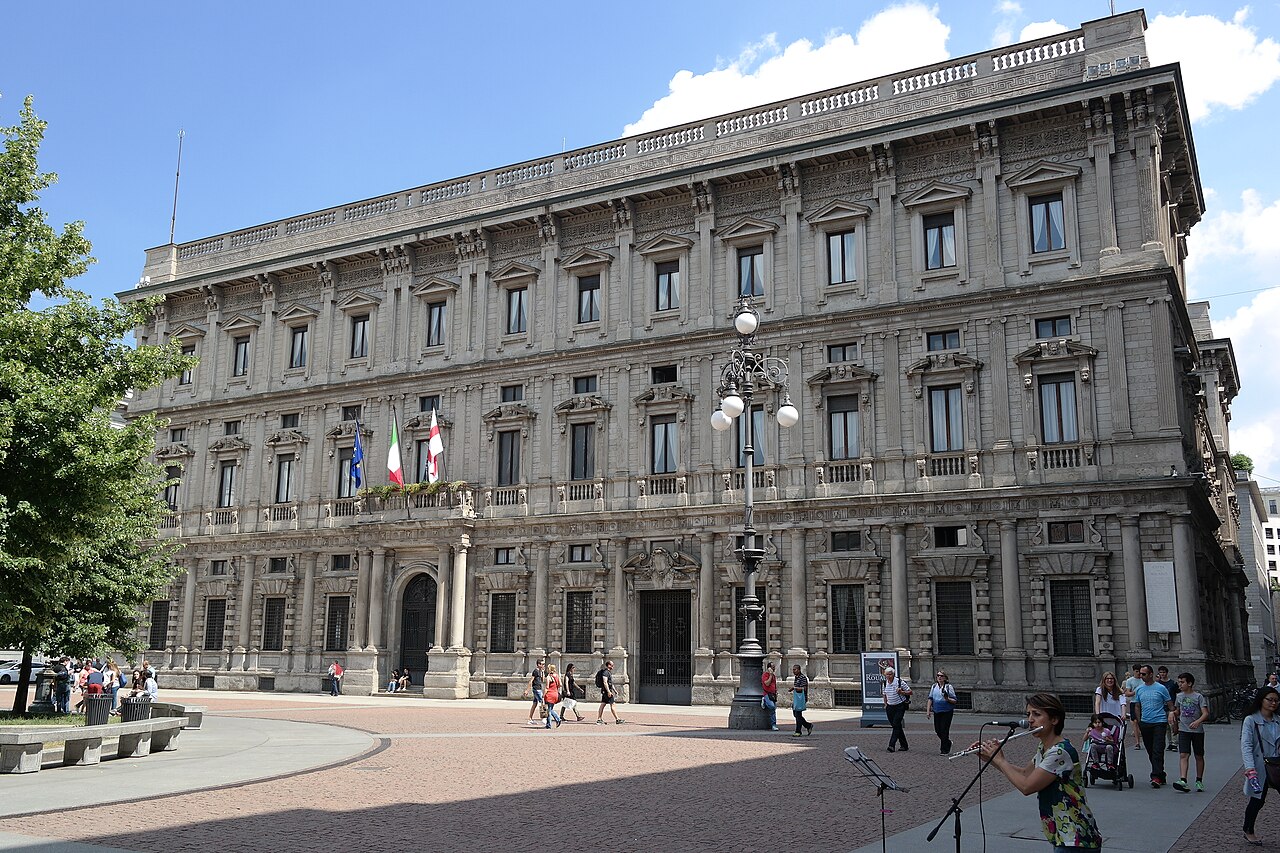
Palazzo Marino is a 16th-century palace located in Piazza della Scala, in the centre of Milan, Italy. It has been Milan's city hall since 9 September 1861. It borders on Piazza San Fedele, Piazza della Scala, Via Case Rotte and Via Tommaso Marino.
The palace was commissioned by Tommaso Marino, a wealthy 16th-century Genoese banker and merchant. It became a property of the state in 1781.
The palace was built from 1557 to 1563 for Tommaso Marino. It was designed by architect Galeazzo Alessi from Perugia. Its main facade originally faced Piazza San Fedele, as Piazza della Scala at the time was a warren of medieval houses. The construction was occasionally slowed down by the opposition of the population, that had a very conservative attitude towards the architecture of the centre of Milan.
Several sculptors from the Fabbrica del Duomo were involved in the decorations this Palazzo. In the courtyard, sculptures were erected representing the Labours of Hercules and the Metamorphoses. The ceiling of the main hall (now known as "Salone dell'Alessi") had frescos and stuccos with the Marriage of Cupid and Psyche by Andrea Semini and Ottavio Semini.
The four corners of the ceiling were also decorated with paintings by Aurelio Busso representing allegories of the four seasons. Further frescos as well as bas reliefs decorated the walls, with mythological themes such as the Muses, Bacchus, Apollo and Mercury by Ottavio Semini. The reliefs depict the story of Perseus.
When Marino died leaving his family bankrupt, the palace became a property of the State, but in 1632 it was sold to another banker, Carlo Omodei. The House of Omodei never inhabited the palace, which maintained its original name "Marino" and was rented to several notable Milanese.
In 1781, the palace was once again bought by the State (the notable Milanese scholar Pietro Verri had an important role in convincing the authorities to buy the palace) and became the seat of administrative and tax offices. The palace was then restored, with the supervision of architect Giuseppe Piermarini, who was responsible for the renovation of the entire area.
In 1848, after the Five Days of Milan, the palace was temporarily used as the seat of the new government of Lombardy. It was finally elected as Milan's city hall on 19 September 1861.
Text adapted from “Palazzo Marino” on Wikipedia, CC BY-SA 4.0.
Palazzo Marino ranks #2,139 of 9,035 worldwide in the atlas's castle fame ranking, and #156 of the 555 mapped in Italy. Founded 1557, it is older than 36% of the atlas's dated landmarks, one of 886 atlas entries founded in the 16th century. Its Wikipedia articles were opened 2,478 times in the last 60 days, more than 74% of the atlas. 18 more atlas landmarks stand within 25 km. The nearest day-trip guide is Milan, 1 km away. See how Italy compares in the castle statistics.
View on the interactive castle map →