 Spain · 14th century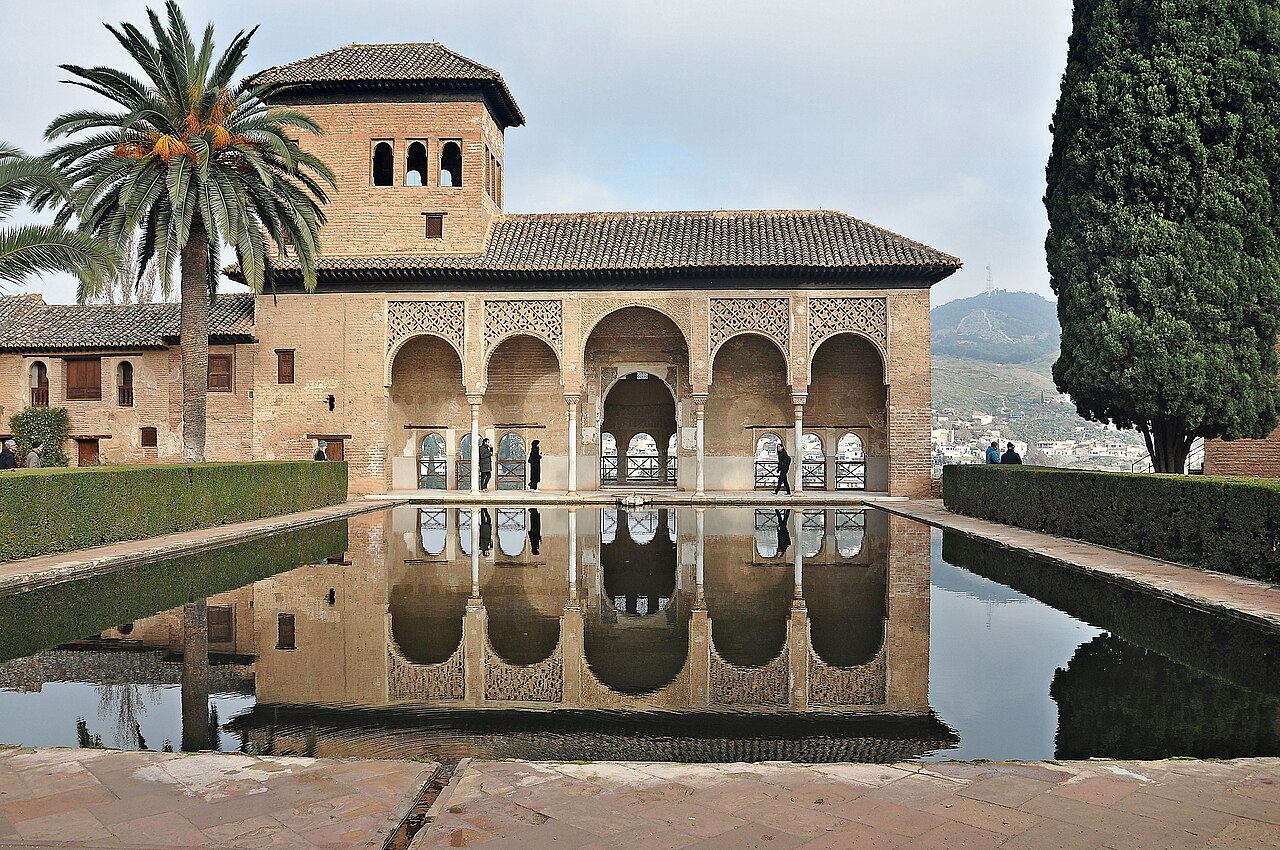
Partal Palace (Spanish: El Palacio del Partal) is a palatial structure inside the Alhambra fortress complex located in Granada, Spain. It was originally built in the early 14th century by the Nasrid ruler Muhammad III, making it the oldest surviving palatial structure in the Alhambra.
The name Partal comes from Arabic al-Barṭal or al-Burtāl (البرطل or البرطال). This word was an Arabisation of the Latin word portale ('portal') that was used in Old Castilian to mean "portico".
The Partal Palace was built by the Nasrid ruler Muhammad III who ruled the Emirate of Granada, the last Muslim state in Al-Andalus (the Iberian Peninsula), from 1302 to 1309. This dating makes it the oldest remaining palace in the Alhambra today. It was also the first of several palaces that were eventually built along the northern perimeter of the Alhambra. Another palace, called the Palacio del Partal Alto by archeologists, once stood to the south in an area now occupied by gardens. Though traditionally attributed to Yusuf III (r. 1408–1417), it was most likely built by Muhammad III's predecessor, Muhammad II (r.
1273–1302). The space between the Palacio del Partal Alto to the south and the outer Alhambra walls to the north was a large garden, the Riyad as-Sayyid ("Garden of the Sayyid", Sayyid being an honorific used by the Nasrids), which may have initially stretched from the Comares Palace in the west to the Torre de las Infantas in the east. Muhammad III built the Partal Palace in this garden area. He re-used a former fortification tower and turned it into a mirador (lookout chamber) integrated into a decorated building.
The Partal Palace is one of the structures that has undergone the most alterations after the Nasrid era. Unlike the neighboring Comares Palace and Palace of the Lions, which were used by Spanish monarchs after the conquest of 1492, the Partal Palace passed under private ownership and was remodeled into a residence by its owners. It was only ceded to the Spanish government in 1891 and then incorporated into the rest of the Alhambra historical site. Over the course of the 20th century it underwent multiple restorations by archeologists and architects in charge of the Alhambra.
Text adapted from “Partal Palace” on Wikipedia, CC BY-SA 4.0.
Partal ranks #2,346 of 9,035 worldwide in the atlas's castle fame ranking, and #85 of the 606 mapped in Spain. Founded c. 1305, it is older than 60% of the atlas's dated landmarks, one of 757 atlas entries founded in the 14th century. Its Wikipedia articles were opened 1,940 times in the last 60 days, more than 69% of the atlas. 11 more atlas landmarks stand within 25 km. The nearest day-trip guide is Granada, 1 km away. It is one of the 123 landmarks on the atlas's regional map of Andalusia. It is stop 20 of 30 on the Andalusian frontier castles, Cádiz to Córdoba. See how Spain compares in the castle statistics.
View on the interactive castle map →