 Spain · 13th century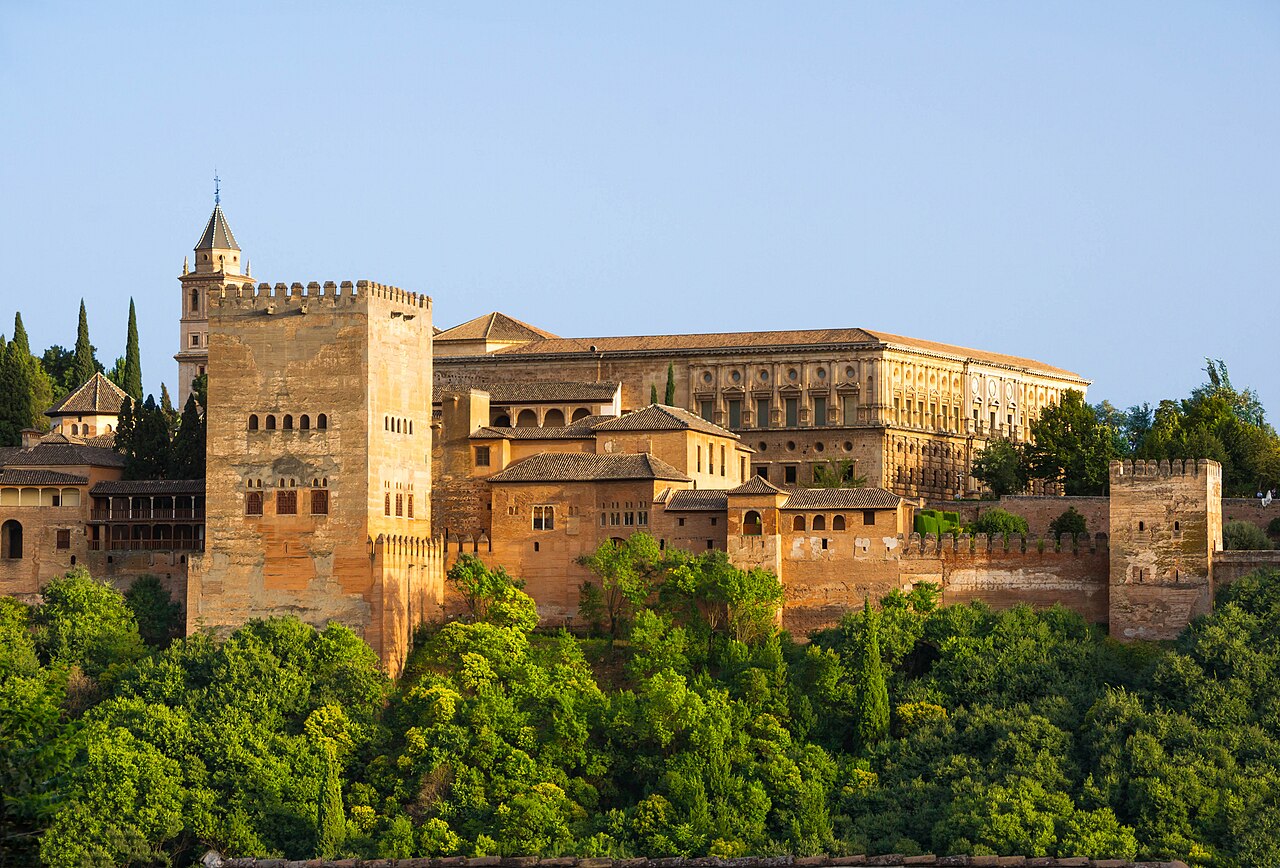
The Alhambra (Spanish: [aˈlambɾa]; Arabic: الْحَمْرَاء, romanized: al-ḥamrāʼ) is a palace city and fortress complex located in Granada, Spain. It is one of the most famous monuments of Islamic architecture and the only well-preserved palace from the medieval Islamic world. Additionally, the palace contains notable examples of Spanish Renaissance architecture.
The building of the complex begun in 1238 CE by Muhammad I Ibn al-Ahmar, the first Nasrid emir and founder of the Emirate of Granada, the last Muslim state of al-Andalus. It was built on Sabika hill, an outcrop of the Sierra Nevada which had been the site of earlier fortresses and of the 11th-century palace of Samuel ibn Naghrillah. Later Nasrid rulers continuously modified the site. The most significant construction campaigns, which gave the royal palaces much of their defining character, took place in the 14th century during the reigns of Yusuf I and Muhammad V. After the conclusion of the Christian Reconquista in 1492, the site became the Royal Court of Ferdinand and Isabella (where Christopher Columbus received royal endorsement for his expedition), and the palaces were partially altered.
In 1526, Charles V commissioned a new Renaissance-style palace in direct juxtaposition with the Nasrid palaces. The Alhambra fell into disrepair over the following centuries, with its buildings occupied by squatters. The troops of Napoleon destroyed parts of it in 1812. After this, the Alhambra became an attraction for British, American, and other European Romantic travellers. The most influential of them was Washington Irving, whose Tales of the Alhambra (1832) brought international attention to the site. The Alhambra was one of the first Islamic monuments to become the object of modern scientific study and has been the subject of numerous restorations since the 19th century.
Text adapted from “Alhambra” on Wikipedia, CC BY-SA 4.0.
Alhambra ranks #7 of 9,079 worldwide in the atlas's castle fame ranking, and #1 of the 607 mapped in Spain. Founded 1239, it is older than 72% of the atlas's dated landmarks — one of 1080 atlas entries founded in the 13th century. Its Wikipedia articles were opened 152,416 times in the last 60 days, more than 99% of the atlas. Wikidata records about 2,600,000 visitors in 2023. 11 more atlas landmarks stand within 25 km. The nearest day-trip guide is Granada, 1 km away. It is one of the 124 landmarks on the atlas's regional map of Andalusia. It is stop 14 of 30 on the Andalusian frontier castles, Cádiz to Córdoba. See how Spain compares in the castle statistics.
View on the interactive castle map →