 Spain · 13th century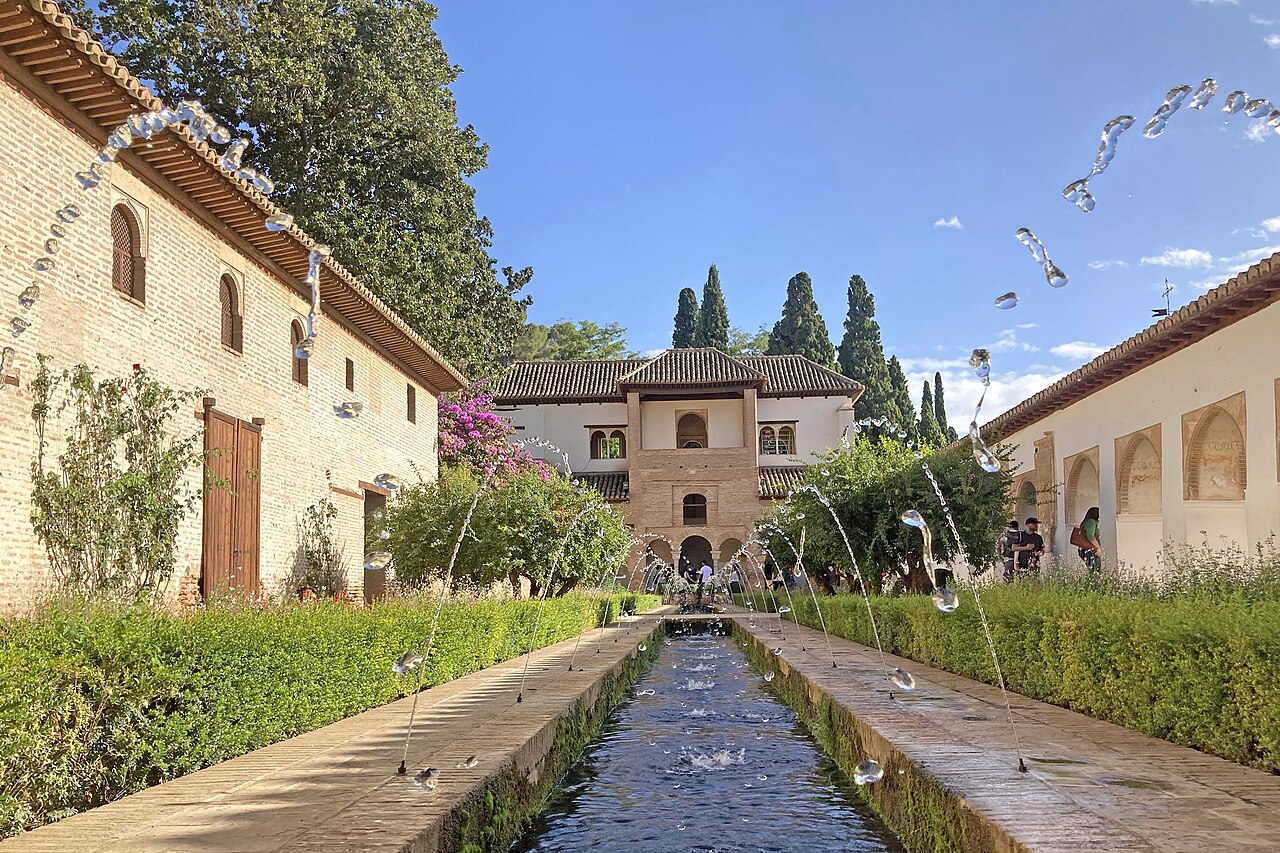
The Generalife (Spanish pronunciation: [xe.ne.ɾa.ˈli.fe]; Arabic: جَنَّة الْعَرِيف, romanized: Jannat al-‘Arīf) was a summer palace and country estate of the Nasrid rulers of the Emirate of Granada in Al-Andalus. It is located directly east of and uphill from the Alhambra palace complex in Granada, Spain.
The most commonly cited etymology for the name "Generalife" is that it derives from jannat al-‘arīf (Arabic: جَنَّة الْعَرِيف) which may variously mean "Garden of the Architect", "Garden of the Artist", "Garden of the Gnostic", or even "Garden of the Flautist". According to Robert Irwin, however, this traditional etymology is unlikely and the true origin of the name is not clearly known. An earlier version of the name recorded in the 16th century by Marmol was Ginalarife, which J.D. Latham suggests is evidence that the first word was originally jinan (Arabic: جِنَاْن; a plural version derived from the same root), not jannat.
The original name of the Generalife may have simply been the equivalent of "Principal Orchard". An ornamental inscription by Ibn al-Yayyab inside the palace names it as the Dar al-Mamlakat as-Sa'ida ("House of the Felicitous Kingdom").
In the Nasrid period, the Generalife was an almunia (from Arabic al-munya, meaning "farm"), a country villa that was used both as a private retreat by elites as well as a farming estate with agricultural functions. The creation of such rural estates and gardens by rulers and elites in al-Andalus dated back to the Umayyad period (8th–10th centuries). Such estates are also found in some historic cities of North Africa, such as the Agdal Gardens of Marrakesh, which have survived to the present day. Their existence in Granada is recorded as early as the Zirid period (11th century). Other Nasrid-period examples of this type were located on the nearby mountainside, such as the Alijares Palace and the Dar al-'Arusa (both probably from the 14th century), as well as in other parts of Granada, such as the Alcázar Genil and the Cuarto Real de Santo Domingo (both from the 13th century, the former being originally an Almohad construction).
Based on the oldest decorations studied in the palace, the Generalife was most likely constructed by Muhammad II (r. 1273–1302) at the end of the 13th century, or possibly by Muhammad III (r. 1302–1309) at the beginning of the 14th century.
Text adapted from “Generalife” on Wikipedia, CC BY-SA 4.0.
Generalife ranks #265 of 9,079 worldwide in the atlas's castle fame ranking, and #12 of the 607 mapped in Spain. Founded c. 1275, it is older than 65% of the atlas's dated landmarks — one of 1080 atlas entries founded in the 13th century. Its Wikipedia articles were opened 10,360 times in the last 60 days, more than 94% of the atlas. 11 more atlas landmarks stand within 25 km. The nearest day-trip guide is Granada, 1 km away. It is one of the 124 landmarks on the atlas's regional map of Andalusia. It is stop 16 of 30 on the Andalusian frontier castles, Cádiz to Córdoba. See how Spain compares in the castle statistics.
View on the interactive castle map →