 Russia · 18th century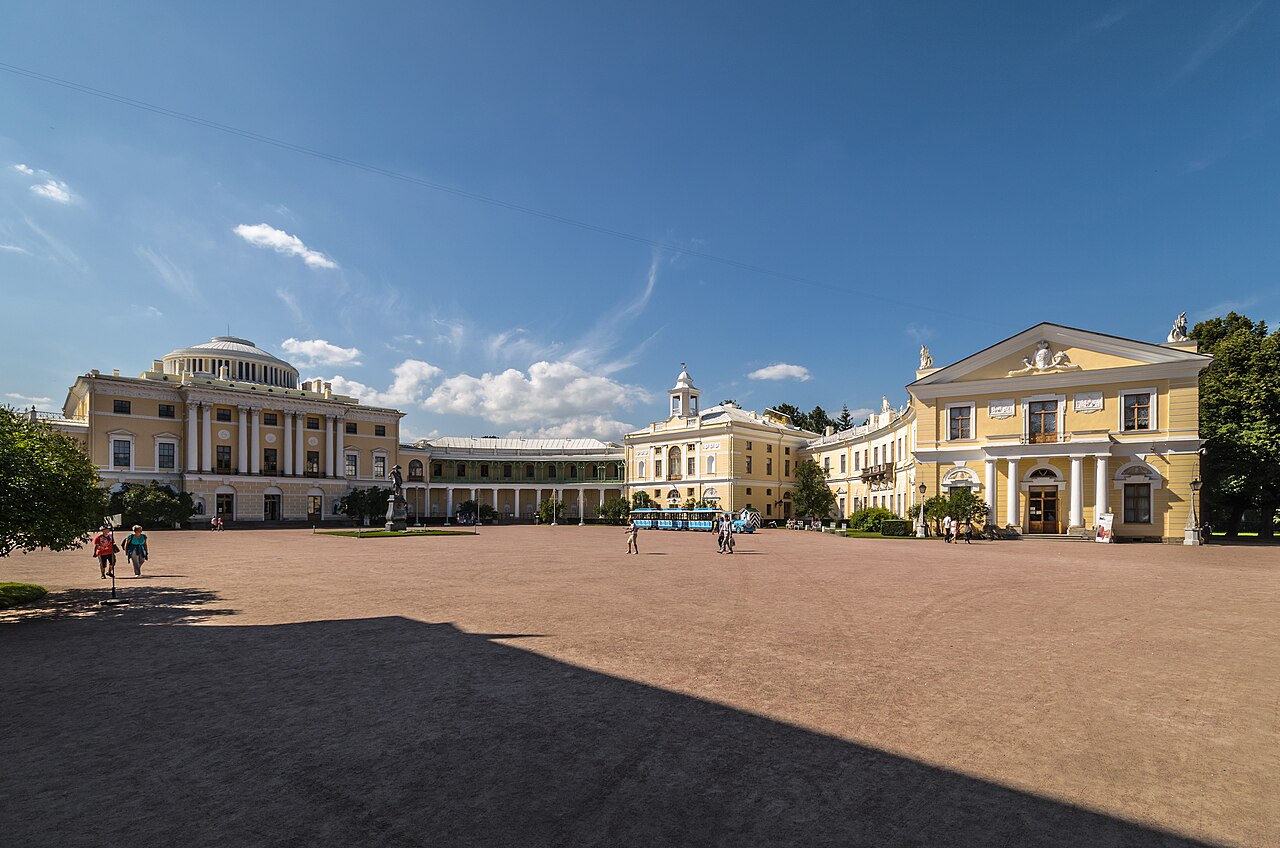
Pavlovsk Palace (Russian: Павловский дворец) is an 18th-century Russian Imperial residence built by the order of Catherine the Great for her son Grand Duke Paul, in Pavlovsk, within Saint Petersburg. After his death, it became the home of his widow, Maria Feodorovna. The palace and the large English garden surrounding it are now a Russian state museum and public park.
In 1777, the Empress Catherine II of Russia gave a parcel of a thousand hectares of forest along the winding Slavyanka River, four kilometers from her residence at Tsarskoye Selo, to her son and heir Paul I and his wife Maria Feodorovna, to celebrate the birth of their first son, the future Alexander I of Russia. At the time the land was given to Paul and Maria Feodorovna, there were two rustic log lodges called Krik and Krak. Paul and his wife spent the summers of 1777 to 1780 in Krik, while their new homes and the garden were being built.
They began by building two wooden buildings, one kilometer apart. Paul's house, a two-story house in the Dutch style, with small gardens, was called "Marienthal", or the "Valley of Maria". Maria's house was a small wooden house with a cupola and flower beds, named "Paullust", or "Paul's Joy". Paul and Maria Feodorovna began to create picturesque "ruins", a Chinese kiosk, Chinese bridges and classical temples in the English landscape garden style which had spread rapidly across Europe in the second half of the 18th century.
In 1780, Catherine the Great loaned her official architect, the Scotsman Charles Cameron, to design a palace on a hillside overlooking the Slavyanka River, near the site of Marienthal. Cameron had studied under English architect Isaac Ware, who was close to William Kent. Kent introduced the Palladian style of architecture into England with his work at Chiswick House for Lord Burlington. Through this connection Cameron became familiar with the original plans of Palladio, which were in the personal collection of Lord Burlington. This style was the major influence on Cameron when he designed Pavlovsk.
Cameron began his project not with the palace itself but with two classical pavilions. The first was the Temple of Friendship, a circular Dorian temple with sixteen columns supporting a low dome, containing a statue of Catherine the Great.
Text adapted from “Pavlovsk Palace” on Wikipedia, CC BY-SA 4.0.
Pavlovsk Palace ranks #931 of 9,035 worldwide in the atlas's castle fame ranking, and #39 of the 145 mapped in Russia. Founded 1782, it is older than 13% of the atlas's dated landmarks, one of 685 atlas entries founded in the 18th century. Its Wikipedia articles were opened 6,125 times in the last 60 days, more than 89% of the atlas. 7 more atlas landmarks stand within 25 km. The nearest day-trip guide is Saint Petersburg, 30 km away. See how Russia compares in the castle statistics.
View on the interactive castle map →