 Romania · 19th century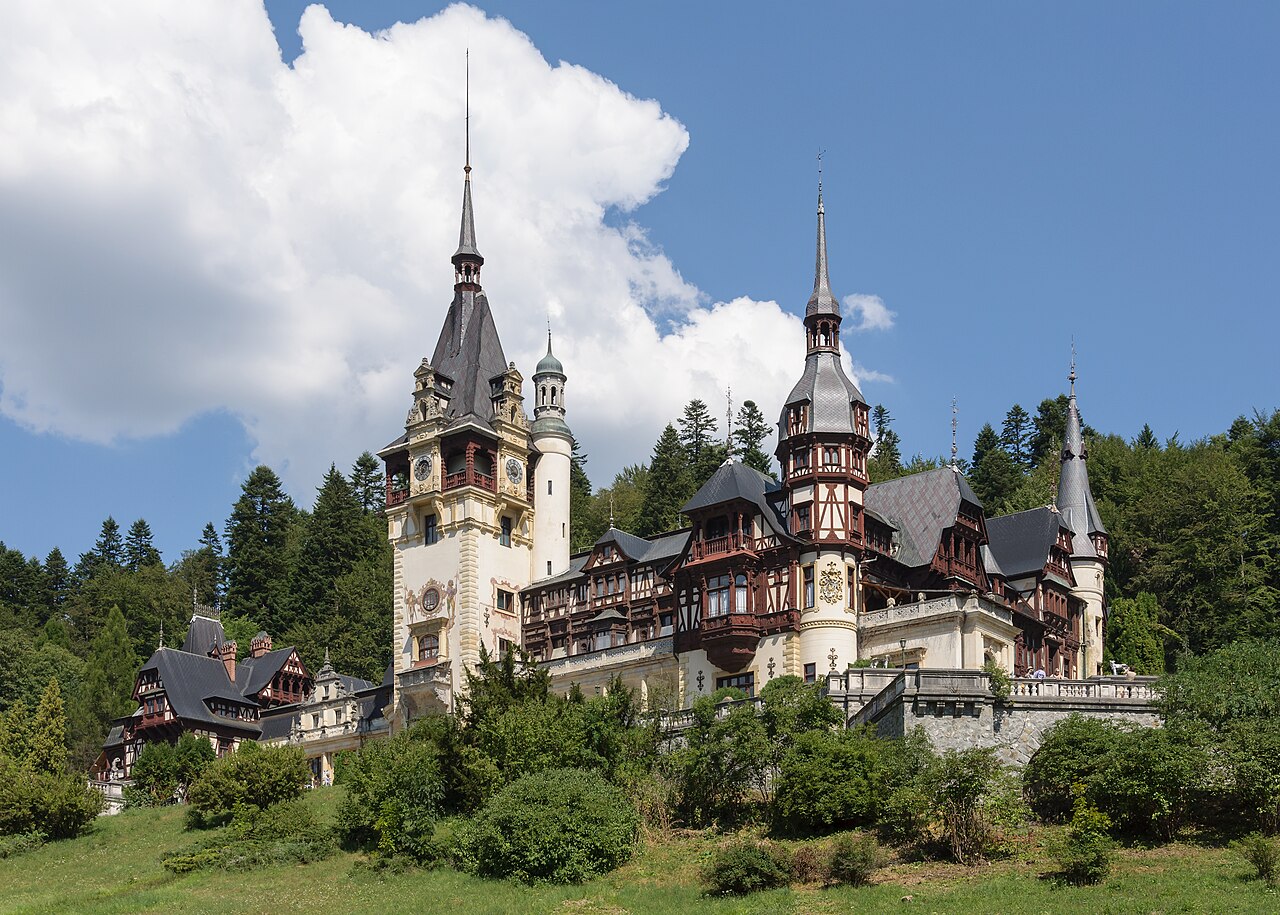
Peleș Castle (Romanian: Castelul Peleș pronounced [kasˈtelul ˈpeleʃ]) is a Neo-Renaissance palace in the Royal Domain of Sinaia in the Carpathian Mountains, near Sinaia, in Prahova County, Romania, on an existing medieval route linking Transylvania and Wallachia, built between 1873 and 1914. Its inauguration was held in 1883. It was constructed for King Carol I of Romania.
The complex is northwest of the town of Sinaia, which is 48 kilometres (30 mi) from Brașov and 124 kilometres (77 mi) from Bucharest. In the southeastern Carpathian Mountains, the complex is composed of three monuments: Peleș Castle, Pelișor Castle, and the Foișor Hunting Lodge.
When King Carol I of Romania (1839–1914), under whose reign the country gained its independence, first visited the site of the future castle in 1866, he fell in love with the magnificent mountain scenery. In 1872, the Crown purchased 5 square kilometres (1.9 sq mi) of land near the Piatra Arsă River. The estate was named the Royal Estate of Sinaia. The King commissioned the construction of a royal hunting preserve and summer retreat on the property, and the foundation was laid for Peleș Castle on 22 August 1873. Several auxiliary buildings were built simultaneously with the castle: the guards' chambers, the Economat Building, the Foișor hunting lodge, the royal stables, and a power plant. Peleș became the world's first castle fully powered by locally produced electricity.
The first three design plans submitted for Peleș were copies of other palaces in Western Europe, and King Carol I rejected them all as lacking originality and being too costly. German architect Johannes Schultz won the project by presenting a more original plan, something that appealed to the King's taste: a grand palatial alpine castle combining different features of classic European styles, mostly following Italian elegance and German aesthetics along Renaissance lines. Works were also led by architect Carol Benesch. Later additions were made between 1893 and 1914 by the Czech architect Karel Liman, who designed the towers, including the main central tower, which is 66 metres (217 ft) in height. The Sipot Building, which served as Liman's headquarters during the construction, was built later on.
Text adapted from “Peleș Castle” on Wikipedia, CC BY-SA 4.0.
Peleș Castle ranks #117 of 9,079 worldwide in the atlas's castle fame ranking, and #3 of the 126 mapped in Romania. Founded 1873, it is older than 6% of the atlas's dated landmarks — one of 717 atlas entries founded in the 19th century. Its Wikipedia articles were opened 38,040 times in the last 60 days, more than 99% of the atlas. 4 more atlas landmarks stand within 25 km. The nearest day-trip guide is Brașov, 33 km away. It is stop 2 of 26 on the Transylvania castle route, Bran to Cluj-Napoca. See how Romania compares in the castle statistics.
View on the interactive castle map →