 Iraq · 8th century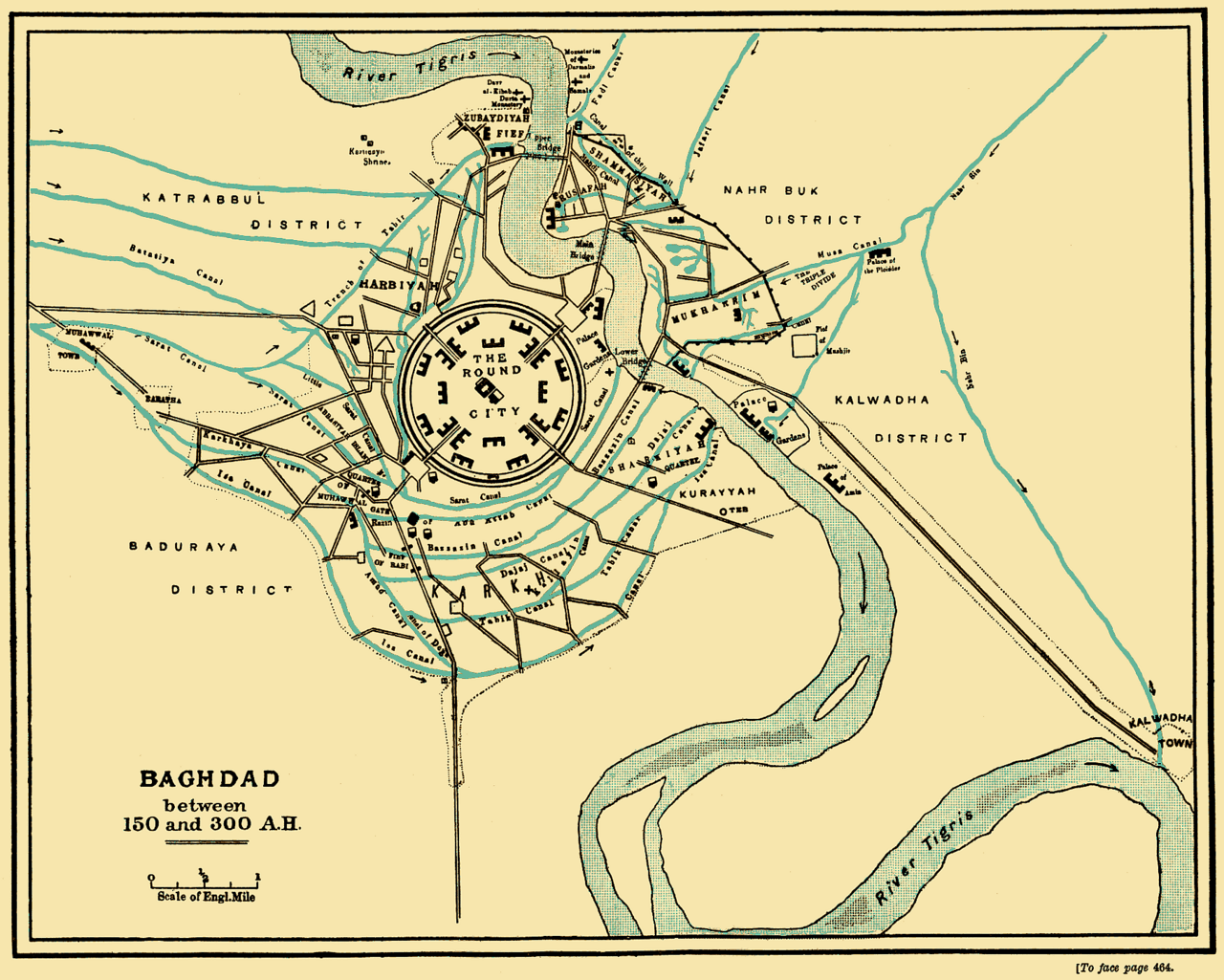
The Round City of Baghdad is the original core of Baghdad, built by the Abbasid Caliph al-Mansur in 762–766 AD as the official residence of the Abbasid court. Its official name in Abbasid times was City of Peace (Arabic: مدينة السلام, romanized: Madīnat as-Salām). The famous library known as the House of Wisdom was located within its grounds.
According to Ya'qubi, the plans for the city were drawn up, but it was not until 2 August 762 that construction began, under the supervision of four architects. Huge resources were amassed for the project: the Arab chroniclers report 100,000 workers and craftsmen, and sums of 18 million gold dinars or 100 million silver dirhams. The caliphal Palace of the Golden Gate and the main mosque, as well as some of the administration offices, were apparently completed by 763, allowing al-Mansur to move his residence into the city, and the rest of the Round City was completed by 766.
Mansur believed that Baghdad was the perfect city to be the capital of the Islamic empire under the Abbasids. Mansur loved the site so much he is quoted saying, "This is indeed the city that I am to found, where I am to live, and where my descendants will reign afterward". The goal was to replace Harran as the seat of the caliphal government; however, a city of Baghdad is mentioned in pre-Islamic texts, including the Talmud, and the Abbasid city was likely built on the site of this earlier settlement.
Baghdad eclipsed Ctesiphon, the capital of the Sasanian Empire, which was located some 30 km (19 mi) to the southeast, which had been under Muslim control since 637, and which became quickly deserted after the foundation of Baghdad. The site of Babylon, which had been deserted since the 2nd century, lies some 90 km (56 mi) to the south.
The old Baghdad was a small village, and despite its name, which is of Iranian origin (bag "god" + dād "gifted"), the original inhabitants were probably Aramaic-speaking Nabateans. The new city, however, was mainly Arabic-speaking, with considerable Persian elements in the population and urban environment, although there may not have been any major Persian settlement in the village of Baghdad or its surrounding communities: all of which were absorbed into the new city of Baghdad.
Text adapted from “Round City of Baghdad” on Wikipedia, CC BY-SA 4.0.
Round city of Baghdad ranks #359 of 9,079 worldwide in the atlas's castle fame ranking, and #4 of the 15 mapped in Iraq. Founded 762, it is older than 95% of the atlas's dated landmarks — one of 48 atlas entries founded in the 8th century. Its Wikipedia articles were opened 8,600 times in the last 60 days, more than 92% of the atlas. 3 more atlas landmarks stand within 25 km. See how Iraq compares in the castle statistics.
View on the interactive castle map →