 Romania · 15th century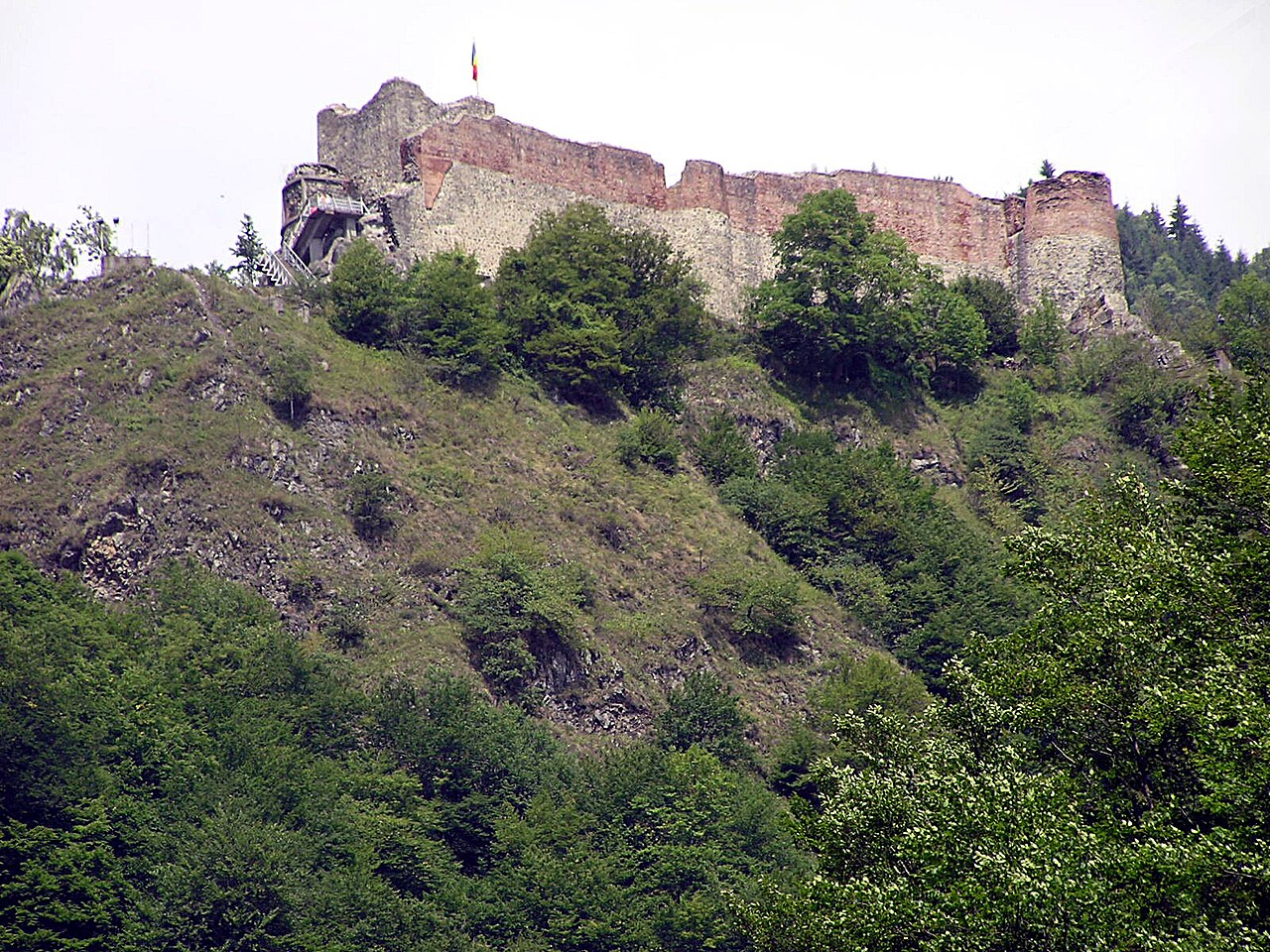
Poenari Castle (Romanian pronunciation: [po.eˈnarʲ]), also known as Poenari Citadel (Romanian: Cetatea Poenari) and Poenari Fortress, is a ruined castle in Romania which was a home of Vlad the Impaler. The citadel is situated on top of a mountain and accessed by climbing 1,480 concrete stairs.
The castle is located on the plateau of Mount Cetatea, facing the west side of the Transfăgărășan, on a canyon formed on the Argeș River valley, close to the Făgăraș Mountains.
Before Poenari Castle was constructed in the mid-15th century, another castle around the same location was erected near the beginning of the 13th century by the Wallachians, called Castle Argeș. In the mid-14th century, Castle Argeș became the main citadel of the Basarab dynasty. In the next few decades, the name and the residents changed a few times but eventually the castle was abandoned and left in ruins.
However, in 1459, realising the potential for a second castle perched high on a steep precipice of rock, Vlad the Impaler repaired and consolidated the structure by arresting his enemies from the Wallachian nobility, making it one of his main fortresses. Vlad rebuilt the former Castle Argeș on the left side of the river with stones from the older Castle Poenari, which was on the right bank and somewhat lower. Although the castle was used for many years after Vlad's death in 1476, it eventually was abandoned again in the first half of the 16th century and was in ruins by the 17th century. The size and location of the castle made it difficult to conquer.
On 13 January 1913, a landslide caused by an earthquake brought down parts of the castle which crashed into the river below. After two further earthquakes in 1940 and 1977 that caused further damage, it was slightly repaired and the walls and its towers still stand today. Since 2009, the site has been administered by the Argeș County Museum.
A smaller replica of Poenari Castle was built in 1906 in Bucharest in Carol Park. Originally built for the Romanian General Exhibition, it is one of the few remaining monuments and constructions that used to be in the park. The construction is currently home to the National Office For The Cult of Heroes and it is only open for public twice in a year: on the Heroes’ Day, which in Romania is the same with the Ascension Day, and on the Romanian Army National Day (25 October).
Text adapted from “Poenari Castle” on Wikipedia, CC BY-SA 4.0.
Poenari Castle ranks #264 of 9,079 worldwide in the atlas's castle fame ranking, and #6 of the 126 mapped in Romania. Founded c. 1450, it is older than 47% of the atlas's dated landmarks — one of 554 atlas entries founded in the 15th century. Its Wikipedia articles were opened 29,316 times in the last 60 days, more than 98% of the atlas. The nearest day-trip guide is Sibiu, 62 km away. See how Romania compares in the castle statistics.
View on the interactive castle map →