 England · 12th century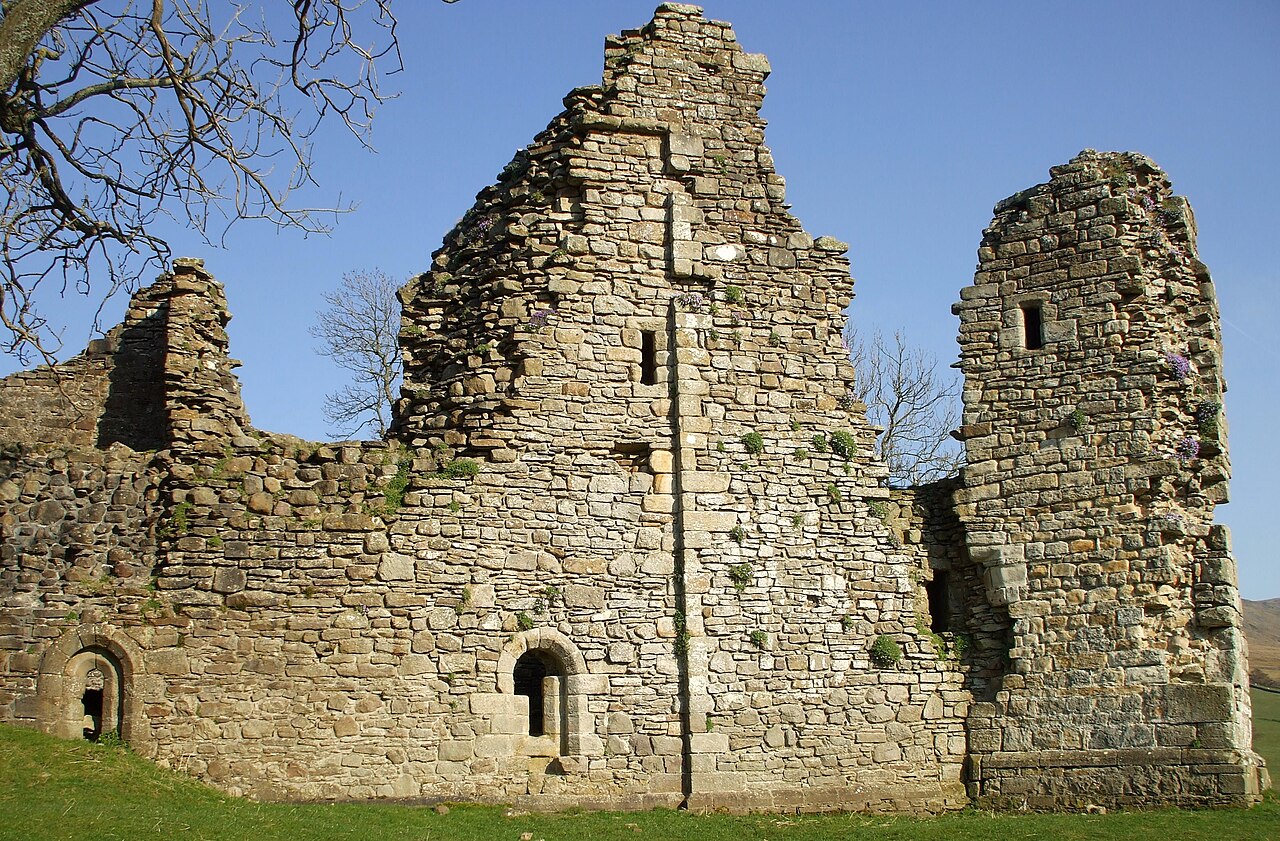
Pendragon Castle is a ruin located in Mallerstang Dale, Cumbria, south of Kirkby Stephen, and close to the hamlet of Outhgill (at grid reference NY781025). It stands above a bend in the River Eden, overlooked by Wild Boar Fell to the south-west and Mallerstang Edge to the east. It is a Grade I listed building.
Let Uther Pendragon do what he can,Eden will run where Eden ran.
Uther (if he was indeed a real person) was possibly a 5th-century chieftain who led resistance to the invading Anglo-Saxons. According to another local legend, Uther and many of his men died here when the Saxons poisoned the well (but other legends give St Albans as the location for his death). There are several other "Arthurian" sites in Cumbria – for example King Arthur's Round Table, near Penrith – and many names in the North-west, such as Penrith and Cumbria, have Celtic origins.
Despite legend (and the discovery of a Roman coin) there is no evidence of any pre-Norman use of this site. The castle was built in the 12th century by Ranulph de Meschines, during the reign of King William Rufus. It has the remains of a Norman keep, with the later addition of a 14th-century garderobe turret, and some further additions in the 17th century.
One of its most notable owners was Sir Hugh de Morville, Lord of Westmorland, one of the four knights who murdered St Thomas Becket in 1170. A nearby high point on Mallerstang Edge is named after him, as Hugh Seat. Another owner was Lady Idonea de Veteripont who, after the death of her husband (Roger de Lilburn), spent much of her remaining years living in the castle, until her death in 1334. Lady Idonea founded the church of St Mary in the nearby hamlet of Outhgill, ca 1311.
The castle was attacked by Scots raiding parties in 1342 and again in 1541. After the latter attack it remained an uninhabitable ruin until it passed into the hands of Lady Anne Clifford, who rebuilt it in 1660, also adding a brewhouse, bakehouse, stables and coach-house. It remained one of the favourites among her many castles until her death in 1676 at the age of 86.
Text adapted from “Pendragon Castle” on Wikipedia, CC BY-SA 4.0.
Pendragon Castle ranks #1,973 of 9,079 worldwide in the atlas's castle fame ranking, and #132 of the 360 mapped in England. Founded c. 1101, it is older than 85% of the atlas's dated landmarks — one of 756 atlas entries founded in the 12th century. Its Wikipedia articles were opened 2,174 times in the last 60 days, more than 71% of the atlas. 3 more atlas landmarks stand within 25 km. The nearest day-trip guide is Newcastle upon Tyne, 78 km away. See how England compares in the castle statistics.
View on the interactive castle map →