 Germany · 14th century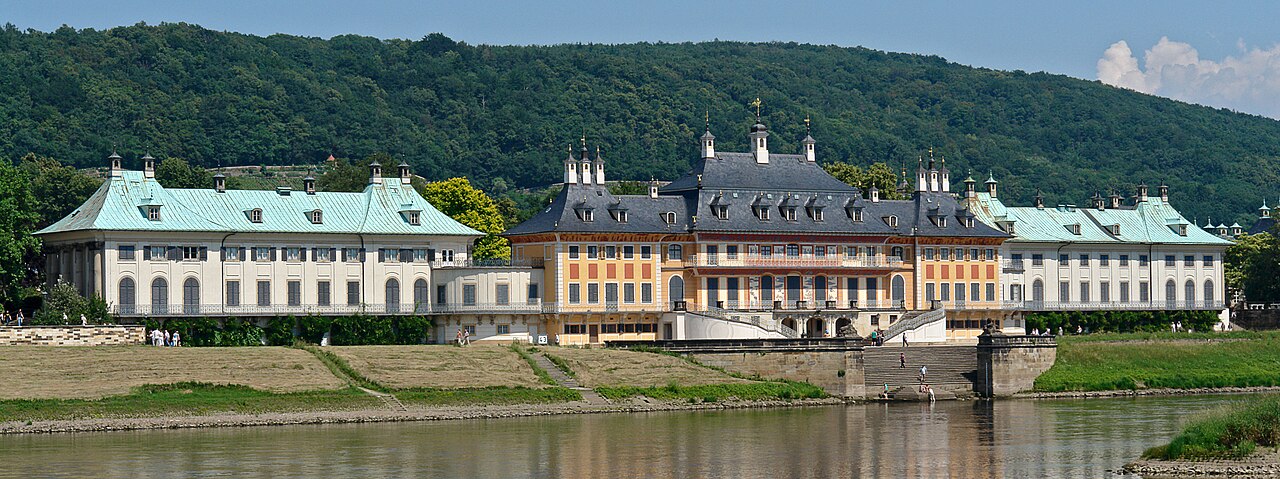
Pillnitz Palace (German: Schloss Pillnitz) is a restored Baroque castle at the eastern end of the city of Dresden in the German state of Saxony. It is located on the right bank of the River Elbe in the former village of Pillnitz. It was the summer residence of many electors and kings of Saxony; it is also known for the Declaration of Pillnitz in 1791.
The complex consists of three main buildings, the Riverside Palace (Wasserpalais) on the riverfront; the Upper Palace (Bergpalais) on the hillside, both Baroque with Chinoiserie elements; and the later Neoclassical New Palace (Neues Palais), which links them together on the east side. The buildings enclose a Baroque garden and are surrounded by a large public park.
Today, the buildings house the arts and crafts museum (Kunstgewerbemuseum) of the Dresden State Art Collections and a Schlossmuseum.
Text adapted from “Pillnitz Castle” on Wikipedia, CC BY-SA 4.0.
Pillnitz Castle ranks #791 of 9,079 worldwide in the atlas's castle fame ranking, and #63 of the 711 mapped in Germany. Founded c. 1400, it is older than 50% of the atlas's dated landmarks — one of 755 atlas entries founded in the 14th century. Its Wikipedia articles were opened 6,515 times in the last 60 days, more than 90% of the atlas. 14 more atlas landmarks stand within 25 km. The nearest day-trip guide is Dresden, 10 km away. See how Germany compares in the castle statistics.
View on the interactive castle map →