 Germany · 18th century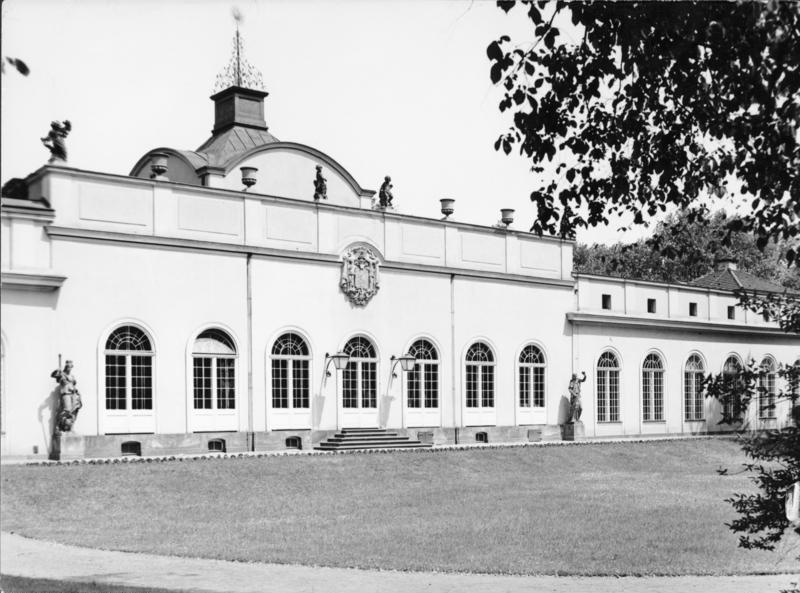
Monbijou Palace was a Rococo palace in central Berlin located in the present-day Monbijou Park on the north bank of the Spree river across from today's Bode Museum and within sight of the Hohenzollern city palace. Heavily damaged in World War II, the ruins were finally razed by the authorities of East Berlin in 1959. The palace has not been rebuilt.
In the Middle Ages the site was outside the city walls on the road to Spandau and contained a manor farmstead of the prince-elector of Brandenburg. The entire area was devastated in the Thirty Years' War.
In 1649, Frederick William I, Elector of Brandenburg, popularly known as the Great Elector (Der Große Kurfürst) for his military and political skills, ordered the property to be re-cultivated and presented it to his first consort, Countess Louise Henriette of Nassau. With great dedication she established there an exemplary rural estate including crops and dairy farming following the Dutch model. The first potatoes in the Margraviate of Brandenburg were grown there as an ornamental plant and curiosity. After Henriette's death in 1667 the property went to the elector's second wife, Sophia Dorothea of Schleswig-Holstein-Sonderburg-Glücksburg. She added a garden with a small summer house, the nucleus of the future palace and grounds. Frederick I, who became Elector of Brandenburg on the death of his father in 1688 and King in Prussia in 1701, decided to expand the estate.
Count von Wartenberg, his chief minister and favorite, was the developer of a "pleasure house", a small palace of just 400 square meters, erected by the royal architect Eosander von Göthe between 1703 and 1706 in a late Baroque style. Friedrich I presented it to Countess Wartenberg, his mistress.
From 1712 the little palace served as the summer residence of Sophia Dorothea of Hanover, who in 1706 married Frederick William I of Prussia, the son and successor of Frederick I. Both she and her father-in-law are attributed with naming the palace "Monbijou", from the French mon bijou ("my jewel"). In 1717 tsar Peter the Great of Russia and his court lodged at Monbijou for two days while traveling abroad. According to contemporary reports, the Russian guests left the property in "a complete mess" after their departure. Dorothea's son, Frederick the Great, had the palace modernized and considerably enlarged as soon as he had acceded to the throne.
Text adapted from “Monbijou Palace” on Wikipedia, CC BY-SA 4.0.
Monbijou Palace ranks #775 of 9,079 worldwide in the atlas's castle fame ranking, and #62 of the 711 mapped in Germany. Founded 1703, it is older than 21% of the atlas's dated landmarks — one of 696 atlas entries founded in the 18th century. Its Wikipedia articles were opened 6,806 times in the last 60 days, more than 90% of the atlas. 21 more atlas landmarks stand within 25 km. The nearest day-trip guide is Berlin, 1 km away. See how Germany compares in the castle statistics.
View on the interactive castle map →